

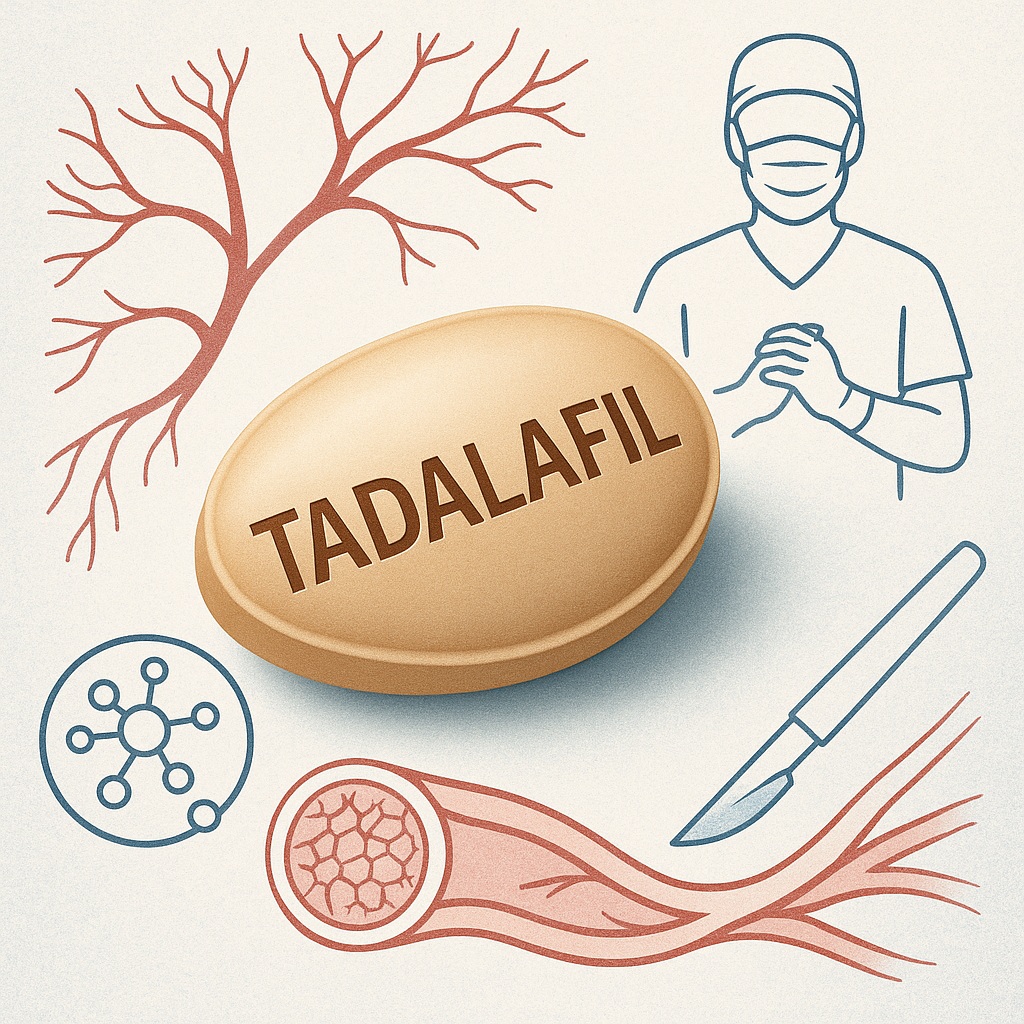
The Clinical Role of Tadalafil in Preserving Erectile Function
Introduction
Erectile dysfunction (ED) remains one of the most distressing complications following radical prostatectomy (RP), affecting both quality of life and postoperative satisfaction among patients treated for prostate cancer. Despite major advances in nerve-sparing surgical techniques, a significant proportion of men continue to experience ED due to transient or permanent neurovascular injury during surgery. The concept of penile rehabilitation has therefore gained increasing attention, focusing on early pharmacological intervention to preserve penile tissue integrity and restore erectile capacity.
Phosphodiesterase type 5 inhibitors (PDE5Is), particularly tadalafil, have been the cornerstone of pharmacological penile rehabilitation strategies. Their mechanism—enhancing nitric oxide–mediated vasodilation and cyclic GMP signaling—targets the endothelial dysfunction and cavernosal hypoxia that follow RP. However, the timing, dosing regimen, and real long-term efficacy of these agents have remained topics of debate.
The randomized controlled trial analyzed here aimed to clarify the clinical benefit of daily and on-demand tadalafil administration in preserving erectile function following bilateral nerve-sparing radical prostatectomy. It provides critical insight into the real-world effectiveness, safety, and pharmacodynamic rationale of tadalafil as part of structured penile rehabilitation programs.
Study Design and Methods
This multicenter, double-blind, randomized, placebo-controlled study was designed to evaluate three intervention arms over a 9-month treatment phase followed by a 6-week drug-free washout period. The trial population included men aged 40–68 years with localized prostate cancer scheduled for bilateral nerve-sparing RP and who demonstrated normal preoperative erectile function, defined by an International Index of Erectile Function–Erectile Function domain (IIEF-EF) score ≥ 22.
Participants were randomized to one of three treatment groups:
- Tadalafil once daily (OaD) at 5 mg,
- Tadalafil on demand (PRN) at 20 mg as needed (maximum once every 3 days),
- Placebo administered once daily.
All treatments commenced approximately four weeks after surgery, coinciding with the typical period of initial postoperative recovery but preceding the development of irreversible structural changes in penile tissue. The study’s primary endpoint was the proportion of patients maintaining baseline erectile function (IIEF-EF ≥ 22) after 9 months of treatment. Secondary outcomes included mean change in IIEF-EF score from baseline, time to erectile function recovery, penile length preservation, and patient-reported satisfaction.
Mechanistic Rationale
Following RP, neuropraxia and endothelial dysfunction lead to a cascade of cavernosal hypoxia, smooth muscle apoptosis, and fibrosis. This results in venous leakage and structural disorganization within the corpora cavernosa, reducing responsiveness to sexual stimulation. Chronic hypoxia is a central pathophysiological driver—hence, early pharmacological interventions aim to maintain oxygenation and prevent long-term fibrotic remodeling.
Tadalafil’s pharmacokinetic profile is particularly advantageous for rehabilitation purposes. Its prolonged half-life (~17.5 hours) ensures sustained PDE5 inhibition and continuous endothelial stimulation, maintaining baseline cavernosal blood flow even in the absence of sexual activity. By promoting regular nocturnal erections and improving microvascular perfusion, tadalafil may support neurovascular recovery and tissue preservation during the critical postoperative months.
The rationale of the trial design, therefore, hinged on the hypothesis that daily tadalafil could maintain erectile tissue homeostasis better than on-demand dosing, which depends on sexual stimulation and results in intermittent PDE5 inhibition.
Clinical Results: Primary Outcomes
At 9 months, tadalafil once daily demonstrated a statistically significant benefit in preserving erectile function compared to placebo. Approximately 25% of patients in the OaD group maintained baseline erectile function (IIEF-EF ≥ 22), versus 14% in the on-demand group and 9% in the placebo group. While full recovery rates may appear modest, the relative improvement in erectile function preservation was clinically meaningful, given the natural course of postoperative ED.
The mean change from baseline in IIEF-EF score further reinforced tadalafil’s efficacy. The OaD group exhibited an average increase of +4.1 points versus placebo (p < 0.05), while the PRN group demonstrated a smaller, non-significant improvement of +1.7 points. These findings confirm that continuous tadalafil exposure, rather than sporadic use, confers superior benefit in maintaining erectile tissue responsiveness during the recovery phase.
Notably, at the 6-week washout period following cessation of therapy, erectile function scores declined across all groups, indicating that tadalafil’s protective effects are primarily pharmacologically dependent rather than indicative of complete neurovascular recovery. This observation suggests that tadalafil acts as a physiological bridge—preserving function while natural recovery continues.
Secondary and Exploratory Findings
Beyond erectile function metrics, tadalafil exerted additional benefits on penile morphology and patient well-being. Preservation of penile length—a frequently overlooked aspect of postoperative quality of life—was significantly higher in the daily tadalafil group, with mean loss reduced to less than 0.5 cm, compared to approximately 1.3 cm in the placebo cohort. This likely reflects improved oxygenation and reduced smooth muscle atrophy within the corpora cavernosa.
Patient satisfaction scores, as measured by validated self-assessment questionnaires, were also highest in the OaD group. Importantly, these findings highlight the dual benefit of tadalafil: objective physiological preservation and subjective improvement in confidence and sexual self-perception, both critical for long-term recovery adherence.
Safety profiles were consistent with prior tadalafil studies. The most common adverse events included headache, dyspepsia, and back pain, occurring in less than 10% of participants. No treatment-related serious adverse events were reported, and discontinuation rates due to side effects were minimal (<5%). The tolerability of daily low-dose tadalafil thus supports its feasibility as a long-term adjunct to surgical recovery protocols.
Comparative Efficacy: Daily vs. On-Demand Tadalafil
The distinction between daily and on-demand tadalafil regimens is clinically significant. Although both aim to enhance penile hemodynamics, their pharmacodynamic exposure differs fundamentally. On-demand dosing delivers transient PDE5 inhibition tied to sexual activity, whereas daily administration maintains near-steady-state plasma concentrations, supporting continuous endothelial conditioning.
In this trial, on-demand tadalafil did not outperform placebo in restoring erectile function during the treatment phase. This result underscores the mechanistic limitation of intermittent therapy: it fails to counteract the chronic ischemic and fibrotic changes that occur independently of sexual activity. In contrast, daily dosing exerts a “maintenance therapy” effect, mitigating structural degeneration while facilitating natural neuroregeneration.
Moreover, consistent tadalafil exposure may improve penile oxygenation even during sleep, indirectly enhancing nocturnal tumescence—an essential physiological process that sustains penile health. The absence of such nightly erections in post-prostatectomy patients is a key contributor to irreversible cavernosal changes; daily tadalafil can thus be viewed as a pharmacological surrogate for this lost mechanism.
Implications for Clinical Practice
The findings from this randomized trial have profound implications for the standard of care following radical prostatectomy. They support the integration of tadalafil 5 mg daily as a first-line pharmacological strategy in penile rehabilitation protocols for men undergoing nerve-sparing surgery.
While spontaneous recovery of erectile function may occur over 12–24 months, pharmacological support during the early postoperative period is critical to preserve tissue viability and responsiveness. The study reinforces the concept that penile rehabilitation is not merely about treating ED—it is about preventing irreversible structural decline.
Clinicians should therefore initiate tadalafil therapy early (within 4–6 weeks post-surgery) and maintain it for at least 9–12 months. Patient counseling should emphasize adherence, as benefits are cumulative and contingent upon consistent dosing. Integration with non-pharmacological measures—such as vacuum erection devices or pelvic floor exercises—may further augment outcomes.
Limitations and Future Directions
Despite its robust design, the trial acknowledges several limitations. First, the absolute recovery rates remain modest, reflecting the complex neurovascular insult of RP. While tadalafil mitigates endothelial and smooth muscle damage, it cannot fully reverse neuropathic injury. Second, the follow-up duration may not capture long-term spontaneous recovery beyond pharmacological dependence. Finally, the absence of objective hemodynamic assessments, such as penile Doppler ultrasonography, limits mechanistic interpretation.
Future research should aim to:
- Combine tadalafil therapy with regenerative modalities, such as low-intensity shockwave therapy or stem-cell–based neuroregeneration.
- Explore extended treatment durations beyond 9 months to determine the potential for permanent functional restoration.
- Investigate pharmacogenomic predictors of tadalafil response to personalize rehabilitation strategies.
Nevertheless, this study remains a benchmark in defining the pharmacological framework of penile rehabilitation and confirms tadalafil’s role as a cornerstone agent in this setting.
Clinical Significance of Findings
The clinical implications of these results extend beyond postoperative erectile function alone. They highlight the preventive, rather than purely therapeutic, role of PDE5 inhibitors in urological recovery. By maintaining cavernosal oxygenation and preventing hypoxia-induced fibrosis, tadalafil protects against the cascade that transforms transient nerve injury into chronic, treatment-resistant ED.
Furthermore, the psychological benefit of maintaining partial erectile function during recovery should not be underestimated. Preservation of sexual confidence fosters patient adherence to rehabilitation protocols and enhances overall satisfaction with prostate cancer treatment outcomes.
In an era emphasizing survivorship and holistic recovery, tadalafil bridges the gap between oncological cure and functional restoration. Its safety, tolerability, and dual endothelial-neurovascular benefits make it an invaluable adjunct in the post-prostatectomy therapeutic arsenal.
Conclusion
This randomized controlled trial provides compelling evidence that daily tadalafil 5 mg significantly improves erectile function preservation compared with placebo and on-demand dosing in men undergoing nerve-sparing radical prostatectomy. Its pharmacological action maintains penile oxygenation, prevents fibrosis, and supports gradual neurovascular recovery, translating into measurable functional and anatomical benefits.
While full recovery remains challenging, early and sustained tadalafil administration constitutes an evidence-based, safe, and physiologically rational intervention for penile rehabilitation. Future strategies should build upon this foundation, integrating tadalafil into multimodal programs that address both vascular and neural recovery pathways.
FAQ
1. How does daily tadalafil help after radical prostatectomy?
Daily tadalafil enhances penile blood flow by inhibiting phosphodiesterase type 5, promoting nitric oxide–mediated vasodilation. This maintains cavernosal oxygenation, prevents hypoxia-induced fibrosis, and supports recovery of erectile tissue responsiveness during the healing period.
2. Is on-demand tadalafil equally effective for rehabilitation?
No. Intermittent (on-demand) use fails to provide continuous endothelial stimulation. The study demonstrated that only daily tadalafil significantly preserved erectile function, emphasizing the need for consistent pharmacologic exposure.
3. How long should tadalafil therapy continue post-surgery?
Clinical evidence supports initiating tadalafil within 4–6 weeks after surgery and continuing for at least 9–12 months. Duration may vary based on recovery progress and patient tolerance, but early and sustained therapy yields the best protective outcomes.
