

Introduction: When Route of Administration Becomes the Clinical Question
Erectile dysfunction (ED) management has long been dominated by oral phosphodiesterase type 5 inhibitors (PDE5i). Since the late 1990s, oral sildenafil, tadalafil, vardenafil, and avanafil have transformed sexual medicine. Their efficacy is well established, their safety profiles are predictable, and their convenience has normalized pharmacologic treatment of ED.
Yet oral therapy is not without limitations. Systemic absorption leads to vasodilatory side effects such as headache, flushing, nasal congestion, and dyspepsia. Hepatic first-pass metabolism influences pharmacokinetics. Food interactions may delay onset. Moreover, some patients prefer a more localized therapeutic approach, particularly those with mild cardiovascular concerns or intolerance to systemic adverse effects.
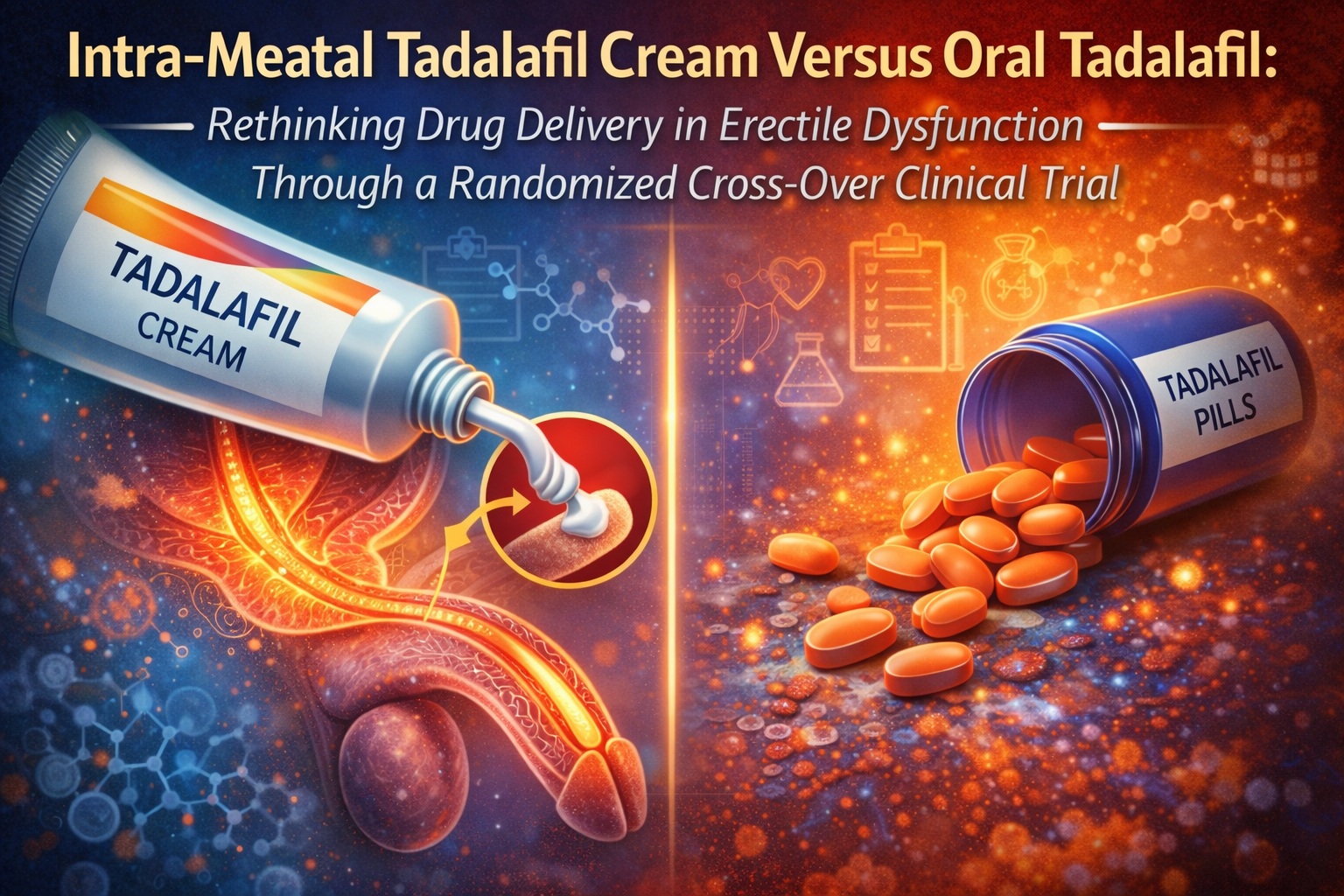
Against this background, the concept of intra-meatal application of tadalafil cream emerges not as novelty, but as pharmacological refinement. The randomized cross-over clinical trial published in the Journal of Clinical Medicine directly compared topical intra-meatal tadalafil cream with oral tadalafil administration, examining efficacy, onset of action, and safety.
The fundamental question is not whether tadalafil works. It does. The real question is whether altering the delivery route can maintain efficacy while improving tolerability and pharmacodynamic profile.
Study Design: A Cross-Over Model That Strengthens Interpretation
The trial was designed as a randomized, two-administration-route, cross-over clinical study . This design deserves emphasis. In a cross-over model, each participant receives both treatments sequentially, serving as his own control. This minimizes inter-individual variability, a critical advantage in sexual medicine where psychological and physiological factors vary widely.
Participants were men diagnosed with erectile dysfunction according to standardized criteria. Subjects were randomized to receive either intra-meatal tadalafil cream or oral tadalafil first, followed by a washout period and then crossover to the alternate therapy.
The endpoints included:
- Erectile function domain scores (IIEF-based assessments)
- Onset of action
- Duration of erection
- Adverse event reporting
- Patient preference
By controlling for baseline characteristics within each participant, the study increases internal validity and reduces confounding factors such as age, comorbidities, and baseline erectile severity.
This methodological choice strengthens confidence in comparative conclusions.
Mechanistic Rationale: Why Intra-Meatal Application Makes Biological Sense
Topical drug delivery aims to achieve localized therapeutic concentrations while minimizing systemic exposure. In the case of tadalafil, intra-meatal application targets the urethral mucosa, allowing trans-mucosal absorption into the corpus spongiosum and adjacent erectile tissues.
The cream formulation utilized a transdermal carrier (Pentravan®), designed to enhance mucosal permeability . The urethral mucosa provides a vascular interface that bypasses gastrointestinal absorption and hepatic first-pass metabolism.
Pharmacokinetic implications include:
- Potentially faster onset of action
- Reduced peak systemic plasma concentration
- Lower incidence of systemic vasodilatory effects
Theoretically, localized delivery may provide sufficient cavernosal PDE5 inhibition while reducing systemic side effects.
The concept is not entirely new—urethral alprostadil has been used for decades. However, applying PDE5 inhibition via a local route represents a novel pharmacological strategy.
Efficacy Outcomes: Comparable Erectile Improvement
The primary efficacy endpoint involved changes in erectile function scores. Both oral tadalafil and intra-meatal tadalafil cream produced statistically significant improvements from baseline .
Importantly, no significant difference was observed between the two administration routes in terms of overall erectile function improvement.
This finding is clinically crucial. It suggests that localized tadalafil application does not compromise therapeutic efficacy.
Erectile rigidity, ability to achieve penetration, and maintenance during intercourse improved similarly under both conditions.
The cross-over design ensures that this equivalence is not merely a function of baseline group differences. Each participant experienced both modalities, allowing direct intra-individual comparison.
From a clinical standpoint, therapeutic equivalence opens the door to individualized route selection.
Onset of Action: A Subtle but Meaningful Distinction
One of the most interesting observations relates to onset timing.
Topical intra-meatal tadalafil demonstrated a tendency toward faster onset of action in some participants . While the difference was not uniformly dramatic, certain subjects reported earlier erectile response compared to oral administration.
This aligns with pharmacokinetic logic. Oral tadalafil must undergo gastrointestinal absorption and systemic distribution. Topical application, by contrast, may facilitate more direct tissue-level exposure.
In clinical practice, faster onset may translate into reduced anticipatory anxiety. For some men, the psychological comfort of predictability outweighs minor differences in rigidity metrics.
In erectile dysfunction therapy, time is not merely pharmacological—it is emotional.
Safety and Tolerability: Systemic Versus Local Adverse Effects
Adverse event profiles differed subtly between routes.
Oral tadalafil produced expected systemic side effects, including:
- Headache
- Flushing
- Dyspepsia
- Nasal congestion
These effects were consistent with established PDE5 inhibitor profiles.
In contrast, intra-meatal application resulted in:
- Mild local burning sensation
- Transient urethral discomfort
- Occasional mild irritation
Systemic side effects were less frequent with topical administration .
This trade-off is clinically intuitive. Reduced systemic exposure lowers vasodilatory effects but introduces localized mucosal sensitivity.
Importantly, no severe adverse events were reported with either route. Both modalities demonstrated acceptable safety profiles.
For patients intolerant to systemic vasodilation—particularly those experiencing frequent headache or flushing—topical administration may represent a viable alternative.
Patient Preference: The Human Variable
The study also assessed patient preference following exposure to both treatments.
Preferences varied. Some participants favored oral administration due to familiarity and simplicity. Others preferred topical application because of perceived faster onset and reduced systemic side effects .
This variability underscores an essential principle: erectile dysfunction therapy is deeply personal.
Convenience, discretion, perceived naturalness, and partner involvement all influence satisfaction.
A therapy that is pharmacologically equivalent but emotionally misaligned will fail in practice.
The availability of multiple routes empowers individualized care.
Pharmacological Implications: Beyond This Study
The broader implication of this research extends beyond tadalafil.
If topical PDE5 inhibition proves clinically viable, it may stimulate development of:
- Alternative dosing formulations
- Combination topical agents
- Customized pharmacokinetic profiles
- Reduced-dose systemic supplementation
It may also encourage research into patients with partial systemic intolerance or polypharmacy concerns.
Moreover, intra-meatal application may theoretically reduce drug–drug interaction risk by limiting systemic concentration peaks, though this requires further pharmacokinetic validation.
In pharmacology, route of administration is often as important as molecule selection.
Limitations: Measured Optimism
Despite its strengths, the study has limitations.
Sample size, while adequate for cross-over design, remains moderate. Long-term safety beyond study duration was not evaluated. Pharmacokinetic plasma concentration data were not comprehensively detailed.
Additionally, mucosal absorption variability among individuals may influence reproducibility.
The psychological impact of applying medication locally—particularly regarding spontaneity—requires further qualitative investigation.
Finally, cost-effectiveness comparisons were not addressed.
Nonetheless, the trial provides robust preliminary evidence supporting therapeutic equivalence.
Clinical Integration: When Should Topical Tadalafil Be Considered?
Based on the data, intra-meatal tadalafil cream may be considered in:
- Patients experiencing systemic adverse effects from oral PDE5 inhibitors
- Individuals preferring localized therapy
- Men seeking potentially faster onset
- Patients concerned about systemic vasodilation
Oral tadalafil remains appropriate for:
- Patients comfortable with systemic therapy
- Those preferring once-daily dosing
- Individuals with established positive response
Importantly, therapy selection should remain patient-centered rather than prescriptive.
The physician’s role is to inform—not to dictate.
Conclusion
The randomized cross-over clinical trial demonstrates that intra-meatal tadalafil cream provides erectile function improvement comparable to oral tadalafil.
While systemic adverse events were more common with oral administration, topical application produced mild local irritation in some cases. Onset of action may be modestly faster with intra-meatal delivery.
The findings support the concept that route of administration can be adapted without sacrificing efficacy.
In modern sexual medicine, innovation is no longer confined to new molecules. It lies in refining how we deliver them.
Sometimes progress is not about discovering something new—but about applying what we already know more intelligently.
FAQ
1. Is intra-meatal tadalafil as effective as oral tadalafil?
Yes. The randomized cross-over trial demonstrated comparable improvements in erectile function scores between the two routes .
2. Does topical tadalafil reduce systemic side effects?
Systemic adverse events were less frequent with intra-meatal application, though mild local irritation may occur .
3. Who should consider topical administration?
Patients intolerant to systemic vasodilatory effects or those seeking localized therapy may benefit from intra-meatal tadalafil cream.
