

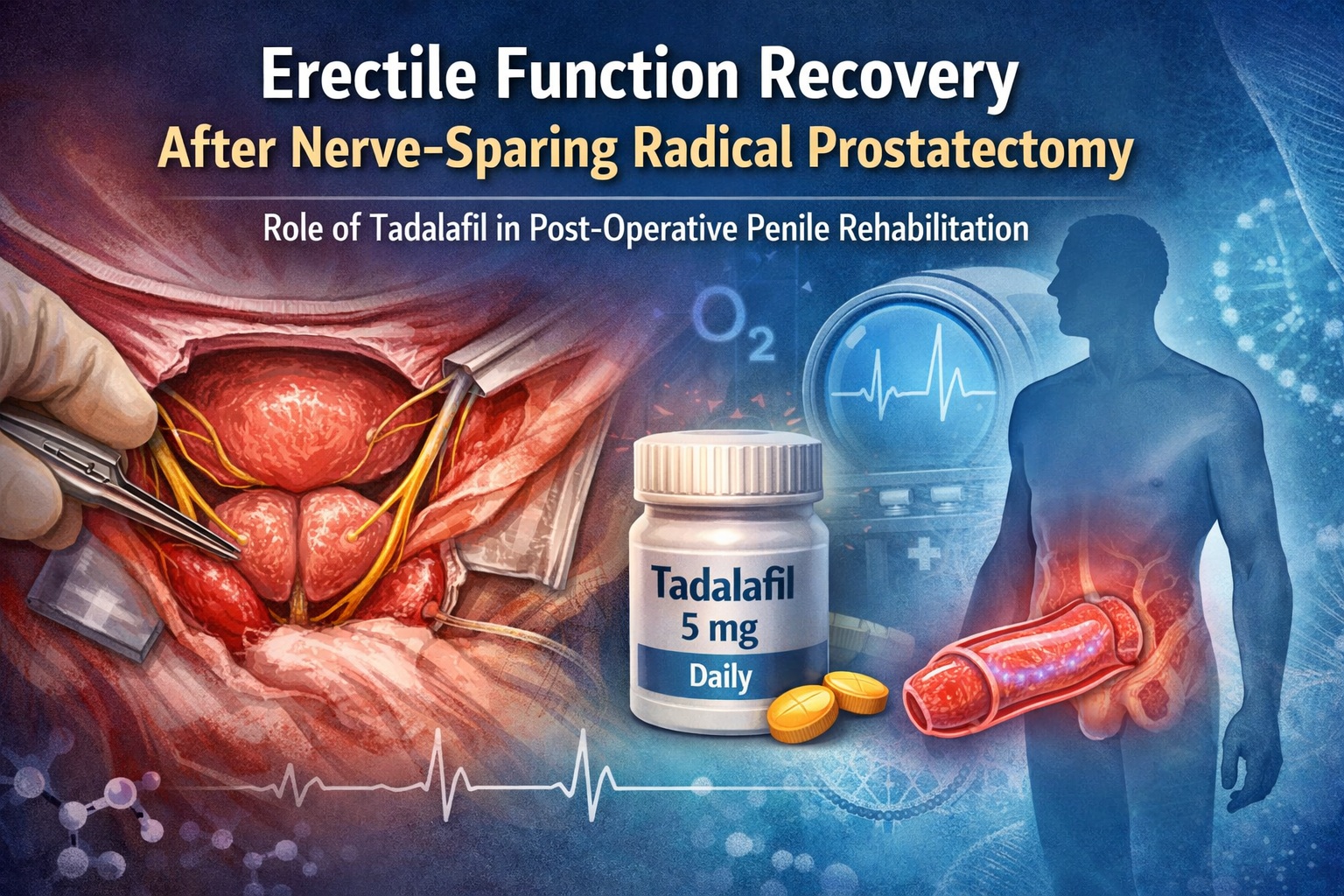
Radical prostatectomy remains a cornerstone in the management of localized prostate cancer. Advances in surgical technique—particularly nerve-sparing approaches—have transformed oncological outcomes while preserving quality of life. Yet even with meticulous nerve preservation, erectile dysfunction (ED) continues to be one of the most feared and functionally significant postoperative complications. For patients, survival without sexual function often feels like a hollow victory.
Over the past two decades, the concept of penile rehabilitation has emerged as a pragmatic response to this challenge. Rather than waiting passively for spontaneous recovery, clinicians now actively intervene to preserve erectile tissue integrity, maintain oxygenation, and support neurovascular recovery. Among the available pharmacologic tools, phosphodiesterase type-5 (PDE5) inhibitors—and particularly tadalafil—have attracted sustained clinical interest.
This article examines the rationale, clinical outcomes, and broader implications of daily low-dose tadalafil following open bilateral nerve-sparing radical prostatectomy. Drawing from the study under review, it reframes the findings within modern understanding of erectile physiology, postoperative neuropraxia, and long-term sexual health .
Erectile Dysfunction After Radical Prostatectomy: More Than a Surgical Complication
Post-prostatectomy erectile dysfunction is not a simple mechanical failure. It is the downstream result of a complex biological cascade initiated at the moment of surgery. Even when cavernous nerves are anatomically preserved, they frequently undergo temporary neuropraxia, leading to reduced nitric oxide release and impaired smooth muscle relaxation within the corpora cavernosa.
The immediate consequence of reduced nocturnal and spontaneous erections is corporal hypoxia. Over time, hypoxia promotes smooth muscle apoptosis, collagen deposition, and cavernosal fibrosis. Once these structural changes become established, erectile dysfunction transitions from a reversible neurogenic problem to a fixed vasculogenic one. At that point, pharmacologic rescue becomes significantly less effective.
This pathophysiological timeline explains why erectile recovery after radical prostatectomy is often described as a “marathon rather than a sprint.” Recovery may take months or years, and without intervention, a substantial proportion of patients never regain baseline erectile function. The study under discussion is grounded in this biological reality: early intervention is not cosmetic—it is preventive.
Nerve-Sparing Surgery: Necessary but Not Sufficient
The development of nerve-sparing radical prostatectomy represented a landmark achievement in urologic surgery. By preserving the neurovascular bundles, surgeons dramatically improved the potential for postoperative sexual function. However, nerve sparing is not synonymous with nerve integrity. Traction, thermal injury, ischemia, and inflammation can all impair neural signaling despite anatomical preservation.
Clinical data consistently show that even after bilateral nerve-sparing procedures, erectile dysfunction rates exceed 50% in untreated patients during the first postoperative year. Age, baseline erectile function, comorbidities, and surgical approach further modulate outcomes. In other words, nerve sparing creates opportunity—but opportunity alone does not guarantee recovery.
This reality underpins the logic of pharmacologic rehabilitation. The goal is not merely to induce erections for intercourse, but to maintain corporal health during the period of neural recovery. Tadalafil, with its long half-life and favorable tolerability profile, is uniquely suited to this role.
Why Tadalafil? Pharmacology Meets Physiology
Tadalafil differs from other PDE5 inhibitors in ways that are particularly relevant to postoperative rehabilitation. Its prolonged half-life allows for sustained inhibition of phosphodiesterase-5, resulting in continuous elevation of cyclic guanosine monophosphate (cGMP) within cavernosal smooth muscle. This translates into enhanced basal blood flow and improved tissue oxygenation, even in the absence of sexual stimulation.
From a physiological perspective, this continuous effect matters. Regular oxygenation of erectile tissue mitigates hypoxia-induced fibrosis and supports endothelial integrity. Experimental models have demonstrated that chronic PDE5 inhibition reduces collagen deposition, preserves smooth muscle content, and attenuates apoptotic pathways following cavernous nerve injury.
The study in question operationalized this concept through a daily 5 mg tadalafil regimen initiated shortly after surgery. Rather than relying on on-demand dosing—which presupposes functional erections—the investigators adopted a strategy aligned with tissue preservation and long-term recovery.
Clinical Outcomes: Interpreting Recovery Beyond Numbers
The reported outcomes are clinically meaningful. At three months postoperatively, nearly three-quarters of patients demonstrated normal erectile function, with similar results persisting at six months. Importantly, severe erectile dysfunction was observed in a minority of patients, and functional outcomes remained stable over time.
These findings are particularly striking when contrasted with historical data from untreated cohorts, in which erectile dysfunction rates often exceed 50% during the same postoperative window. While the study lacks a control group, the magnitude and consistency of recovery suggest that daily tadalafil contributes meaningfully to functional preservation.
Equally notable is the absence of significant deterioration between three and six months. This stability implies that early gains are not transient and that tadalafil may help consolidate recovery rather than merely accelerate it. In clinical terms, this distinction matters: patients value durable function, not short-lived improvement.
Safety, Tolerability, and Real-World Applicability
Any rehabilitation strategy must balance efficacy against tolerability, particularly in an older population with comorbidities. The safety profile observed in this study is reassuring. Adverse effects were infrequent, mild, and consistent with known pharmacology of PDE5 inhibitors.
Low-dose daily tadalafil appears to strike an optimal balance: sufficient pharmacologic activity to support tissue health without imposing a burdensome side-effect profile. This is a critical consideration, as adherence is central to rehabilitation success. A therapy that patients discontinue prematurely is unlikely to deliver long-term benefit.
From a practical standpoint, daily dosing also simplifies patient behavior. It removes the psychological pressure associated with “performance-based” medication use and reframes treatment as part of postoperative recovery rather than sexual testing. This subtle shift often improves acceptance and compliance.
Penile Rehabilitation as a Preventive Strategy
The concept of penile rehabilitation challenges traditional reactive models of erectile dysfunction management. Instead of treating ED once it becomes established, rehabilitation aims to prevent irreversible structural damage during the vulnerable postoperative period.
Daily tadalafil fits naturally into this framework. By maintaining cavernosal oxygenation and endothelial function, it supports the biological environment necessary for nerve recovery to translate into functional erections. The study reinforces the idea that timing matters: initiating therapy early, before fibrosis sets in, is likely more effective than delayed intervention.
This approach aligns with broader preventive paradigms in medicine. Just as early mobilization prevents muscle atrophy and anticoagulation prevents thrombosis, early penile rehabilitation seeks to preserve function before loss becomes permanent.
Limitations and the Need for Clinical Judgment
No single study provides definitive answers, and this one is no exception. The absence of a control group limits causal inference, and the relatively small sample size constrains generalizability. Longer follow-up would also be valuable to assess whether benefits persist beyond six months.
Nevertheless, the findings are biologically plausible, clinically coherent, and consistent with broader literature. In practice, clinicians must often make decisions in the absence of perfect evidence. In this context, daily tadalafil represents a low-risk intervention with a favorable balance of potential benefit.
The key is individualized care. Not every patient will respond identically, and factors such as age, baseline function, and comorbid disease must inform expectations. Penile rehabilitation is not a guarantee—it is an opportunity.
Integrating Tadalafil Into Postoperative Care Pathways
For urologists, the challenge lies not in prescribing tadalafil, but in framing its purpose correctly. Patients should understand that rehabilitation is about preserving tissue health, not immediate sexual performance. Setting realistic expectations reduces frustration and improves satisfaction.
Daily tadalafil should be presented as one component of a comprehensive recovery strategy, alongside pelvic floor rehabilitation, cardiovascular risk management, and psychological support. Erectile function does not exist in isolation; it reflects systemic health, emotional well-being, and relational context.
When integrated thoughtfully, tadalafil-based rehabilitation can transform postoperative care from passive observation to active functional preservation.
Conclusion
Erectile dysfunction after nerve-sparing radical prostatectomy remains a significant clinical challenge, but it is no longer an inevitable outcome. The use of daily low-dose tadalafil represents a rational, physiologically grounded strategy to support erectile recovery during the critical postoperative period.
The study reviewed here demonstrates that early, continuous PDE5 inhibition can preserve erectile function in a substantial proportion of patients, with minimal adverse effects. While further research is warranted, the existing evidence supports tadalafil as a valuable tool in penile rehabilitation.
In the broader view, this approach reflects a shift in urologic care: from accepting functional loss as collateral damage to actively preventing it. For patients, that shift makes all the difference.
FAQ
1. When should tadalafil be started after nerve-sparing radical prostatectomy?
Ideally within the first few weeks postoperatively, once surgical healing is confirmed, to prevent early hypoxia-induced tissue damage.
2. Is daily tadalafil more effective than on-demand use for rehabilitation?
Daily dosing is better suited for rehabilitation because it supports continuous tissue oxygenation rather than episodic erections.
3. Does tadalafil guarantee full recovery of erectile function?
No. Recovery depends on multiple factors, but tadalafil significantly improves the likelihood of preserving and restoring function.
