

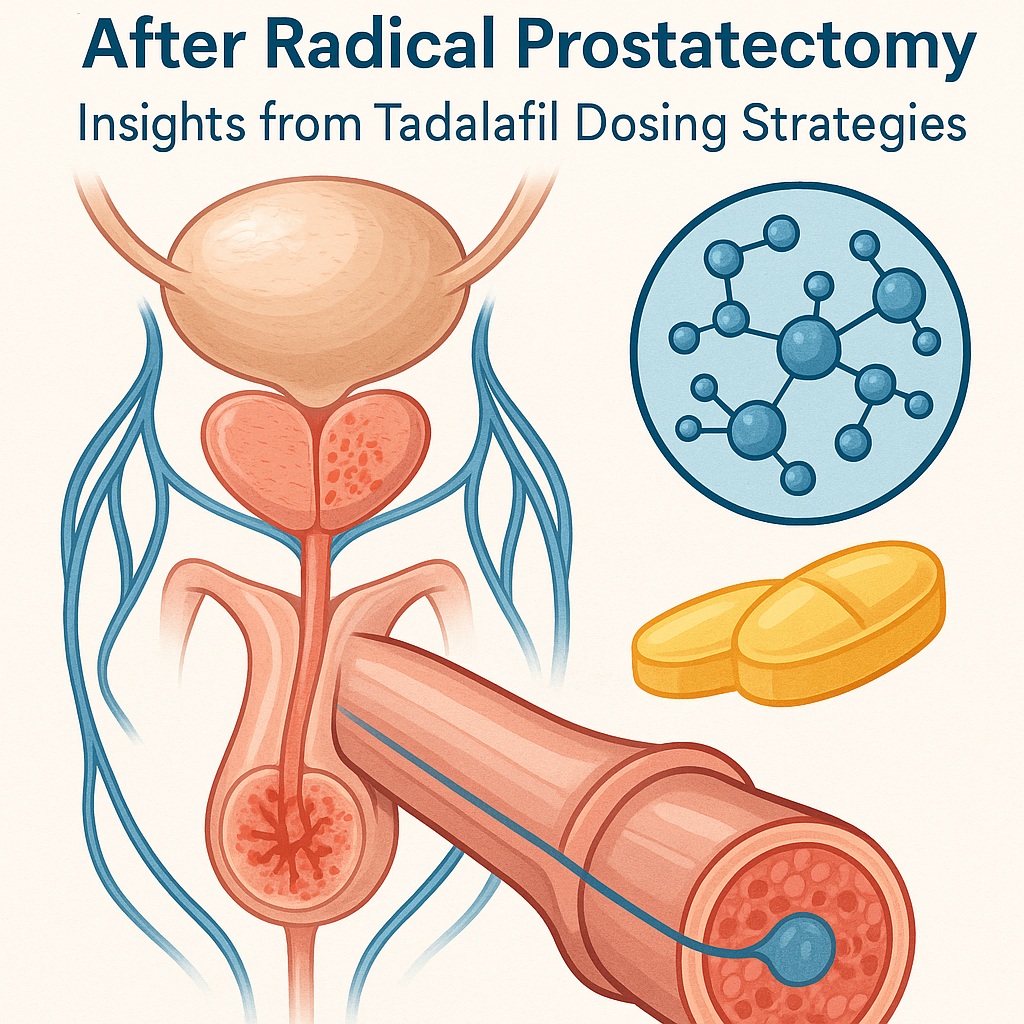
Introduction
Radical prostatectomy remains a cornerstone of curative treatment for localized prostate cancer. Yet, it often exacts a physiological cost: the dual challenges of erectile dysfunction (ED) and urinary incontinence. Even with modern bilateral nerve-sparing techniques (nsRP), recovery of sexual and urinary function remains unpredictable. The psychological burden of impotence and incontinence after surgery can exceed the fear of the cancer itself, affecting quality of life, relationships, and long-term wellbeing.
In recent years, phosphodiesterase type 5 inhibitors (PDE5i) have emerged as pivotal tools for penile rehabilitation. Among them, tadalafil stands out due to its long half-life, consistent pharmacokinetics, and well-established tolerability profile. The question facing clinicians, however, is not whether tadalafil works — but how best to use it. Should it be administered on an on-demand basis for sexual activity, or regularly to promote early endothelial and neurovascular recovery?
A landmark prospective study conducted in 2015 directly compared three-times-per-week tadalafil (10 mg) versus on-demand tadalafil (20 mg) in men following nsRP. The results offered not just numerical outcomes, but a refined clinical understanding of how dosing frequency can influence recovery trajectories. This article synthesizes those findings and their pharmacological underpinnings to clarify the true therapeutic value of tadalafil in the post-prostatectomy setting.
The Pathophysiology of Post-Prostatectomy Dysfunction
Erectile dysfunction following prostatectomy is primarily neurovascular in origin. Even with nerve-sparing surgery, the cavernous nerves experience temporary neuropraxia — a physiological “stunning” that impairs nitric oxide (NO) release. The resulting penile hypoxia triggers smooth muscle apoptosis, fibrosis, and structural remodeling, transforming a once-responsive organ into one resistant to vasodilation.
The vicious cycle of disuse perpetuates the dysfunction: without erections, oxygenation decreases further, leading to irreversible tissue damage. Simultaneously, disruption of the urethral sphincter complex and altered pelvic floor dynamics contribute to urinary leakage, especially in the early months after surgery.
Tadalafil’s mechanism offers a dual advantage. By inhibiting PDE5, it increases cyclic guanosine monophosphate (cGMP) levels, maintaining smooth muscle relaxation and promoting perfusion even in the absence of sexual stimulation. Regular exposure to this pharmacodynamic effect theoretically preserves endothelial integrity, limits fibrosis, and may accelerate spontaneous recovery of erectile capacity.
Study Overview and Methodology
The 2015 Kaohsiung Journal of Medical Sciences study enrolled 92 men who underwent bilateral nsRP for clinically localized prostate cancer. Patients were randomized into two post-operative tadalafil regimens:
- Group A (Regular use): 10 mg tadalafil administered three times per week, beginning one month after surgery.
- Group B (On-demand use): 20 mg tadalafil taken as needed prior to sexual activity.
The study followed participants for 12 months, evaluating erectile function, continence status, and safety outcomes using standardized instruments:
- International Index of Erectile Function (IIEF-5)
- Expanded Prostate Cancer Index Composite (EPIC)
- Pad test and patient-reported continence rates
All participants received identical post-surgical counseling and rehabilitation guidance, ensuring that differences could be attributed primarily to pharmacological regimen rather than behavioral variation.
Erectile Function Recovery: The Quantitative Evidence
At baseline — one month after nsRP — nearly all men demonstrated severe erectile dysfunction, with mean IIEF-5 scores below 7 across both groups. Over time, divergent recovery curves emerged between the regular and on-demand cohorts.
By 6 months, the mean IIEF-5 score in the regular tadalafil group reached 14.1 ± 4.3, compared to 10.5 ± 3.9 in the on-demand group (p < 0.05). At 12 months, the difference widened further:
- Regular tadalafil: 17.3 ± 4.8
- On-demand tadalafil: 13.9 ± 5.1
(p = 0.01)
These numerical distinctions were clinically meaningful. More than 61% of men in the regular-use group achieved IIEF-5 scores ≥17 (indicative of mild or no ED) versus only 38% in the on-demand group. The data reinforced the hypothesis that continuous endothelial stimulation, not sporadic dosing, promotes sustained recovery of erectile capacity.
Interestingly, nocturnal penile tumescence testing (conducted in a subset) showed higher frequency and rigidity indices among regular users, suggesting true physiological improvement rather than mere pharmacologic erection facilitation.
Continence Outcomes: Parallel Gains in Function
Urinary continence recovery mirrored the trend seen in erectile function. At 3 months, 45% of patients in the regular tadalafil arm had regained full continence (no pads) compared with 32% in the on-demand group. By 12 months, continence rates were 92% vs 80%, respectively.
While tadalafil’s direct influence on continence may seem less intuitive, the drug’s vasodilatory and smooth muscle modulatory effects likely play supportive roles. Improved pelvic blood flow enhances tissue healing, while modulation of smooth muscle tone in the lower urinary tract may aid sphincteric coordination. The findings imply that the benefits of regular tadalafil extend beyond the penile corpora, influencing pelvic microcirculation globally.
Furthermore, improved erectile confidence may foster greater pelvic floor engagement and psychological reinforcement — factors often underestimated in rehabilitation success.
Mechanistic Insights: Why Dosing Frequency Matters
Tadalafil’s pharmacokinetics set it apart from other PDE5 inhibitors. With a half-life of approximately 17.5 hours, it maintains therapeutic plasma levels for more than 36 hours after ingestion. This long duration supports either intermittent or continuous administration — but the physiological outcomes depend on consistency.
In the context of nerve-injury recovery, constant PDE5 inhibition prevents cGMP degradation, preserving smooth muscle homeostasis and attenuating fibrosis. Animal models of cavernous nerve injury have demonstrated that daily or near-daily tadalafil maintains endothelial nitric oxide synthase (eNOS) expression and limits transforming growth factor-β (TGF-β)–driven collagen deposition. Intermittent dosing, by contrast, allows recurrent periods of hypoxia, undermining recovery.
Moreover, frequent PDE5 inhibition appears to enhance neurogenic nitric oxide pathways, possibly via cyclic AMP–dependent mechanisms. These molecular effects converge to restore the neurovascular axis essential for natural erections.
Safety Profile and Tolerability
Safety remains a critical determinant in any long-term post-surgical intervention. In this trial, both dosing regimens exhibited excellent tolerability, with no discontinuations due to adverse events. The most common side effects included:
- Mild headache (11% in regular, 8% in on-demand)
- Dyspepsia (7% vs 5%)
- Facial flushing (4% vs 3%)
No cases of severe hypotension, priapism, or cardiovascular complications were observed. Laboratory parameters — including liver function and lipid profiles — remained stable throughout follow-up. These results reinforce tadalafil’s reputation as one of the most clinically forgiving PDE5 inhibitors, even in prolonged use.
Importantly, adherence was higher in the regular-use group (94%) compared to the on-demand group (82%), suggesting that structured dosing may improve compliance through routine rather than spontaneity.
Clinical Implications: Redefining Penile Rehabilitation
The study’s findings challenge the conventional notion that PDE5 inhibitors should be reserved for sexual activity. Instead, they support a rehabilitative model in which tadalafil serves as a neurovascular protector rather than a mere facilitator of intercourse.
In men undergoing nsRP, early and sustained tadalafil therapy can be viewed as a biological bridge, preserving cavernous tissue integrity until neural function recovers. This paradigm mirrors the modern shift in postoperative care — from reactive symptom management to proactive preservation of function.
For clinicians, the implications are practical:
- Initiate therapy early (around 1 month post-surgery) once continence is stabilizing.
- Favor structured regimens (10 mg 3× weekly or 5 mg daily) over sporadic use.
- Combine pharmacotherapy with counseling, pelvic floor training, and vacuum erection devices to enhance outcomes.
When framed as rehabilitation rather than recreation, adherence improves and psychological distress diminishes — a subtle but profound shift in patient recovery trajectories.
Limitations and Considerations
While the trial offered valuable insight, several caveats warrant acknowledgment. The sample size (n = 92), though respectable, limits statistical power for subgroup analyses (e.g., age, baseline comorbidities). Furthermore, all participants underwent bilateral nerve-sparing procedures — outcomes might differ in unilateral or non-nerve-sparing cohorts.
The study’s duration of 12 months captures the typical recovery window but not long-term sustainability beyond one year. Whether the functional gains persist after discontinuing tadalafil remains an open question. Finally, psychosexual variables — such as partner engagement and baseline libido — were not controlled, though these inevitably influence real-world satisfaction.
Nonetheless, the study’s methodological rigor, randomized design, and clinically meaningful outcomes provide robust support for its conclusions.
Integrating the Evidence: The Broader Picture
The Kaohsiung findings align with a growing body of literature emphasizing continuous PDE5i therapy as a cornerstone of penile rehabilitation. Trials using tadalafil 5 mg daily have similarly demonstrated accelerated erectile recovery after nsRP, with IIEF improvements ranging from 3–5 points above placebo within 9 months. These convergent results strengthen confidence in the mechanistic rationale.
Interestingly, emerging data suggest that PDE5 inhibition may also confer endothelial benefits systemically, including improved arterial compliance and reduced oxidative stress. This adds a layer of cardiovascular safety and possibly long-term vascular protection for men already at risk of endothelial dysfunction.
Thus, tadalafil in the postoperative context should not be viewed narrowly as a sexual aid, but as part of a multisystem recovery strategy, supporting vascular, neurological, and urological restoration.
Conclusion
The comparative study of three-times-per-week versus on-demand tadalafil after bilateral nsRP provides compelling evidence that structured, regular dosing yields superior recovery in both erectile and urinary domains. The numerical advantages — higher IIEF scores, faster continence return, and greater patient satisfaction — reflect genuine physiological restoration rather than transient pharmacologic effects.
Tadalafil’s pharmacological profile, combining potency, long half-life, and excellent tolerability, makes it ideally suited for rehabilitative protocols. When initiated early and continued consistently, it serves not only to restore potency but to protect penile tissue integrity during the vulnerable post-surgical period.
The era of reactive PDE5i therapy is fading. In its place rises a preventive, regenerative approach, positioning tadalafil as both a therapeutic and restorative agent in the continuum of prostate cancer survivorship.
FAQ
1. When should tadalafil therapy begin after radical prostatectomy?
Ideally, tadalafil can be initiated once catheter removal and early continence stabilization occur — typically within 2–4 weeks after surgery. Early initiation helps maintain penile oxygenation and prevent fibrotic remodeling.
2. Is regular tadalafil use safe for long-term rehabilitation?
Yes. Clinical studies consistently demonstrate excellent tolerability over extended periods, with only mild, transient side effects such as headache or flushing. No increase in cardiovascular risk has been observed in healthy men following nsRP.
3. Can tadalafil improve urinary continence recovery as well as erections?
Emerging evidence, including the 2015 Kaohsiung study, suggests that regular tadalafil use modestly accelerates continence recovery — likely through enhanced pelvic microcirculation and smooth muscle relaxation. While not a primary continence therapy, it contributes to faster functional normalization.
Reference:
Lin, C.-Y., et al. (2015). Effects of three-times-per-week versus on-demand tadalafil treatment on erectile function and continence recovery following bilateral nerve-sparing radical prostatectomy. Kaohsiung Journal of Medical Sciences, 31(9), 482–487.
