

Introduction: When the Prostate Meets the Endothelium
Benign prostatic hyperplasia (BPH) is usually approached as a local anatomical problem. The prostate enlarges, the urethra narrows, urinary flow weakens, and symptoms accumulate. We prescribe alpha-blockers to relax smooth muscle, 5-alpha reductase inhibitors to shrink glandular tissue, and, increasingly, phosphodiesterase type 5 (PDE5) inhibitors to address both lower urinary tract symptoms (LUTS) and erectile dysfunction (ED).
Yet the prostate does not exist in isolation. It resides within a vascular network governed by endothelial function, nitric oxide signaling, and arterial elasticity. When these systemic factors deteriorate—as they often do in aging men—urinary and sexual symptoms rarely remain unaffected.
The 2018 study published in The Aging Male examined an intriguing hypothesis: could daily tadalafil 5 mg, beyond improving LUTS and ED, also enhance vascular endothelial function in men with BPH? The results suggest that the answer is yes—and that the implications extend well beyond the bladder outlet.
This article explores the physiological rationale, clinical findings, and broader meaning of those results. We will examine why daily tadalafil may act not merely as a symptomatic therapy, but as a modulator of vascular health.
Study Design: A Prospective Look at Prostate and Vessels
The study was a prospective clinical investigation approved by an institutional review board, enrolling 81 men with BPH and LUTS . The mean age was 66.4 years, and the average prostate volume was approximately 30 ml. Nearly half had never received prior LUTS medication, while the remainder were dissatisfied with existing alpha-blocker or 5-alpha reductase therapy and received tadalafil as add-on treatment.
Participants received daily tadalafil 5 mg and were followed at 1, 3, 6, and 12 months. The investigators assessed a comprehensive panel of outcomes:
- Subjective LUTS measures: International Prostate Symptom Score (IPSS) and Overactive Bladder Symptom Score (OABSS)
- Objective urinary measures: maximum and mean flow rates, voided volume, and post-void residual urine (RU)
- Erectile function via SHIM score
- Endothelial function using brachial-ankle pulse wave velocity (baPWV) and ankle-brachial index (ABI)
- Peripheral neuropathy using vibration perception threshold (VPT)
Fifty-three patients completed the full 12-month course, while others continued or discontinued for various reasons .
This design allowed for both early and sustained effect assessment. Notably, vascular parameters were tracked longitudinally—a feature that distinguishes this study from shorter pilot investigations.
Urinary Symptom Relief: Rapid and Sustained Improvement
The subjective LUTS outcomes were robust and clinically meaningful. Total IPSS scores decreased significantly from the first month onward and remained improved through 12 months . A similar pattern was observed for OABSS.
The graphical data presented in Figures 2 and 3 show a clear downward trajectory in symptom burden. The improvement was not transient; it persisted over a full year. This sustained benefit is particularly relevant for a chronic condition such as BPH.
Objective parameters supported these subjective improvements. Post-void residual urine decreased significantly, as illustrated in Figure 4 . Because residual urine is less influenced by patient psychology than symptom questionnaires, its reduction reinforces the physiological effect of tadalafil.
Maximum and mean flow rates increased significantly by six months (Figures 5 and 6) . Although voided volume did not change, the combination of reduced residual urine and improved flow suggests improved bladder emptying efficiency.
These findings confirm what prior randomized trials have suggested: daily tadalafil is an effective treatment for LUTS associated with BPH. But the study did not stop there.
Erectile Function: Gradual Recovery Rather Than Instant Gratification
The SHIM score did not significantly improve at one month. Instead, a statistically significant increase emerged at three months and persisted at six and twelve months .
This temporal pattern is noteworthy. In younger ED populations treated on-demand, PDE5 inhibitors often produce immediate improvement. In this older BPH cohort, erectile recovery was gradual. This suggests that endothelial remodeling, improved pelvic perfusion, and perhaps psychosocial adaptation require time.
The authors observed that their BPH patients were significantly older than typical ED clinic patients. It is plausible that sexual function was not their primary concern at baseline. Nevertheless, sustained improvement indicates that daily tadalafil confers sexual benefit even when urinary symptoms dominate the clinical picture.
Importantly, this reinforces the interconnected nature of LUTS and ED. The pelvic vasculature does not discriminate between bladder outlet and corpora cavernosa.
Endothelial Function: The Central and Novel Finding
The most compelling contribution of this study lies in its vascular data.
Brachial-ankle pulse wave velocity (baPWV) is a noninvasive measure of arterial stiffness. Higher values indicate reduced elasticity and greater vascular damage. As men age, baPWV typically increases. In this study, baPWV significantly decreased at 3 and 6 months (p < .01) and remained improved at 12 months (p < .05) .
Figure 8 visually demonstrates this downward trend. Although a slight upward drift appeared between six and twelve months—likely reflecting age-related progression—the values remained below baseline .
In clinical terms, this suggests improved arterial elasticity. Because endothelial dysfunction precedes overt cardiovascular disease, improvement in baPWV may represent more than a local pelvic phenomenon. It implies systemic vascular benefit.
The ankle-brachial index (ABI), an indicator of arterial sclerosis, also improved significantly at six months . Although most participants did not have overt peripheral arterial disease, this finding supports enhanced vascular performance.
The authors concluded that tadalafil improved endothelial function—a conclusion grounded in objective vascular metrics rather than speculative theory.
Mechanistic Insight: Nitric Oxide Beyond the Penis
PDE5 inhibitors act by preventing degradation of cyclic guanosine monophosphate (cGMP), thereby amplifying nitric oxide–mediated smooth muscle relaxation. While this mechanism is classically associated with penile erection, smooth muscle is ubiquitous throughout the vasculature.
Endothelial dysfunction involves impaired nitric oxide bioavailability, increased oxidative stress, and reduced vasodilatory capacity. By enhancing the NO–cGMP pathway, tadalafil may restore endothelial responsiveness.
Moreover, chronic low-dose administration differs fundamentally from on-demand use. Continuous exposure may allow sustained improvement in vascular tone, reduced arterial stiffness, and possibly attenuation of inflammatory signaling.
In this context, daily tadalafil resembles not merely a symptomatic agent but a modulator of vascular physiology. The study’s data align with earlier smaller pilot investigations that demonstrated improved flow-mediated dilation and pelvic blood flow after PDE5 inhibitor therapy .
Peripheral Neuropathy: A Negative but Informative Finding
Vibration perception threshold (VPT), used to assess peripheral neuropathy, did not change during the study . Approximately half of the patients exhibited reduced baseline VPT, yet no significant improvement occurred.
This negative finding is instructive. The cohort did not primarily consist of diabetic patients. Peripheral neuropathy in diabetes is multifactorial and may not be reversible by improved endothelial function alone.
Thus, while tadalafil may enhance vascular elasticity, it does not appear to modify established neuropathic changes in this population. This distinction prevents overinterpretation of its systemic benefits.
Clinical Interpretation: A Drug with Dual and Possibly Triple Utility
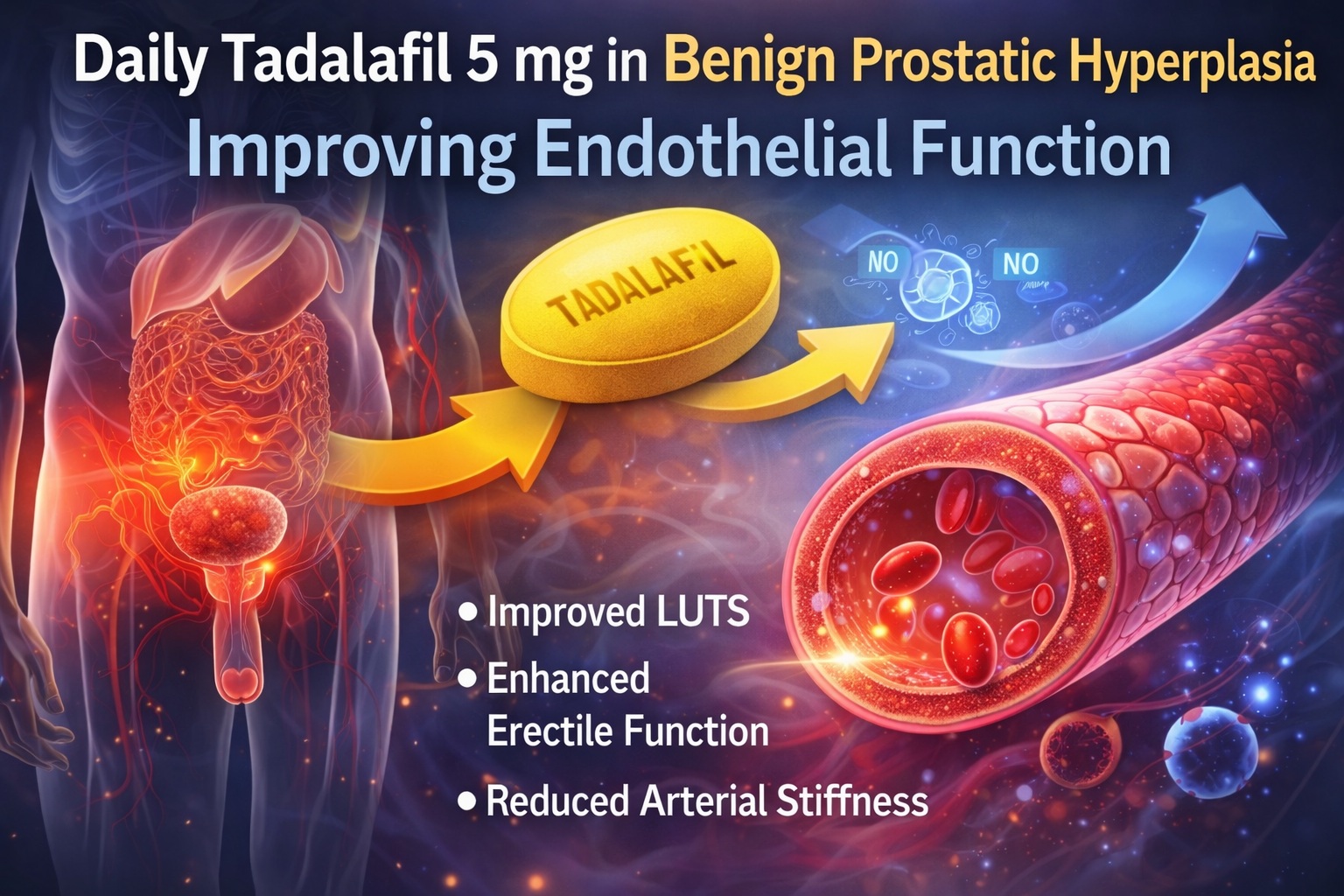
Daily tadalafil 5 mg has already secured approval for both ED and LUTS associated with BPH. This study adds a third dimension: measurable improvement in endothelial function.
For clinicians, the implications are multifaceted. In older men with LUTS and concomitant cardiovascular risk factors, daily tadalafil may offer:
- Symptomatic urinary relief
- Improvement in erectile function
- Enhancement of vascular elasticity
It is tempting to describe this as an “anti-aging” pharmacological strategy, though such terminology must be used cautiously. Nevertheless, when a single agent favorably influences urinary symptoms, sexual health, and vascular metrics, its role expands beyond niche urological application.
Importantly, the therapy was well tolerated over twelve months. Only four patients discontinued the study, and no serious adverse events were reported .
Limitations: Interpreting with Scientific Discipline
Despite its strengths, the study has limitations. It was not randomized or placebo-controlled. Without a control group, regression to the mean and lifestyle influences cannot be entirely excluded.
The sample size, while larger than earlier pilot studies, remains modest. Furthermore, the cohort appears relatively low-risk for overt vascular disease, as only one patient had an ABI below 0.9 .
Nonetheless, the consistency of baPWV improvement across multiple time points strengthens the inference of a pharmacological effect.
Future randomized controlled trials with cardiovascular endpoints would help clarify whether improved endothelial metrics translate into reduced clinical events.
Broader Perspective: Prostate Therapy as Vascular Medicine
BPH management has traditionally focused on urinary flow and gland size. Yet the aging male patient often presents with a constellation of metabolic and vascular comorbidities.
Endothelial dysfunction represents a common denominator linking LUTS, ED, metabolic syndrome, and cardiovascular disease. The observation that daily tadalafil improves baPWV invites a broader reframing of BPH therapy.
Perhaps the question is no longer “Does tadalafil relieve urinary symptoms?” but rather “Can LUTS therapy simultaneously improve systemic vascular health?”
If so, urologists occupy a pivotal position in preventive medicine. A prescription written for urinary hesitancy may also influence arterial elasticity—a therapeutic irony that underscores the interconnectedness of human physiology.
Conclusion: A Urological Agent with Systemic Reach
The study published in The Aging Male demonstrates that daily tadalafil 5 mg improves LUTS, enhances erectile function, and reduces arterial stiffness as measured by baPWV .
While further controlled research is required, the findings support the concept that PDE5 inhibition exerts beneficial vascular effects beyond the pelvis. Improved endothelial function may represent an additional therapeutic dividend in aging men with BPH.
In modern medicine, we increasingly value interventions that address multiple domains without multiplying pill burden. Daily tadalafil may exemplify such an approach—treating the prostate while quietly assisting the arteries.
FAQ
1. Does daily tadalafil only treat urinary symptoms, or does it affect blood vessels too?
In this study, daily tadalafil 5 mg significantly improved arterial stiffness measured by baPWV, indicating enhanced endothelial function. Therefore, its effects appear to extend beyond urinary symptom relief.
2. How long does it take to see improvement in erectile function with daily tadalafil in older men with BPH?
Erectile function improved significantly after three months of continuous daily use and continued to improve up to twelve months. The effect appears gradual rather than immediate in this population.
3. Can tadalafil reverse peripheral neuropathy?
In this study, vibration perception thresholds did not improve, suggesting that daily tadalafil does not significantly reverse peripheral neuropathy in non-diabetic BPH patients.
