

Introduction
Erectile dysfunction (ED) and lower urinary tract symptoms (LUTS) are among the most common, and perhaps most silently suffered, disorders in adult men. Affecting millions worldwide, these conditions are not only physically distressing but also carry profound psychological and relational consequences. Over the past two decades, phosphodiesterase type 5 inhibitors (PDE5Is)—notably tadalafil, sildenafil, and vardenafil—have revolutionized treatment. Yet, as any clinician can attest, a significant proportion of men fail to respond adequately to these drugs, even at optimized doses and durations.
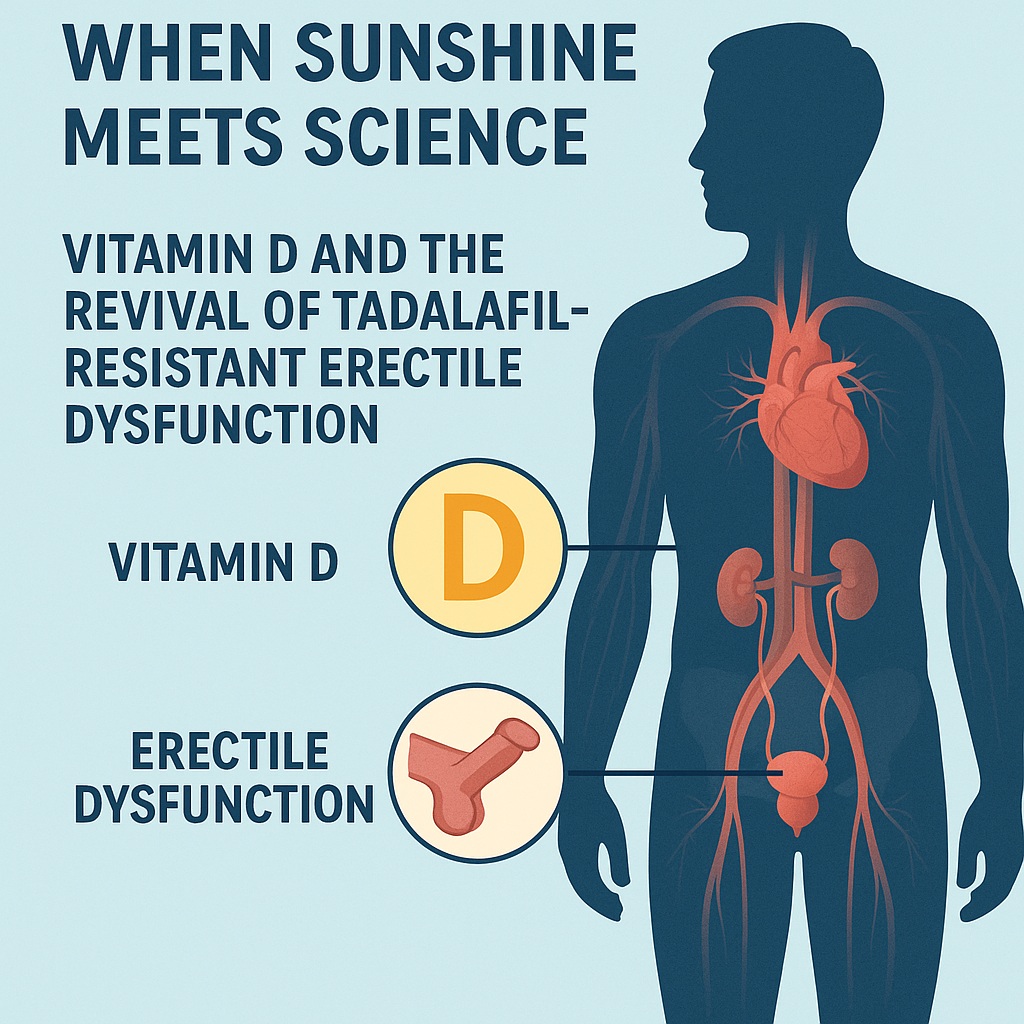
When first-line therapy falters, physicians often turn to mechanical devices, hormonal evaluations, or invasive interventions. But a new line of inquiry suggests that the missing ingredient may not be found in the prescription pad — but in the sunlight. Indeed, a growing body of research implicates vitamin D deficiency in the pathophysiology of both erectile dysfunction and urinary symptoms. The relationship is biologically plausible: vitamin D influences endothelial function, testosterone synthesis, and smooth muscle tone—three critical components of male sexual and urinary health.
A study conducted at Prof. Dr. Cemil Tascioglu City Hospital (Istanbul) by Ermec et al. (2022) offers compelling evidence that vitamin D supplementation can restore responsiveness to tadalafil in men whose ED and LUTS were previously resistant to therapy. Their findings invite us to rethink how we interpret “drug resistance” in sexual medicine—and whether the real issue lies not in pharmacology, but in physiology.
Erectile Dysfunction and LUTS: Two Sides of the Same Pathophysiologic Coin
Although often treated as separate entities, erectile dysfunction and lower urinary tract symptoms share a common vascular foundation. Both conditions stem from impaired nitric oxide (NO) signaling and endothelial dysfunction, processes that compromise smooth muscle relaxation in penile and bladder neck tissues alike.
The penis and bladder rely on finely tuned vascular regulation. In the corpus cavernosum, NO triggers cyclic guanosine monophosphate (cGMP) accumulation, leading to smooth muscle relaxation and erection. PDE5 inhibitors like tadalafil sustain this process by preventing cGMP degradation. Meanwhile, in the lower urinary tract, similar smooth muscle modulation governs urine flow and detrusor relaxation.
However, in chronic disease states—such as diabetes, metabolic syndrome, or vitamin D deficiency—endothelial cells lose their ability to produce NO efficiently. The result? A stiffer, less responsive vasculature that resists pharmacologic stimulation. The patient, quite understandably, concludes that tadalafil “doesn’t work anymore.”
But perhaps the drug works perfectly well—only the endothelium does not.
Vitamin D: More Than a Bone Builder
Once relegated to discussions of calcium and bone health, vitamin D has emerged as a systemic regulator of cellular function. Its active form, 1,25-dihydroxyvitamin D3 (calcitriol), acts as a steroid hormone with receptors (VDRs) present in nearly every organ system—including vascular endothelium, prostate, testis, and bladder.
Vitamin D’s influence on sexual and urinary physiology can be summarized through three interconnected pathways:
- Endothelial modulation: Vitamin D enhances nitric oxide synthase (eNOS) expression, improving vasodilation and microcirculatory health.
- Hormonal regulation: It supports testosterone synthesis by modulating luteinizing hormone (LH) signaling and testicular steroidogenesis.
- Anti-inflammatory effect: Chronic inflammation disrupts pelvic vascular integrity. Vitamin D suppresses proinflammatory cytokines (IL-6, TNF-α), thereby preserving endothelial function.
Collectively, these effects help maintain the vascular and hormonal conditions required for normal erection and lower urinary tract function. When vitamin D levels fall below 20 ng/mL, this entire network begins to deteriorate — leaving patients physiologically less responsive to PDE5 inhibitors.
The Study: Rethinking “Tadalafil Resistance”
Design and Methodology
The Istanbul team recruited 84 male patients (ages 28–70) who presented with combined LUTS and ED between 2017 and 2020. All participants had been prescribed tadalafil 5 mg daily for one month but failed to show satisfactory improvement—defined by persistently low International Index of Erectile Function–Erectile Function (IIEF-EF) scores and minimal symptom relief.
Upon evaluation, patients with vitamin D deficiency (<20 ng/mL) were identified and administered oral vitamin D3 at a dose of 100,000 IU per week for four weeks, alongside continued tadalafil therapy. Parameters assessed before and after treatment included:
- IIEF-EF score – erectile function
- IPSS score – lower urinary tract symptom severity
- Serum testosterone levels
- 25(OH)D vitamin D levels
This pragmatic design allowed the researchers to test whether replenishing vitamin D could “unlock” tadalafil’s full therapeutic potential in previously non-responsive patients.
Results: When the Deficient Respond
The findings were nothing short of remarkable. After just one month of combined therapy, patients exhibited statistically significant improvements across all measured domains.
Erectile Function and Urinary Symptoms
- IIEF-EF score increased from 10.73 ± 6.12 (pre-treatment) to 24.18 ± 4.87 (post-treatment) (p = 0.001).
- IPSS score decreased from 9.12 ± 7.16 to 3.11 ± 1.08 (p = 0.003).
In simple terms, erectile function more than doubled, while urinary symptoms were reduced by two-thirds. These are not marginal effects—they represent clinically meaningful restoration of function in men previously considered “non-responders.”
Hormonal and Biochemical Correlations
- Testosterone levels rose modestly, from 3.45 ± 0.99 ng/mL to 3.77 ± 1.23 ng/mL (p < 0.001).
- 25(OH)D levels increased from deficient (<20 ng/mL) to a mean of 30.50 ± 7.56 ng/mL (p < 0.001).
Statistical analysis revealed robust correlations:
- IIEF-EF and Vitamin D levels: r = 0.661 (moderate positive correlation)
- IIEF-EF and testosterone: r = 0.674 (moderate positive correlation)
- IIEF-EF and IPSS: r = -0.458 (negative correlation — improved urinary function paralleled better erection quality)
Interestingly, while vitamin D and testosterone showed only a weak positive correlation (r = 0.321), their combined influence on erectile function was synergistic.
These data collectively suggest that vitamin D correction enhances both vascular and hormonal axes, leading to improved tadalafil efficacy.
Discussion: Unmasking a Metabolic Bottleneck
The Endothelial Hypothesis
The success of tadalafil depends on the health of the endothelial–NO–cGMP axis. PDE5 inhibitors amplify nitric oxide’s downstream effects, but they cannot generate NO de novo. In vitamin D deficiency, endothelial cells produce less NO, reducing cGMP synthesis and leaving tadalafil with little substrate to work on. This “metabolic bottleneck” explains why PDE5 inhibitors often fail in otherwise healthy men with undiagnosed deficiencies.
By replenishing vitamin D, the endothelial machinery is restored: NO production rises, smooth muscle responsiveness improves, and the pharmacodynamic ceiling of tadalafil expands. This biochemical synergy underscores the importance of addressing nutrient deficiencies as part of ED management.
The Testosterone Connection
Vitamin D receptors (VDRs) are present in Leydig cells, where testosterone is synthesized. Deficiency reduces their responsiveness to luteinizing hormone, impairing steroidogenesis. Even the modest increase observed in this study—around 9%—is physiologically relevant, as testosterone acts as a cofactor in maintaining nitric oxide synthase activity. Thus, vitamin D restoration likely contributes to a dual mechanism: improved endothelial function and hormonal normalization.
Implications for Lower Urinary Tract Function
The improvement in IPSS scores suggests that vitamin D’s benefits extend beyond penile hemodynamics. The bladder detrusor muscle, prostate, and urethral sphincter all contain smooth muscle fibers influenced by NO signaling. Reduced inflammation and enhanced vascular perfusion in these structures may alleviate LUTS. Moreover, chronic vitamin D deficiency is linked to benign prostatic hyperplasia (BPH) and detrusor overactivity, conditions characterized by pelvic ischemia. Restoring adequate levels could therefore reverse some of the underlying pathophysiologic drivers.
Rethinking “Treatment Resistance” in ED
Medicine often labels patients as “treatment-resistant” when a drug fails to achieve its expected effect. But as this study illustrates, drug resistance can be physiological rather than pharmacologic. A molecule like tadalafil cannot perform optimally in a biochemically impaired environment. This insight invites a more holistic approach to ED and LUTS management—one that evaluates not just sexual mechanics but systemic health.
Practical Clinical Implications
- Assess vitamin D levels in men who do not respond to first-line PDE5Is.
- Supplement deficiency aggressively (≥100,000 IU weekly for 4 weeks, under supervision).
- Monitor response through both symptom scales (IIEF, IPSS) and biochemical markers.
Such an approach is inexpensive, safe, and evidence-based—qualities rarely aligned in urological pharmacotherapy.
The Broader Message
The broader implication of this work is philosophical as much as clinical. It challenges the reductionist model that views sexual dysfunction as a purely penile problem. Instead, it reframes it as a biopsychometabolic disorder—a reflection of systemic health, hormonal equilibrium, and vascular integrity. In this framework, vitamin D becomes not just a nutrient, but a signal of overall vitality.
Limitations and Future Directions
While the study provides persuasive data, it is not without caveats:
- Non-randomized design: All participants received both tadalafil and vitamin D; a placebo-controlled arm would have strengthened causality.
- Short duration: The effects were measured after only four weeks; longer-term outcomes remain untested.
- Population bias: The cohort consisted of middle-aged Turkish men; results may vary across ethnicities and climates.
- No endothelial biomarkers: Measurements such as flow-mediated dilation or cGMP levels could have directly validated the proposed mechanisms.
Future studies should include randomized, double-blind, placebo-controlled designs with larger, ethnically diverse populations. Additionally, exploring dose-response relationships and long-term hormonal impacts would further clarify vitamin D’s therapeutic scope.
The Clinical Takeaway
This research underscores a deceptively simple but transformative message: optimizing vitamin D status can resurrect the efficacy of tadalafil in men who previously failed therapy. By correcting a systemic deficiency, we can enhance endothelial responsiveness, improve hormonal balance, and restore normal sexual and urinary function.
The findings hold practical resonance in daily urological practice. In the age of precision medicine, it is not enough to prescribe powerful drugs; we must ensure the body is biochemically ready to respond to them. Sometimes, the most sophisticated pharmacologic intervention needs something as elemental as sunlight to succeed.
Conclusion
In summary, the combination of vitamin D supplementation and tadalafil 5 mg daily markedly improved erectile and urinary function in vitamin D-deficient men who were otherwise unresponsive to PDE5 inhibitor therapy. The underlying mechanisms likely involve both enhanced endothelial function and modest increases in testosterone production.
These results remind us that sexual health is inseparable from systemic health. The failure of a drug may not indicate its inefficacy, but rather the body’s inability to cooperate. The addition of vitamin D—simple, safe, and scientifically grounded—may bridge this gap, turning non-responders into responders and reasserting that even in the age of molecular pharmacology, basic physiology still matters most.
FAQ
1. Can vitamin D alone treat erectile dysfunction?
Not effectively. While vitamin D can improve endothelial and hormonal health, most patients with significant ED require PDE5 inhibitors such as tadalafil. However, adequate vitamin D levels enhance the response to these drugs.
2. What vitamin D levels are considered optimal for sexual health?
Levels above 30 ng/mL are generally considered sufficient. Deficiency (<20 ng/mL) is associated with endothelial dysfunction and reduced responsiveness to PDE5 inhibitors.
3. How long does it take to see improvement after vitamin D supplementation?
In this study, noticeable improvement occurred within four weeks of high-dose vitamin D therapy combined with tadalafil. However, sustained benefits depend on maintaining normal vitamin D levels through continued supplementation or sunlight exposure.
