

Counterfeit pharmaceuticals represent one of the most pervasive and dangerous threats to global public health. Among all therapeutic classes affected by illicit manufacturing, few are as frequently targeted as erectile dysfunction (ED) medications. The immense consumer demand, high retail cost, and emotional sensitivity connected with sexual health create a market uniquely vulnerable to exploitation. For every legitimate sildenafil or tadalafil tablet dispensed, an unregulated supply chain somewhere produces a visually convincing but chemically questionable imitation.
The stakes are far from trivial. Counterfeit ED medications are not harmless placebos; rather, they routinely contain incorrect active pharmaceutical ingredient (API) doses, inappropriate substitutes, toxic excipients, and heavy metals originating from crude manufacturing environments. Distinguishing authentic from fraudulent tablets using traditional analytic chemistry alone has proven challenging because counterfeiters closely mimic drug appearance, tablet geometry, coloring agents, and packaging. This has necessitated more sophisticated forensic approaches that can peer beneath surfaces, map elemental composition, and reveal structural anomalies invisible to standard techniques.
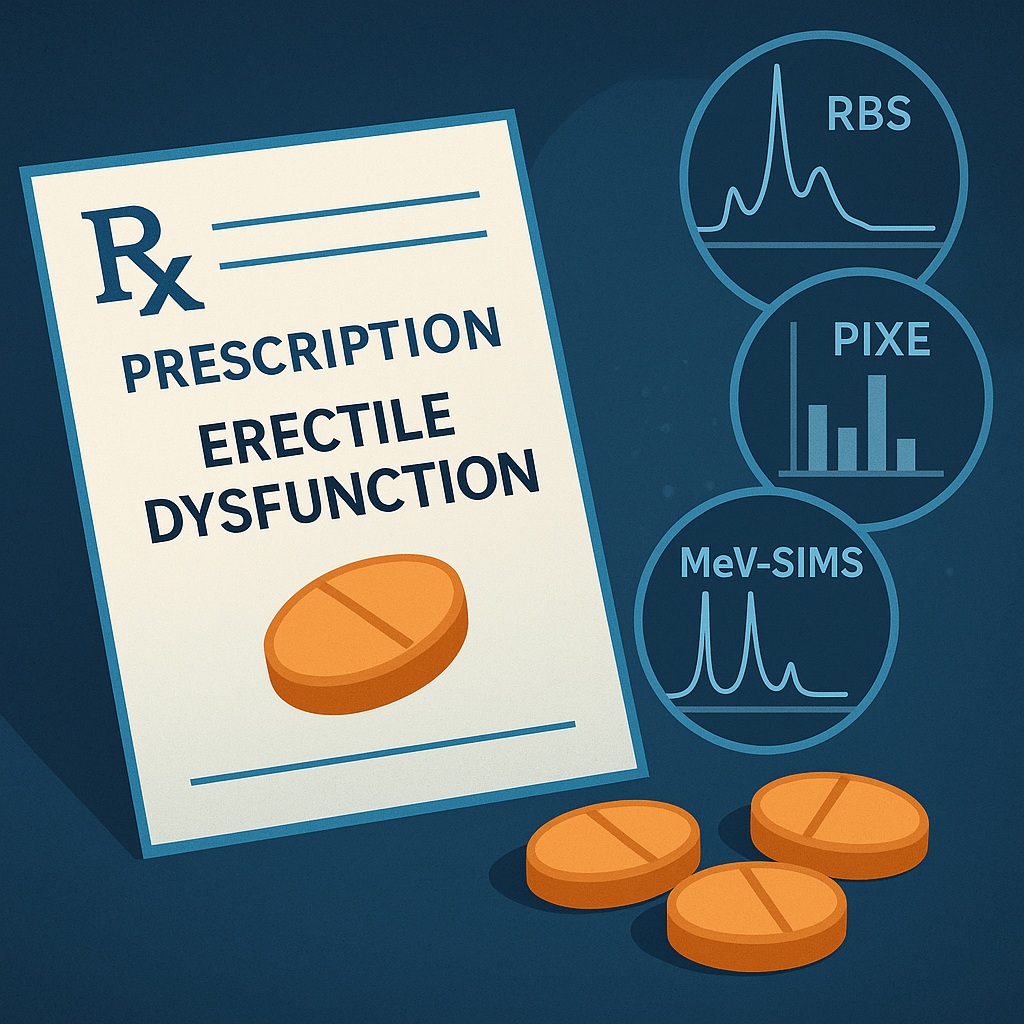
A promising frontier in this battle is the application of ion beam analytical techniques—specifically Rutherford Backscattering Spectrometry (RBS), Particle-Induced X-ray Emission (PIXE), and mega-electron-volt Secondary Ion Mass Spectrometry (MeV-SIMS). These high-precision physical methods, traditionally used in materials science, microelectronics, and planetary geology, have recently found their way into pharmaceutical forensics. The study upon which this article is based demonstrates how these methods uncover chemical fingerprints, inorganic contaminants, manufacturing inconsistencies, and compositional heterogeneity that unequivocally differentiate legitimate ED drugs from their counterfeit counterparts.
The purpose of this review is to translate these findings into a comprehensive, clinically relevant narrative that explains not only what these techniques detect, but why such detection matters for safeguarding patient health. While the subject matter may involve physics more commonly found in accelerator laboratories than in clinical practice, the implications are unmistakably medical.
Why Erectile Dysfunction Drugs Are Prime Targets for Counterfeiting
Erectile dysfunction medications occupy a peculiar intersection of embarrassment, demand, and accessibility. Patients often seek them discreetly, sometimes outside regulated pharmacies, which inadvertently strengthens the counterfeit market. The appeal of online vendors claiming “authentic” products at steep discounts only magnifies the risk. Counterfeiters understand human psychology: when shame suppresses patient–provider interaction, vigilance declines, and counterfeit products slip easily into circulation.
From a public health perspective, ED drugs are ideal case studies in pharmaceutical fraud for several reasons. Their global distribution is immense, spanning high-income and low-income regions alike. They are used by otherwise healthy individuals who may not tolerate unexpected pharmacologic insults well. Moreover, ED medications have narrow therapeutic windows, where small deviations in API concentration can cause dramatic physiologic effects—from hypotension to priapism.
These factors underscore the necessity of tools that detect counterfeits without ambiguity. While conventional analytical chemistry remains essential, many fraudulent tablets successfully evade detection by mimicking API content while differing subtly—but dangerously—in elemental composition, excipient use, and microstructural integrity. Ion beam techniques excel precisely where traditional assays plateau.
How Ion Beam Analytical Techniques Advance Pharmaceutical Forensics
The scientific elegance of ion beam methods lies in their ability to interrogate materials at the elemental and molecular level without destroying them. This is of profound value in forensic contexts: one can analyze tablets taken from seized shipments or suspected batches without altering their appearance or compromising evidentiary integrity.
RBS: The Architecture of Elemental Depth
Rutherford Backscattering Spectrometry works by directing high-energy ions at a sample, then analyzing the energies of ions scattered backward. Because scattering energy loss correlates with atomic mass, RBS creates a layered map of elemental composition and depth distribution.
In counterfeit ED tablets, RBS reveals:
- differences in coating composition
- inconsistent layering of excipients
- heavy metal impurities
- elemental profiles absent from branded formulations
These anomalies are not cosmetic: inconsistent coatings affect dissolution; heavy metals pose toxicological dangers; and aberrant layering may disrupt drug absorption.
PIXE: Elemental Fingerprinting with Exceptional Sensitivity
PIXE measures X-rays emitted when high-energy particles interact with atomic electron shells. Each element emits a unique X-ray signature, making PIXE ideal for chemical identification even at trace levels.
Its application to counterfeit ED drugs allows detection of:
- inorganic contaminants such as chromium, nickel, lead, and arsenic
- coloring agents inconsistent with pharmaceutical-grade materials
- elemental ratios characteristic of specific manufacturing environments
Because counterfeit operations often lack quality control, PIXE profiles display chaotic multielement spectra, whereas genuine tablets exhibit tightly controlled elemental consistency.
MeV-SIMS: High-Resolution Molecular Topography
Traditional SIMS is already widely used for surface molecular analysis, but MeV-SIMS enhances sensitivity and mass resolution by employing mega-electron-volt ions.
In counterfeit ED tablets, MeV-SIMS identifies:
- altered excipient composition
- non-pharmaceutical binders such as industrial glues or starches
- unexpected molecular clusters that suggest uncontrolled synthesis
- degradation products associated with improper storage
The presence of off-target organic species may not always be lethal but strongly indicates noncompliance with manufacturing standards.
Together, these three techniques provide a multidimensional forensic portrait—elemental depth, elemental identity, and molecular distribution—that cannot be counterfeited.
What the Study Revealed: Authentic vs. Counterfeit Tablets Under the Ion Beam
The study applied RBS, PIXE, and MeV-SIMS to reference sildenafil and tadalafil tablets alongside authenticated counterfeit examples collected from enforcement agencies. The results were both striking and unsettling.
1. Counterfeit coatings were compositionally inconsistent
RBS demonstrated abrupt changes in coating thickness and elemental composition. Authentic tablets showed uniform layering of pharmaceutical-grade excipients; counterfeits displayed irregular, sometimes multilayered coatings that suggested manual or makeshift production.
These findings highlight a critical quality issue: coating integrity affects drug release. Erratic coating chemistry may cause delayed or unpredictable onset of action, ironically undermining the very purpose of ED therapy.
2. Heavy metal contamination was widespread
PIXE detected concerning levels of:
- chromium
- manganese
- nickel
- zinc
- lead in some samples
Heavy metals originate from unregulated equipment, contaminated raw materials, or improvised mixing vessels. While trace metals in regulated pharmaceuticals are carefully controlled, counterfeit drugs showed signatures characteristic of crude industrial settings.
This poses a direct toxicological threat, especially given that ED drugs are often consumed repeatedly and chronically.
3. Molecular signatures diverged dramatically
MeV-SIMS spectral profiles revealed:
- alternative fillers (e.g., talc, industrial starches, chalk)
- binder molecules not recognized in pharmacopeia
- decomposed or oxidized sildenafil derivatives in substandard formulations
These chemical fingerprints cannot be erased through aesthetic mimicry. Even visually identical tablets diverge molecularly once examined with MeV-SIMS.
4. API concentration alone is not enough to ensure authenticity
Perhaps the most revealing insight is that some counterfeit tablets contained approximately correct sildenafil concentrations yet possessed wildly different elemental and molecular compositions.
This confirms a longstanding challenge in pharmaceutical forensics: dosage assay alone is insufficient to confirm legitimacy. True authentication requires a deeper structural analysis—precisely where ion beam techniques excel.
Clinical Implications: Why Physicians Should Care About Forensic Physics
Although clinicians rarely interact directly with forensic laboratories, the consequences of counterfeit ED drug use manifest in clinical settings daily. Ion beam analytical techniques provide the evidentiary backbone that informs public health warnings, regulatory actions, and patient counseling.
1. Toxic contaminants lead to systemic illness
Heavy metals detected in counterfeit products contribute to:
- nephrotoxicity
- neurotoxicity
- endocrine disruption
- hematologic dysfunction
These adverse effects may be subtle at first, misattributed to aging or comorbidities, delaying diagnosis.
2. Unpredictable pharmacokinetics yield therapeutic failure
Counterfeiters frequently underdose or overdose sildenafil. Patients may interpret therapeutic failure as worsening ED rather than adulteration, which may prompt unnecessary dose escalation, dependency on online markets, or misguided treatment changes.
3. Counterfeit drugs exacerbate cardiovascular risk
Many ED patients already have cardiovascular comorbidities. Contaminants and uncontrolled drug release increase:
- blood pressure instability
- risk of interaction with nitrates
- arrhythmogenic potential
Ironically, fake ED medication may endanger the very physiology tadalafil or sildenafil were intended to protect.
4. Patient trust deteriorates
Repeated therapeutic failure erodes confidence in medical care. Ion beam–based authentication helps public health authorities remove fraudulent products, indirectly restoring patient trust.
The Broader Public Health Landscape
The counterfeit drug crisis extends far beyond ED therapy, but ED medications serve as a particularly illustrative example of how modern ion beam tools can protect consumers.
Regulatory agencies increasingly use RBS, PIXE, and MeV-SIMS to:
- profile manufacturing signatures
- trace batches to specific illicit facilities
- identify recurring elemental or molecular patterns
- support cross-border enforcement
The study demonstrates that these tools not only detect counterfeits but can attribute them to specific production practices. In a world where globalization enables international counterfeit distribution, the ability to link chemical signatures back to manufacturing sources is invaluable.
Where This Technology Is Heading
The application of ion beam techniques to pharmaceuticals is still in its adolescence, but several trends indicate an expanding future role.
- Automation and AI-based spectral interpretation will accelerate counterfeit identification.
- Miniaturized ion beam systems may eventually enable on-site customs screening.
- Integrated molecular–elemental databases will allow rapid comparison across jurisdictions.
- Advanced MeV-SIMS imaging may uncover previously undetectable excipient adulterants.
These trajectories signal a future where counterfeit detection becomes faster, cheaper, and more globally coordinated.
Conclusion
The study underlying this article offers a compelling demonstration of how modern ion beam analytical techniques—RBS, PIXE, and MeV-SIMS—transform the detection and characterization of counterfeit ED medications. Their combined ability to resolve elemental depth, identify trace contaminants, and map molecular distributions provides a forensic clarity far beyond traditional pharmaceutical assays.
Counterfeit ED drugs are not mere inconveniences; they are biomedical hazards. Through the adoption of advanced ion beam technologies, regulatory agencies and forensic laboratories now possess powerful tools to expose illicit manufacturing, protect patients, and uphold the integrity of pharmaceutical supply chains.
Unmasking fraudulent tablets is no longer a guessing game—it is a precise scientific process driven by physics, chemistry, and an unwavering commitment to public health.
FAQ
1. Why are counterfeit ED drugs so dangerous?
Because they frequently contain incorrect dosages, toxic contaminants, or unsafe excipients. They may appear legitimate but differ chemically in ways that can cause cardiovascular, renal, or neurologic harm.
2. What makes ion beam techniques superior to standard analysis?
RBS, PIXE, and MeV-SIMS detect elemental and molecular signatures invisible to routine chemical assays. They identify impurities, inorganic contaminants, and excipient anomalies that reveal counterfeit origins.
3. Can patients distinguish counterfeit ED drugs on their own?
Almost never. Counterfeiters closely mimic pill shape, color, and packaging. Only laboratory analysis—particularly ion beam techniques—can reliably identify fraudulent products.
