

Introduction
Ureteral stents are invaluable tools in urology. They ensure drainage of the upper urinary tract after obstruction, protect renal function, and facilitate postoperative recovery after procedures such as ureteroscopy or lithotripsy. Yet, they are often described by patients as both a blessing and a curse. While stents save kidneys, they frequently impose a burden of discomfort known as ureteral stent-related symptoms (uSRS). These include urgency, frequency, dysuria, incomplete bladder emptying, and pelvic pain. Their impact extends beyond the urinary tract to impair work productivity, sleep, and even sexual activity.
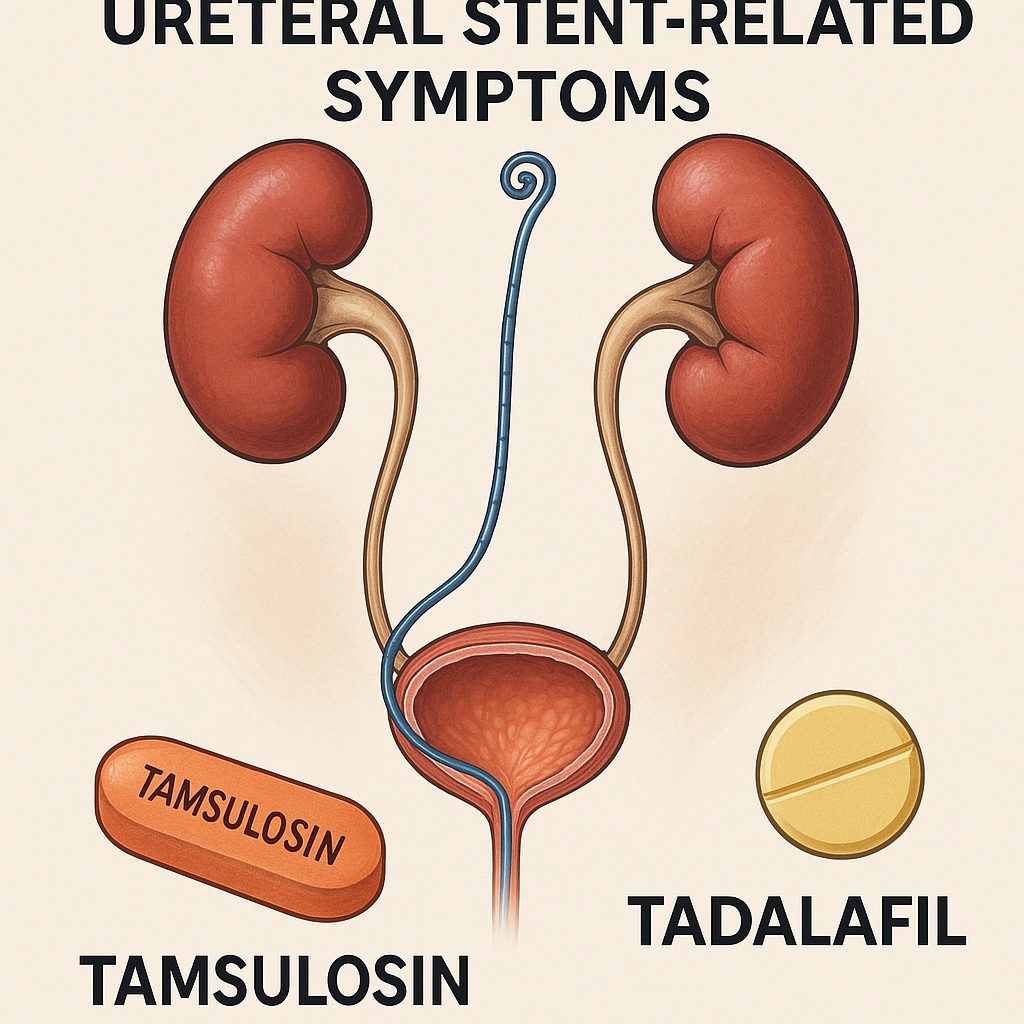
Over the years, pharmacologic strategies have been sought to mitigate these complaints. Alpha-adrenergic blockers, such as tamsulosin, and phosphodiesterase-5 inhibitors, such as tadalafil, are leading candidates. Tamsulosin relieves symptoms by relaxing smooth muscle tone in the distal ureter and bladder outlet. Tadalafil, though best known for treating erectile dysfunction, exerts beneficial effects on the urinary tract through smooth muscle relaxation and improved pelvic circulation.
The comparative effectiveness of these two drugs in reducing uSRS has remained a subject of clinical debate. Recent randomized, double-blind trials have attempted to resolve the question: should clinicians reach for the traditional alpha-blocker or the newer PDE5 inhibitor? The study from Hasanuddin University, Makassar, Indonesia, offers timely evidence by directly comparing daily tamsulosin 0.4 mg with tadalafil 10 mg in patients undergoing unilateral ureteral stent insertion.
Mechanisms of Symptom Development and Pharmacologic Rationale
To appreciate why medications matter, one must first understand the genesis of uSRS. Stents irritate the bladder mucosa, particularly the sensitive trigone area. Their coils may provoke local inflammation, while their presence can trigger detrusor overactivity. Urinary reflux from the bladder into the kidney, combined with ureteral spasms, contributes to flank pain and colicky sensations. Symptoms typically begin within days of insertion and peak by the second week, persisting until removal.
Tamsulosin, an alpha-1 adrenergic receptor antagonist, counteracts these phenomena by reducing ureteral spasm, decreasing intravesical pressure, and improving urinary flow. Its selectivity for alpha-1A and alpha-1D receptors, abundant in the distal ureter and bladder neck, explains its targeted action.
Tadalafil, in contrast, blocks phosphodiesterase-5 (PDE5), preventing breakdown of cyclic GMP. This prolongs nitric oxide-mediated smooth muscle relaxation in the ureter, bladder neck, and trigone. By easing spasms and improving blood flow, tadalafil addresses both pain and irritative voiding symptoms. An added advantage is its impact on sexual function, an often-overlooked domain in patients burdened with stents.
Thus, while both drugs act on smooth muscle relaxation, their pathways differ. Tamsulosin modulates adrenergic tone, whereas tadalafil amplifies nitric oxide signaling. The clinical question is whether one pathway offers superior relief—or whether patients benefit differently depending on symptom profile.
Study Design and Patient Characteristics
The Makassar study employed a rigorous double-blind, randomized design. Fifty patients requiring unilateral ureteral stent placement for stones or related conditions were enrolled. Inclusion criteria ensured a focused cohort: adults aged 18–79 with no prior sexual dysfunction, diabetes, malignancy, or cardiovascular disease. Exclusions were equally strict, eliminating confounders such as prostate enlargement, urinary tract infections, or previous ureteral surgery.
Participants were randomized into two groups:
- Group I (n = 25): Received tadalafil 10 mg daily.
- Group II (n = 25): Received tamsulosin 0.4 mg daily.
Both regimens began on day seven after stent insertion and continued through day 28. Symptom evaluation employed the validated Ureteral Symptom Score Questionnaire (USSQ), administered weekly. Domains assessed included voiding symptoms, pain, general condition, work activity, sexual activity, and additional symptoms. Data analysis was performed with SPSS, applying a significance threshold of p < 0.05.
Demographically, 60% of participants were male and 40% female, with a mean age of 41 years. Most fell into the 36–50 year age group, aligning with the typical demographic of stone disease patients. Stent placement was nearly evenly split between right and left ureters. Importantly, BMI data indicated a predominance of normal weight, reducing confounding from obesity-related urinary complaints.
Results: Comparing Symptom Domains
The trial produced compelling evidence favoring tadalafil across most domains, though nuances emerged.
Voiding symptoms (frequency, urgency, incomplete emptying):
In the first two weeks, differences between groups were negligible. By weeks three and four, tadalafil demonstrated significantly greater reductions, cutting scores by more than 80%, compared to 58% for tamsulosin. This delayed divergence highlights tadalafil’s cumulative benefit as smooth muscle relaxation and improved bladder dynamics consolidate.
Pain:
Here, tadalafil’s superiority was clear from the outset. Across all four weeks, pain scores declined more sharply in the tadalafil group, with a staggering 96% reduction by week four. Tamsulosin achieved a respectable 65% reduction, but patients on tadalafil reported earlier and more profound relief—a critical factor in daily comfort.
General condition:
Improvements in general well-being mirrored the trends in voiding and pain scores. While tamsulosin initially edged ahead in week one, tadalafil dominated by weeks three and four, yielding nearly 96% improvement compared to 70% with tamsulosin.
Work activity:
Ureteral stents notoriously hinder productivity, with discomfort limiting concentration and mobility. Both drugs improved work scores, but tadalafil produced consistently superior results, with 82% improvement versus 62% for tamsulosin.
Sexual activity:
This domain revealed tadalafil’s unique advantage. While tamsulosin modestly reduced sexual complaints, tadalafil significantly improved sexual activity scores, reflecting its dual role in relieving LUTS and addressing erectile physiology. For sexually active patients, this difference is particularly meaningful.
Additional symptoms (hematuria, dysuria, incontinence):
Tadalafil again showed greater reductions, particularly after the first week, when differences became statistically significant. By week four, scores had declined by nearly 80% with tadalafil, compared to 49% with tamsulosin.
Overall, the data positioned tadalafil as the more comprehensive agent, with particularly striking benefits in pain relief and sexual health. Tamsulosin remained effective but consistently trailed behind.
Clinical Interpretation and Practical Implications
These results must be viewed in the context of clinical practice. Ureteral stents are temporary, but the weeks of discomfort they impose can feel interminable to patients. The ability to reduce symptoms more rapidly and more completely translates directly into improved quality of life.
Tamsulosin, long established as the go-to medication, remains effective, especially in voiding symptoms. Its safety and affordability ensure continued relevance. However, for patients who value rapid pain relief, improved general condition, and preserved sexual function, tadalafil appears to offer superior benefits.
Clinicians must also weigh patient profiles. For younger, sexually active individuals, tadalafil may be preferable. For older patients with cost concerns or contraindications to PDE5 inhibitors, tamsulosin remains a rational choice. The trial does not suggest abandoning alpha-blockers altogether, but it challenges the assumption that they are always first-line. Instead, it opens the door to individualized prescribing based on patient priorities.
Limitations and Future Directions
As with all clinical studies, limitations temper the conclusions. The sample size was modest at 50 participants, restricting statistical power. The duration of observation was four weeks, reflecting the typical lifespan of a stent but not capturing long-term outcomes or safety profiles. Exclusion of patients with significant comorbidities limits generalizability to real-world populations where diabetes, cardiovascular disease, or prostate enlargement are common.
Future studies should expand sample size, include diverse populations, and explore combination therapy. A regimen combining tadalafil and tamsulosin may provide synergistic relief, addressing different aspects of uSRS. Cost-effectiveness analyses would also clarify whether the greater symptom relief of tadalafil justifies its higher price in resource-limited settings.
Nonetheless, this study contributes valuable comparative data to guide clinicians. It reinforces the need for proactive symptom management and challenges practitioners to consider newer pharmacologic strategies rather than relying solely on tradition.
Conclusion
Ureteral stents are a necessary evil in modern urology: indispensable for drainage yet notorious for discomfort. Effective pharmacologic management can transform the stent experience from intolerable to manageable.
This comparative trial demonstrated that both tamsulosin and tadalafil significantly reduced ureteral stent-related symptoms. However, tadalafil consistently outperformed tamsulosin in nearly all domains, particularly in pain relief, general well-being, work activity, sexual health, and additional urinary symptoms.
For clinicians, the message is clear: tadalafil should be considered not merely as an alternative but as a potentially superior choice for managing stent-related symptoms, especially in younger or sexually active patients. For patients, it offers not just relief from discomfort but also preservation of intimacy and daily function. While further research is warranted, this study tilts the therapeutic balance in favor of PDE5 inhibition for uSRS.
FAQ
1. Which drug is better for ureteral stent symptoms, tamsulosin or tadalafil?
Both are effective, but tadalafil demonstrated superior results in most domains, particularly pain relief and sexual health. Tamsulosin remains useful, especially for voiding symptoms, but tadalafil offers broader benefits.
2. Is tadalafil safe for patients with ureteral stents?
Yes. In the study, tadalafil 10 mg daily was well tolerated, with no major safety concerns. However, patients with cardiovascular disease, hypotension, or nitrate use should be evaluated carefully before prescribing.
3. Can tamsulosin and tadalafil be used together for better results?
The study compared them individually, but future research may explore combination therapy. Given their distinct mechanisms, combining both could provide additive benefits, though safety and cost considerations must be assessed.
