

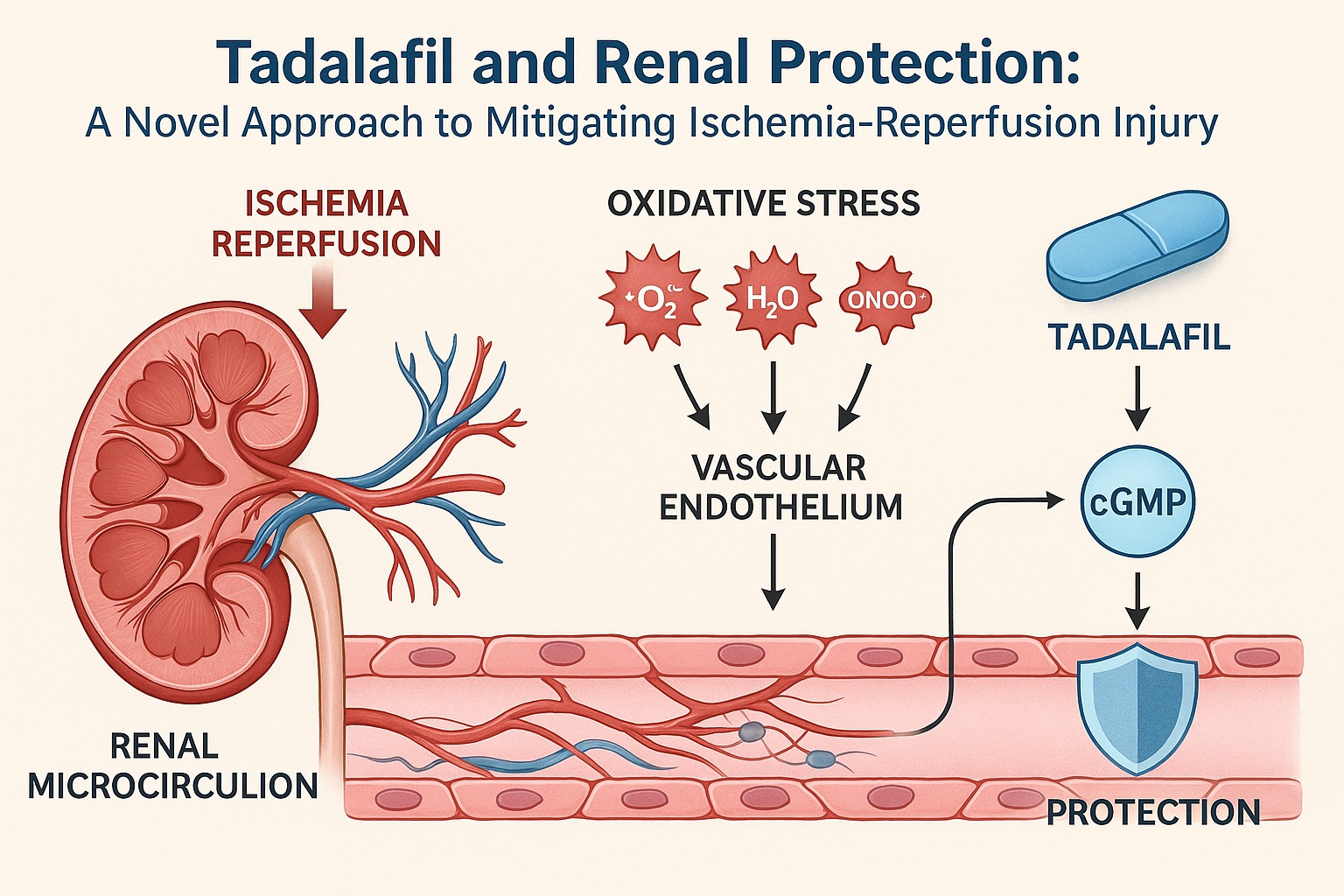
Ischemia-reperfusion (I/R) injury remains one of the most complex and clinically significant mechanisms of renal damage, commonly arising after surgical procedures, trauma, and transplantation. While re-establishing blood flow is essential for survival of ischemic tissues, paradoxically, reperfusion can trigger a cascade of oxidative and inflammatory events that compound the initial insult. The kidney, with its intricate microvasculature and high metabolic demand, is particularly vulnerable.
Recent experimental evidence highlights an unlikely ally in combating renal I/R injury—tadalafil, a phosphodiesterase type 5 (PDE5) inhibitor more commonly associated with the management of erectile dysfunction. This agent’s pharmacological footprint extends far beyond its urological fame, revealing promising cytoprotective, vasodilatory, and antioxidant effects.
In this article, we examine the emerging role of tadalafil as a potential renoprotective agent, dissecting its biochemical and histological impacts on ischemia-reperfusion injury, and exploring how modulation of nitric oxide signaling may hold the key to protecting renal tissue from oxidative catastrophe.
Understanding Renal Ischemia-Reperfusion Injury
The kidney’s susceptibility to ischemia is largely a result of its metabolic architecture. The renal cortex and medulla require continuous perfusion to maintain ion gradients and tubular transport. When blood flow is interrupted, adenosine triphosphate (ATP) stores rapidly deplete, impairing ionic homeostasis. Sodium and calcium accumulate within cells, activating destructive enzymes such as phospholipases, proteases, and endonucleases.
Upon reperfusion, oxygen supply is suddenly restored—but rather than immediate recovery, this phase provokes a surge of reactive oxygen species (ROS) and proinflammatory mediators. The phenomenon, aptly termed reperfusion injury, culminates in lipid peroxidation, mitochondrial dysfunction, endothelial injury, and apoptotic cell death.
Several cellular systems respond to this crisis. Nitric oxide synthases (NOSs)—particularly inducible (iNOS) and endothelial (eNOS) isoforms—are rapidly activated. Nitric oxide (NO) plays a dual role: at physiological levels, it maintains vasodilation and perfusion; at excessive concentrations, it reacts with superoxide to generate peroxynitrite, a powerful oxidant capable of damaging proteins and DNA. Thus, the same molecule that sustains renal blood flow can, in excess, contribute to its destruction.
Conventional therapies for I/R injury remain limited to supportive care, antioxidant supplementation, and ischemic preconditioning. Against this backdrop, agents capable of preserving endothelial integrity and modulating oxidative stress, such as tadalafil, have captured growing attention.
Tadalafil Beyond Erectile Dysfunction: A Pharmacological Overview
Tadalafil belongs to the family of phosphodiesterase type 5 inhibitors (PDE5i), which includes sildenafil and vardenafil. By preventing the breakdown of cyclic guanosine monophosphate (cGMP), PDE5 inhibitors enhance the downstream effects of nitric oxide, leading to smooth muscle relaxation and vasodilation.
What differentiates tadalafil from its counterparts is its distinct molecular structure and long half-life (approximately 17.5 hours), four times that of sildenafil. This extended activity translates into prolonged endothelial support and sustained increases in intracellular cGMP.
While PDE5 inhibitors are classically employed in managing erectile dysfunction and pulmonary hypertension, their capacity to influence vascular homeostasis, inflammation, and apoptosis has sparked considerable scientific curiosity. Experimental evidence now suggests these agents can limit ischemic tissue damage across multiple organs—including the myocardium, liver, and kidneys—by attenuating oxidative stress and regulating nitric oxide bioavailability.
The 2015 study by Erol and colleagues represents a cornerstone in this evolving field, systematically evaluating tadalafil’s effect on renal I/R injury in a controlled animal model.
Experimental Design: Modeling Kidney Injury and Protection
In this preclinical investigation, twenty-one Wistar albino rats were divided into three groups:
- Control group: normal renal function, no ischemia.
- Ischemia/Reperfusion (I/R) group: right kidney pedicle clamped for 1 hour to induce ischemia, followed by 1 hour of reperfusion.
- Tadalafil + I/R group: received 10 mg/kg of tadalafil intraperitoneally 30 minutes before ischemia.
After treatment and reperfusion, the kidneys were removed for biochemical and histological analysis. Blood and tissue samples were examined for malondialdehyde (MDA), a marker of lipid peroxidation, and total antioxidant capacity (TAC), reflecting systemic antioxidative defenses. Immunohistochemical staining assessed markers of cellular stress and apoptosis: iNOS, eNOS, and apoptotic protease activating factor-1 (APAF-1).
This design enabled a detailed exploration of how tadalafil influenced oxidative metabolism, nitric oxide signaling, and structural preservation in renal tissue.
Oxidative Stress and Antioxidant Defense: Tadalafil Restores the Balance
One of the hallmarks of I/R injury is oxidative stress—the excessive accumulation of ROS that overwhelms intrinsic antioxidant systems. The study demonstrated that I/R insult markedly increased MDA levels in both renal tissue and serum, confirming elevated lipid peroxidation.
Interestingly, while tadalafil did not significantly reduce MDA within the ischemic kidney tissue itself, serum MDA levels dropped significantly, suggesting systemic mitigation of oxidative load. More importantly, TAC levels increased sharply in tadalafil-treated rats, reaching values comparable to the control group.
These results indicate that tadalafil’s antioxidant properties may be more pronounced in circulating systems than at the site of direct ischemic injury. Nonetheless, by preserving systemic antioxidant capacity, the drug appears to shield renal and vascular structures from oxidative amplification during reperfusion.
Mechanistically, this protection likely stems from cGMP-mediated activation of antioxidant enzymes and suppression of pro-oxidative pathways involving NADPH oxidase and xanthine oxidase. The net result is a biochemical environment less conducive to peroxidation and cellular necrosis.
Histopathological Evidence: Structural Preservation of the Kidney
Microscopic evaluation revealed stark differences between untreated and tadalafil-treated rats. In the I/R group, kidneys displayed classic features of acute tubular injury—nuclear loss, cytoplasmic vacuolization, brush border disruption, tubular dilatation, and interstitial edema. These lesions collectively signify profound ischemic insult.
Conversely, the tadalafil group exhibited substantial preservation of renal architecture, with fewer necrotic tubules, less congestion, and reduced edema. Quantitative scoring confirmed a significant reduction in tissue damage (p < 0.05).
These findings are consistent with the hypothesis that PDE5 inhibition not only supports vascular tone but also maintains cellular membrane integrity and tubular morphology during oxidative stress. By stabilizing endothelial function and mitigating calcium overload, tadalafil prevents the progression from reversible cellular swelling to irreversible necrosis.
Molecular Insights: Nitric Oxide Synthases and Apoptotic Regulation
Nitric oxide synthases play a pivotal role in the I/R landscape. Under stress, iNOS and eNOS expression increase, amplifying nitric oxide production. When uncontrolled, this leads to nitrosative stress and tissue injury.
Immunohistochemical analysis in this study revealed that iNOS and eNOS expression surged in the I/R group, while tadalafil significantly reduced both markers, returning them close to baseline levels. This downregulation indicates a restoration of NO homeostasis—reducing toxic overproduction without compromising physiological vasodilation.
Similarly, APAF-1, a key mediator of apoptosis, showed elevated staining in ischemic kidneys but decreased substantially in tadalafil-treated animals. This reduction in apoptotic signaling suggests that tadalafil confers antiapoptotic protection, possibly through the NO–cGMP–protein kinase G pathway, which modulates mitochondrial permeability and cytochrome c release.
Collectively, these findings highlight tadalafil’s dual molecular action: dampening excessive NO synthesis while simultaneously preventing programmed cell death—a combination that enhances cellular survival in reperfused tissues.
The Role of Nitric Oxide: Friend, Foe, or Both?
The paradox of nitric oxide in renal injury is a recurring theme in pathophysiology. While essential for vasodilation and perfusion, NO’s toxic potential emerges when its concentration surpasses the buffering capacity of antioxidants. Under these conditions, NO combines with superoxide to form peroxynitrite, a potent nitrating agent that damages lipids, proteins, and DNA.
The present findings suggest that tadalafil’s renoprotective effect lies in modulating, not abolishing, NO signaling. By preventing excessive NOS activation, tadalafil maintains an optimal NO level that preserves endothelial function without tipping into oxidative toxicity.
Interestingly, some studies report the opposite effect with sildenafil—where increased iNOS and eNOS expression contributed to tissue protection, perhaps by maintaining perfusion. This discrepancy underscores a key insight: the beneficial or harmful nature of NO is context-dependent, influenced by timing, tissue type, and coexisting oxidative stress. Tadalafil’s longer half-life and stable pharmacokinetics may enable it to fine-tune this balance more effectively than shorter-acting PDE5 inhibitors.
Biochemical Markers of Damage: MDA, TAC, and Cellular Homeostasis
Malondialdehyde (MDA) serves as a robust indicator of lipid membrane oxidation, while total antioxidant capacity (TAC) reflects the collective ability of enzymatic and nonenzymatic antioxidants—such as glutathione, catalase, and superoxide dismutase—to neutralize ROS.
In this study, I/R injury caused a sharp rise in MDA and a concurrent drop in TAC, confirming oxidative imbalance. Tadalafil administration restored TAC and lowered MDA in plasma, implying systemic correction of redox homeostasis.
From a clinical perspective, these findings suggest that PDE5 inhibitors could enhance renal resilience during surgical or transplant-related ischemia, particularly when oxidative injury is a concern.
By limiting lipid peroxidation and preserving antioxidant reserves, tadalafil contributes to biochemical stability that supports functional recovery of the kidney following ischemic events.
Histological Correlation: Less Damage, Fewer Dead Cells
The visual impact of tadalafil’s protection was striking. In histological sections, untreated I/R kidneys resembled a battlefield of cellular destruction—fragmented nuclei, loss of brush borders, and tubular dilation predominated. In contrast, the tadalafil-treated kidneys retained organized epithelial linings, minimal cytoplasmic vacuolization, and preserved lumen structure.
These morphological improvements corresponded with the observed biochemical normalization, underscoring that tadalafil’s benefits are not merely statistical but structural. The drug’s protective influence translated into tangible tissue preservation, an essential step toward functional protection.
Mechanistic Interpretation: How Tadalafil Works
Several complementary mechanisms likely underlie tadalafil’s renoprotective action:
- cGMP elevation: By inhibiting PDE5, tadalafil sustains cGMP signaling, enhancing vasodilation and improving microvascular perfusion during reperfusion.
- Antioxidant reinforcement: Elevated cGMP activates protein kinase G, which reduces ROS generation and enhances antioxidant enzyme activity.
- Mitochondrial stabilization: cGMP-dependent pathways help maintain mitochondrial membrane potential, preventing cytochrome c release and apoptotic cascade activation.
- Endothelial protection: Tadalafil improves nitric oxide bioavailability while preventing its pathological overproduction, balancing vasodilatory and oxidative roles.
Together, these effects converge to mitigate oxidative stress, inflammation, and apoptosis, the triad that drives ischemic renal damage.
Clinical Implications and Translational Potential
While the study was conducted in animal models, its implications extend to human medicine. Renal ischemia-reperfusion injury is a frequent complication of cardiovascular surgery, renal transplantation, and aortic clamping. The morbidity associated with acute kidney injury (AKI) in these contexts is substantial.
Tadalafil’s long half-life, hemodynamic stability, and established safety profile make it a viable candidate for perioperative protection. Administered before high-risk procedures, it could theoretically reduce postoperative renal dysfunction by improving perfusion and reducing oxidative insult.
However, dosage optimization, timing, and patient selection require rigorous clinical evaluation. Translating preclinical insights into practice demands careful pharmacokinetic modeling and toxicity assessment. Nevertheless, the concept of repurposing PDE5 inhibitors for organ protection offers an exciting frontier in pharmacotherapy.
Limitations and Future Directions
Despite its promise, several limitations temper enthusiasm. The study’s small sample size and use of healthy animal models limit direct clinical extrapolation. Ischemia in human pathology often occurs alongside comorbidities—diabetes, hypertension, atherosclerosis—that may alter pharmacodynamics.
Moreover, the exact molecular interplay between tadalafil, NOS isoforms, and ROS generation remains incompletely defined. Does tadalafil exert its effects solely through cGMP modulation, or are there NO-independent pathways involved?
Future research should explore:
- Long-term functional outcomes post-ischemia.
- Comparative efficacy among PDE5 inhibitors.
- Synergistic combinations with antioxidants or anti-inflammatory drugs.
- Controlled clinical trials in surgical and transplant patients.
Only through such rigorous investigation can tadalafil’s renoprotective potential move from bench to bedside.
Conclusion
The work of Erol et al. illuminates a compelling narrative: tadalafil, a well-known vasodilator, can double as a renal guardian against ischemia-reperfusion injury. By bolstering antioxidant defenses, stabilizing nitric oxide dynamics, and curbing apoptotic signaling, tadalafil mitigates both the biochemical and structural hallmarks of renal damage.
While more studies are warranted, the data suggest a paradigm shift in how clinicians might leverage existing cardiovascular drugs for organ protection. Beyond the realm of erectile dysfunction, PDE5 inhibitors could soon find a second calling—safeguarding kidneys from the perils of reperfusion.
FAQ
1. How does tadalafil protect the kidney during ischemia-reperfusion injury?
Tadalafil enhances nitric oxide–cGMP signaling, reducing oxidative stress and inflammation. It stabilizes endothelial function, increases antioxidant capacity, and prevents excessive apoptosis, thereby preserving renal structure and function.
2. Is this protective effect unique to tadalafil among PDE5 inhibitors?
While other PDE5 inhibitors like sildenafil and vardenafil show similar benefits, tadalafil’s long half-life and pharmacological stability offer prolonged vascular and antioxidant protection, making it particularly suited for perioperative use.
3. Could tadalafil be used clinically to prevent kidney injury after surgery or transplantation?
Potentially yes, but further human studies are essential. The experimental results are promising, suggesting tadalafil could reduce acute kidney injury risk in procedures involving ischemia, but optimal dosing and timing must be clinically validated.
Reference:
Erol, B. et al. The Protective Effects of Tadalafil on Renal Damage Following Ischemia-Reperfusion Injury in Rats. Kaohsiung Journal of Medical Sciences, 31(8), 454–462, 2015.
