

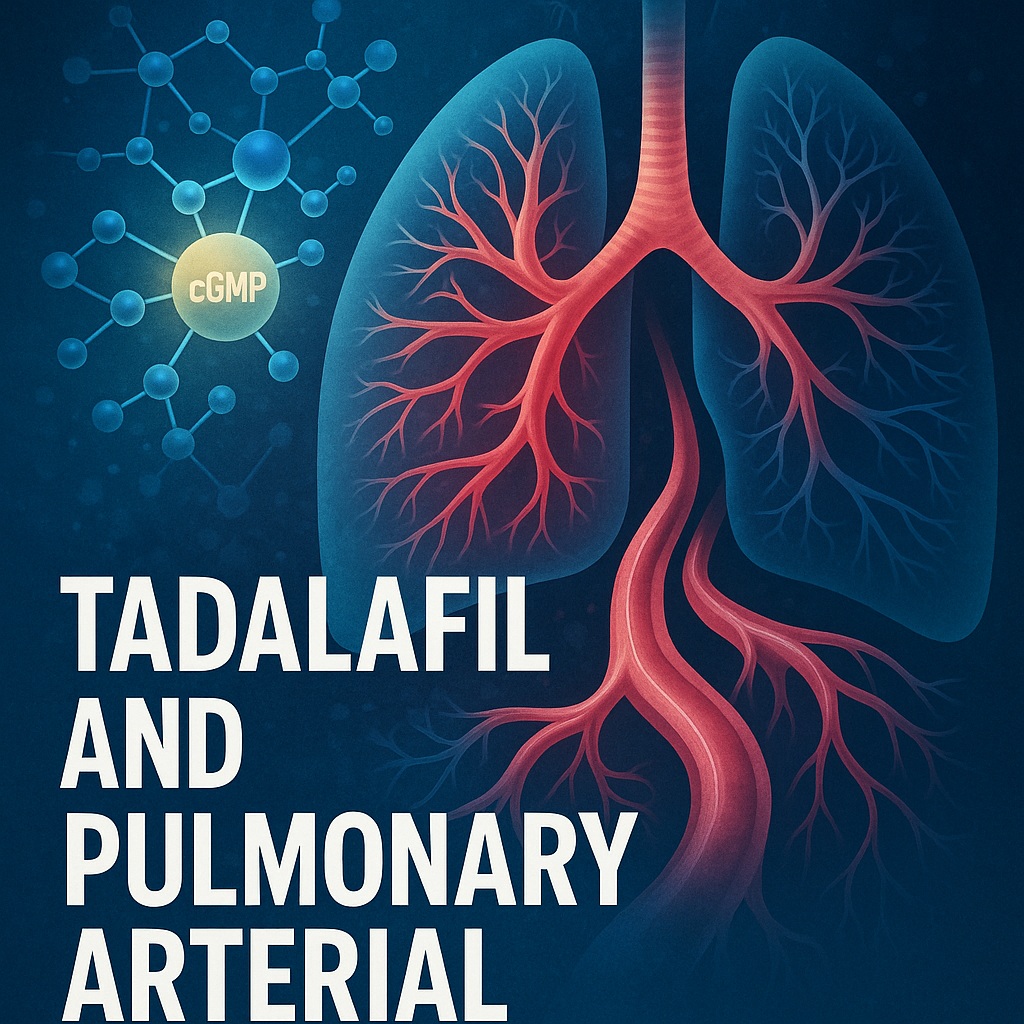
Pulmonary arterial hypertension (PAH) remains one of the most formidable challenges in cardiovascular medicine. This progressive and often fatal condition is characterized by relentless elevation of pulmonary vascular resistance, right ventricular hypertrophy, and, ultimately, heart failure. Over the past two decades, the therapeutic landscape has evolved from symptomatic management to mechanistic intervention — and one agent has drawn particular attention for its endurance and efficacy: tadalafil, a long-acting phosphodiesterase type 5 (PDE5) inhibitor.
While tadalafil is best known for treating erectile dysfunction, its pharmacologic profile — specifically its prolonged half-life and vascular selectivity — has positioned it as a promising candidate for chronic pulmonary vasculopathies. This article delves into the preclinical foundations of tadalafil’s role in PAH, exploring how it improves pulmonary hemodynamics, enhances survival, and provides sustained benefits even when therapy begins late in the disease process.
Understanding Pulmonary Arterial Hypertension: The Biology of Constriction and Collapse
At its core, PAH is a story of imbalance — a mismatch between vasodilatory and vasoconstrictive forces in the pulmonary circulation. Endothelial dysfunction plays the central role. The progressive loss of nitric oxide (NO) synthesis and the overexpression of vasoconstrictors like endothelin-1 initiate a cascade of events that reshape the pulmonary vasculature. Smooth muscle proliferation, adventitial fibrosis, and lumen narrowing collectively elevate pulmonary arterial pressure.
Over time, these structural changes overload the right ventricle (RV). The heart, designed to pump blood into a low-resistance circuit, faces an uphill battle against rising pulmonary pressures. Compensatory hypertrophy soon gives way to dilation and failure — the principal cause of mortality in PAH.
Traditional therapies such as calcium channel blockers, diuretics, and inotropic agents offer symptomatic relief but do not halt disease progression. Targeted treatments — prostacyclin analogues, endothelin receptor antagonists, and PDE5 inhibitors — emerged to directly modulate pulmonary vascular tone. Yet, even within this pharmacologic class, not all PDE5 inhibitors are created equal.
The Molecular Logic of PDE5 Inhibition
Phosphodiesterase type 5 (PDE5) regulates intracellular concentrations of cyclic guanosine monophosphate (cGMP), the downstream messenger of nitric oxide. By hydrolyzing cGMP, PDE5 effectively terminates NO-mediated vasodilation. Inhibition of PDE5 thus amplifies and prolongs cGMP signaling, promoting relaxation of smooth muscle in pulmonary arteries, decreasing vascular resistance, and improving perfusion.
Among PDE5 inhibitors, tadalafil stands out. Its half-life of approximately 17.5 hours enables once-daily administration, a convenience not shared by shorter-acting counterparts such as sildenafil. Moreover, tadalafil exhibits remarkable selectivity for PDE5 over other phosphodiesterase isoforms, minimizing off-target effects.
In pulmonary vasculature — rich in PDE5 expression — this selectivity becomes a therapeutic advantage. The sustained elevation of cGMP achieved by tadalafil not only induces vasodilation but also counteracts endothelial proliferation and right ventricular overload.
The Monocrotaline Rat Model: Reconstructing Pulmonary Hypertension in the Laboratory
To understand tadalafil’s impact on pulmonary hypertension, researchers have relied on a time-honored preclinical model — the monocrotaline (MCT)-induced PAH rat. After a single injection of MCT, hepatically activated metabolites injure pulmonary vascular endothelium, setting off a predictable sequence of inflammation, medial thickening, and RV hypertrophy.
Within three to four weeks, these animals develop hallmark features of PAH — elevated mean pulmonary arterial pressure (mPAP), hypoxemia, and right heart enlargement. Mortality approaches 70% by the sixth week post-injection.
This model mirrors the human disease not only pathologically but also therapeutically: agents that work in patients, such as sildenafil and bosentan, similarly improve outcomes in MCT rats. Hence, it serves as a robust platform for evaluating new pharmacologic strategies.
Early Intervention: Halting the Cascade Before Collapse
When administered immediately after MCT exposure, tadalafil profoundly altered disease trajectory. At doses up to 10 mg/kg daily, it preserved mean pulmonary arterial pressure within the normal range — roughly 15 mmHg — effectively preventing the onset of hypertension.
This protective effect correlated with an elevation in pulmonary cGMP concentrations. The data showed a 130% increase in lung cGMP relative to untreated controls, reinforcing the mechanistic link between PDE5 inhibition and vasorelaxation.
Equally important, tadalafil reduced right ventricular systolic pressure and attenuated ventricular hypertrophy, preserving cardiac structure and function. By maintaining normal hemodynamics, tadalafil demonstrated a preventive potential that goes beyond symptom relief — it interrupted the disease’s early pathobiology.
The pharmacological performance at the 10 mg/kg dose paralleled that of sildenafil administered twice daily at 25 mg/kg. However, the convenience of once-daily dosing and sustained biochemical action underscore tadalafil’s clinical advantage for chronic conditions where adherence and consistent plasma levels are critical.
Late Intervention: Reversing Established Pulmonary Hypertension
The true test of any PAH therapy lies not in prevention but in reversal. In the late-phase experiment, treatment began three weeks after MCT injection, when pulmonary hypertension and vascular remodeling were fully established.
Even in this advanced stage, tadalafil produced remarkable improvements. Survival rates increased in a dose-dependent manner — from 55% at 0.5 mg/kg to 70% at 10 mg/kg, compared to only 40% in untreated controls. Median survival extended from 16 days in the control group to 27 days at the highest tadalafil dose, a 70% improvement in life expectancy.
Blood gas analyses told a parallel story. Tadalafil-treated rats exhibited higher arterial oxygen pressure (PaO₂) and oxygen saturation (SaO₂), reflecting enhanced pulmonary perfusion and gas exchange. Although the improvements did not reach statistical significance in all groups, the trend was consistent and physiologically meaningful.
These findings are especially relevant to human PAH, which is often diagnosed late. Tadalafil’s ability to improve survival even when treatment is delayed speaks to its potential as a rescue therapy rather than a purely preventive measure.
The Role of cGMP: Molecular Mediator of Recovery
At the molecular level, tadalafil’s efficacy centers on its capacity to sustain high concentrations of cGMP within pulmonary tissues. In the late treatment phase, cGMP levels in tadalafil-treated rats were nearly three times higher than in untreated controls. This elevation fosters vasodilation, reduces vascular resistance, and stabilizes oxygen delivery.
But cGMP’s influence extends beyond the vascular wall. In hypertrophied right ventricles, PDE5 expression becomes upregulated — a maladaptive change that diminishes cardiac responsiveness to endogenous natriuretic peptides. By inhibiting PDE5, tadalafil restores cGMP availability, enhancing both myocardial contractility and relaxation.
Moreover, the drug’s action may indirectly potentiate the effects of atrial (ANP) and B-type (BNP) natriuretic peptides, two hormones with intrinsic cardioprotective functions. This synergism not only reduces pulmonary pressure but also counteracts maladaptive cardiac remodeling.
Right Ventricular Hypertrophy: A Complicated Relationship
Interestingly, despite its benefits in hemodynamics and survival, tadalafil did not completely prevent right ventricular hypertrophy (RVH) at lower doses. This paradox suggests that while pulmonary vasodilation alleviates afterload, other mechanisms — perhaps metabolic or inflammatory — continue to drive myocardial growth.
At the highest dose, however, tadalafil achieved noticeable attenuation of RVH, underscoring the importance of dose intensity and sustained exposure. It is plausible that prolonged elevation of cGMP not only relaxes pulmonary arteries but also suppresses hypertrophic signaling pathways within the myocardium.
Furthermore, studies have shown that PDE5 inhibition can enhance right ventricular contractility via cAMP–cGMP cross-talk, particularly when PDE3 is concurrently inhibited. This dual modulation — reducing vascular resistance while boosting ventricular performance — may explain the compound’s unique cardiopulmonary synergy.
Mechanistic Insights: Linking Vascular Biology and Cardiac Function
Tadalafil’s multifaceted impact in PAH can be summarized through a simple physiological logic:
- Vascular relaxation: PDE5 inhibition increases cGMP, leading to smooth muscle relaxation and reduced pulmonary artery pressure.
- Improved oxygenation: Enhanced blood flow through remodeled vessels increases PaO₂ and SaO₂, alleviating systemic hypoxia.
- Right ventricular support: Elevated cGMP and secondary cAMP stabilization improve contractile efficiency and delay heart failure progression.
The chronic increase in cGMP effectively counteracts the pathophysiologic triad of PAH — vasoconstriction, vascular remodeling, and right ventricular overload. This integrative mechanism distinguishes tadalafil from agents that target only one limb of the disease process.
Comparative Perspective: Tadalafil versus Sildenafil
While both tadalafil and sildenafil belong to the same pharmacologic class, their pharmacokinetic and tissue distribution profiles differ substantially. Sildenafil acts rapidly but dissipates within hours, necessitating multiple daily doses. Tadalafil, with its 17-hour half-life, maintains therapeutic concentrations for a full day, ensuring stable hemodynamic control.
In the MCT rat model, the overall efficacy of tadalafil (10 mg/kg once daily) was comparable to that of sildenafil (25 mg/kg twice daily). However, the longer-acting compound demonstrated superior maintenance of pulmonary cGMP levels and greater consistency in survival improvement across dosing ranges.
Clinically, this translates to improved patient compliance, reduced fluctuations in vascular tone, and sustained relief from PAH symptoms — advantages that align with the chronic, progressive nature of the disease.
Translating Preclinical Evidence into Clinical Promise
The preclinical data build a compelling case for tadalafil as a durable and convenient therapy for PAH. Its long-lasting inhibition of PDE5 supports continuous vasodilation, efficient oxygen exchange, and delayed right ventricular decompensation.
In humans, the approved 40 mg daily dose provides plasma exposures analogous to those seen in efficacious rat regimens. Moreover, tadalafil’s favorable tolerability profile — minimal systemic hypotension and limited drug interactions — enhances its suitability for long-term management.
Importantly, the drug’s efficacy in both early and late disease phases implies potential benefit across the full clinical spectrum of PAH, from newly diagnosed patients to those with advanced right heart dysfunction.
Beyond Vasodilation: The Broader Therapeutic Implications
Recent insights suggest that PDE5 inhibitors may exert antiproliferative, anti-inflammatory, and antifibrotic effects within the pulmonary vasculature. By modulating intracellular signaling cascades, tadalafil could suppress smooth muscle cell proliferation and extracellular matrix deposition — processes central to vascular remodeling.
Furthermore, the observed potentiation of natriuretic peptide signaling may confer renal and systemic benefits, improving volume management and reducing neurohormonal activation. These systemic effects align with the broader cardiovascular advantages observed in heart failure studies involving PDE5 inhibition.
Taken together, tadalafil’s role extends beyond mere vasodilation. It represents a metabolic and molecular recalibration of the pulmonary circulation — a therapy that restores balance to a system in biochemical disarray.
Limitations and Future Directions
Despite encouraging results, several questions remain. The monocrotaline model, while robust, does not fully capture the heterogeneity of human PAH, which can arise from autoimmune, genetic, or thromboembolic origins. Additionally, extrapolation from rats to humans must consider interspecies differences in PDE expression and pharmacokinetics.
Future research should focus on combination therapies, integrating tadalafil with endothelin receptor antagonists or prostacyclin analogues to maximize vasodilatory and antiproliferative synergy. Longitudinal clinical studies are also essential to determine whether the survival benefit observed in animal models translates into durable outcomes for patients.
Conclusion: A Long Breath of Hope
In the relentless progression of pulmonary arterial hypertension, time is both the enemy and the measure of therapeutic success. Tadalafil, through its sustained action on the NO–cGMP pathway, offers a temporal advantage — maintaining vascular relaxation, improving oxygenation, and extending survival even in late-stage disease.
The findings from preclinical research not only validate tadalafil’s pharmacologic rationale but also illuminate its clinical promise. As a once-daily oral therapy with consistent hemodynamic benefits, tadalafil stands as a cornerstone in the evolving management of PAH, where quality and quantity of life are measured in each carefully preserved breath.
FAQ: Tadalafil and Pulmonary Arterial Hypertension
1. How does tadalafil differ from sildenafil in treating pulmonary hypertension?
Tadalafil offers a longer duration of action — about 36 hours — compared to sildenafil’s 4–6 hours. This allows once-daily dosing, ensuring steady plasma levels and consistent pulmonary vasodilation without peaks and troughs that can compromise efficacy or tolerability.
2. Can tadalafil reverse established pulmonary arterial hypertension?
While complete reversal is unlikely, tadalafil significantly improves hemodynamic parameters, oxygenation, and survival even in advanced disease stages. It stabilizes pulmonary pressures, supports right ventricular function, and slows progression toward heart failure.
3. Is tadalafil safe for long-term use in PAH patients?
Yes. Clinical trials and post-marketing data indicate that tadalafil is well tolerated, with side effects typically mild — such as headache or flushing. Its cardiovascular selectivity and long half-life make it suitable for chronic therapy in both early and advanced PAH.
