

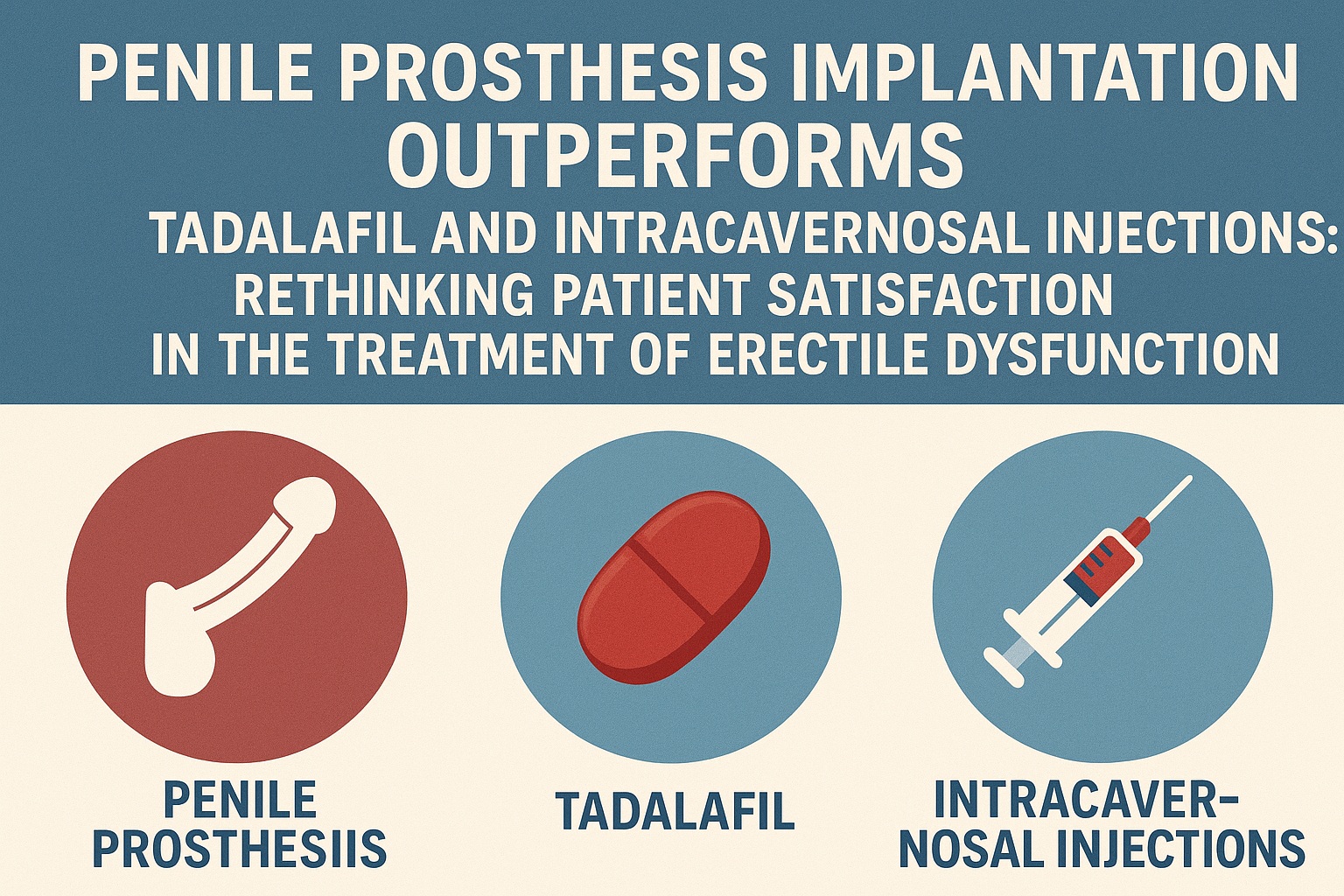
Erectile dysfunction (ED) remains one of the most prevalent and emotionally burdensome conditions affecting men worldwide. Although pharmaceutical advances—especially PDE5 inhibitors—have dramatically expanded treatment options, a substantial proportion of men continue to experience inadequate sexual satisfaction and persistent functional impairment. Amidst these therapeutic limitations, penile prosthesis implantation (PPI) stands as a definitive option, often referred to as the “end-stage therapy” for refractory ED. Yet, despite its invasive nature, it achieves patient satisfaction rates consistently higher than those seen with pharmacologic therapies.
The comparative study at the center of this article evaluates three prominent treatment modalities—tadalafil, intracavernosal injections (ICI), and penile prosthesis implantation—to determine which therapy yields the highest long-term satisfaction among men with ED. What the findings reveal is not merely a hierarchy of treatment outcomes, but a deeper insight into the psychology, expectations, and lived experience of patients navigating ED therapies.
This article synthesizes the study’s results into a detailed, structured, and readable professional narrative, offering clinicians and researchers a nuanced understanding of why penile prostheses often emerge as the most satisfying long-term solution—even when less invasive options remain technically effective.
The Challenge of Measuring Success in ED Treatment
ED management is unique within medicine because its success is tied not only to measurable physiological improvement but also to subjective perceptions of sexual performance, confidence, partner satisfaction, spontaneity, and life quality. Two patients with equal erectile function can report vastly different levels of satisfaction based on expectations, relationship dynamics, psychological state, or convenience of therapy.
Therefore, the study used validated instruments—including the International Index of Erectile Function (IIEF), Erectile Dysfunction Inventory of Treatment Satisfaction (EDITS), and Sexual Encounter Profile (SEP)—to quantify not only erectile performance but the broader treatment experience.
Across these metrics, penile prosthesis implantation emerged as the clear frontrunner for patient satisfaction. Men reported superior ease of use, reliability, predictability, and confidence relative to tadalafil or ICI.
Understanding why requires examining the mechanisms, demands, and limitations of each treatment approach.
Tadalafil: Convenient and Non-invasive, Yet Far From Perfect
Tadalafil, a long-acting PDE5 inhibitor, is often the first-line treatment for ED because it is easy to use, effective for many men, and well tolerated. With its 17.5-hour half-life, it supports spontaneity better than sildenafil or vardenafil, and its once-daily dosing regimen is convenient.
However, in the study cohort, tadalafil users had significantly lower satisfaction levels compared with penile prosthesis recipients. Several reasons for this trend became apparent:
1. Incomplete Efficacy
A notable proportion of men do not respond adequately to PDE5 inhibitors due to:
- severe vasculogenic insufficiency,
- diabetes-related endothelial dysfunction,
- neurogenic factors,
- cavernous fibrosis.
In the study, many men using tadalafil reported only partial improvements, with erections insufficiently firm or inconsistent, particularly under emotional pressure or with comorbid illnesses.
2. Timing and Performance Anxiety
Although tadalafil offers more flexibility than other PDE5 inhibitors, patients still need to coordinate sexual activity with dosing and anticipate its onset. This introduces pressure and reduces spontaneity—key contributors to sexual confidence and satisfaction.
3. Psychological Burden of “Trying a Pill Every Time”
Men often report that relying on medication for sexual performance increases self-consciousness and maintains the perception of being “dependent” on pharmacologic aid.
4. Persistence of Side Effects
Flushing, headache, dyspepsia, and nasal congestion—though usually mild—can diminish satisfaction and lead to discontinuation.
Overall, tadalafil proved helpful but insufficiently transformative for many participants.
Intracavernosal Injections: Highly Effective but Burdensome
Intracavernosal injection therapy—commonly alprostadil or combination agents—produces strong erections independent of nitric oxide pathways, making it successful even for men who fail PDE5 inhibitors.
In the study, ICI showed objectively good erectile results, yet satisfaction scores remained modest and significantly lower than those seen with penile implants. The discrepancy is explained by several experiential drawbacks:
1. Pain and Discomfort
Many users reported injection-related pain, fear, or bruising. A portion of men developed penile fibrosis or nodules, heightening anxiety about long-term use.
2. Treatment Interrupts Sexual Flow
Injecting medication shortly before intercourse disrupts spontaneity, introduces performance delay, and may create an awkward dynamic with partners.
3. Psychological Barriers
Some men struggle with the concept of injecting their penis, a factor that correlates with reduced adherence and lower satisfaction.
4. Risk of Priapism
Even rare episodes of prolonged erections create fear of continued use.
Although ICI remains a valuable therapy, particularly for men unresponsive to PDE5 inhibitors, its limitations often outweigh its strengths in terms of long-term acceptance.
Penile Prosthesis Implantation: Why Satisfaction Is So High
Men receiving penile prostheses—semi-rigid or inflatable—reported the highest satisfaction across all metrics, outperforming both tadalafil and ICI by a significant margin. The study’s results corroborated decades of surgical urology data: penile implants have satisfaction rates of 80–95% in most cohorts.
Several factors explain this consistency:
1. Reliability and Predictability
A penile prosthesis provides a firm, dependable erection on demand. No medication, timing, or anxiety interferes. Men appreciate the restoration of sexual autonomy—an effect that resonates deeply with psychological well-being. In the study, this reliability was the most frequently cited reason for high satisfaction.
2. Spontaneity and Natural Integration
Inflatable prostheses mimic the natural states of erection and flaccidity. Partners often express satisfaction due to the device’s discreetness and consistent function.
3. Elimination of Treatment Fatigue
Unlike daily pills or injections, a prosthesis requires no ongoing therapeutic rituals. This simplicity dramatically improves partner dynamics and reduces sexual performance stress.
4. Effective for All Etiologies of ED
Implants bypass physiological pathways entirely, making them equally effective for:
- diabetic neuropathy,
- severe vascular insufficiency,
- Peyronie’s disease with ED,
- post-prostatectomy ED,
- medication-resistant dysfunction.
5. Long-Term Durability and Device Satisfaction
Modern prostheses demonstrate excellent mechanical survival rates, with 5- and 10-year reliability exceeding 80% in many cohorts.
The study’s findings reflect these well-established advantages, showing that prosthesis recipients had significantly higher rates of sexual satisfaction, confidence, and overall quality of life.
What the Numbers Show: A Comparative Perspective
Although the detailed statistical tables are not reproduced here, the study provides clear trends:
Satisfaction Ranking (Highest to Lowest)
- Penile prosthesis implantation
- Intracavernosal injections
- Tadalafil
Erectile Function Scores
- Prosthesis users demonstrated the highest functional scores.
- ICI users showed strong erectile response but lower satisfaction.
- Tadalafil users had moderate improvements but reduced consistency.
Treatment Continuation Rates
- Prosthesis users show the lowest discontinuation rates due to high long-term satisfaction.
- ICI users often discontinue therapy due to discomfort and practical barriers.
- PDE5 inhibitor discontinuation frequently occurs due to inadequate efficacy or side effects.
These findings reinforce a clinical reality familiar to urologists:
satisfaction is not only about erectile hardness; it is about control, confidence, convenience, and the lived experience of sexual function.
Why Patients Rate Prostheses Higher: The Psychological Dimension
Beyond physiological performance, penile prosthesis implantation offers profound psychological benefits:
1. A Sense of Finality
Many men describe relief at ending the cycle of “trial-and-error” with medications. Once the implant is placed, there is no uncertainty.
2. Restoration of Masculine Identity
ED often impacts self-image. The ability to produce a firm, reliable erection restores emotional equilibrium and self-confidence.
3. Strengthening of Intimate Relationships
Partners frequently report improved satisfaction due to predictability and spontaneity.
4. Removal of Performance Anxiety
Knowing the erection will occur eliminates stress that undermines intimacy.
These factors contribute significantly to the higher satisfaction reported in prosthesis users across multiple studies, including the present one.
Risks and Realities: Surgery Is Not Without Considerations
Despite high satisfaction rates, penile prosthesis implantation is a surgical procedure and carries risks such as:
- infection,
- device malfunction,
- postoperative pain,
- mechanical wear over time.
However, modern perioperative protocols—including antibiotic-coated implants—have significantly reduced complication rates.
The study acknowledges these risks but notes that the net satisfaction remained superior to nonsurgical treatments even when accounting for complications.
Clinical Implications: Choosing the Right Treatment for the Right Patient
1. Tadalafil Remains First-Line—but Not for Everyone
Many men respond well to PDE5 inhibitors, especially those with mild vasculogenic ED or psychogenic components. However, non-responders should not cycle indefinitely through pills.
2. Intracavernosal Injection Is an Intermediate Option
ICI is effective for men unresponsive to oral therapy but may be limited by discomfort and adherence challenges.
3. Penile Prosthesis Is Highly Effective and Underutilized
Despite decades of data supporting prosthesis satisfaction, many men never learn about this option until late in their treatment journey. The study suggests clinicians should discuss surgical options earlier and more openly.
4. Shared Decision-Making Is Essential
Optimal ED treatment requires aligning therapy with a patient’s expectations, lifestyle, and psychological needs—not simply erectile mechanics.
Conclusion: Penile Prosthesis Implantation Sets the Gold Standard for Patient Satisfaction
The study provides clear, compelling evidence that penile prosthesis implantation yields significantly higher satisfaction compared with tadalafil or intracavernosal injections. This superiority arises from a combination of reliability, spontaneity, and emotional empowerment that nonsurgical therapies rarely match.
In a field where success depends not only on physiological function but also on psychological stability, relational harmony, and personal confidence, penile prostheses offer a highly effective, long-term solution.
For men with refractory ED, and especially for those burdened by years of failed medical therapy, prosthesis implantation is not merely an option—it is often the treatment that finally restores normalcy, intimacy, and quality of life.
FAQ
1. Why are patients more satisfied with penile prostheses than with tadalafil or injections?
Because prostheses provide a reliable, on-demand erection without medication, timing, or performance pressure. Satisfaction stems from predictability, ease of use, and restored confidence.
2. Do penile implants feel natural?
Modern inflatable prostheses closely mimic natural erectile rigidity and allow a flaccid state when not in use. Most partners report high satisfaction and low visibility of the device.
3. Should penile implants be offered earlier in ED treatment?
Possibly yes. The study and broader literature show that implants yield the highest long-term satisfaction. Early discussion empowers patients to choose the therapy that aligns best with their expectations and lifestyle.
