

Introduction
Erectile dysfunction (ED) continues to be one of the most prevalent yet under-discussed medical conditions affecting men worldwide. Beyond the physical impairment of penile rigidity, ED casts long shadows across mental health, self-esteem, and relationship satisfaction. It is estimated that more than half of men aged 40 to 70 will experience some degree of erectile difficulty during their lifetime. This is not merely a disorder of performance but a reflection of vascular health, endothelial integrity, and hormonal balance.
Historically, the therapeutic cornerstone for ED has been phosphodiesterase type 5 inhibitors (PDE5Is) such as sildenafil, vardenafil, avanafil, and tadalafil. These agents revolutionized the field by offering a pharmacologic shortcut to penile smooth muscle relaxation and augmented cavernosal filling. However, despite their proven efficacy, PDE5Is are not curative. They provide symptomatic relief — a pharmacological crutch rather than a true biological restoration. Many patients, particularly those with vasculogenic etiologies or endothelial dysfunction, find themselves reliant on the tablet before every sexual encounter.
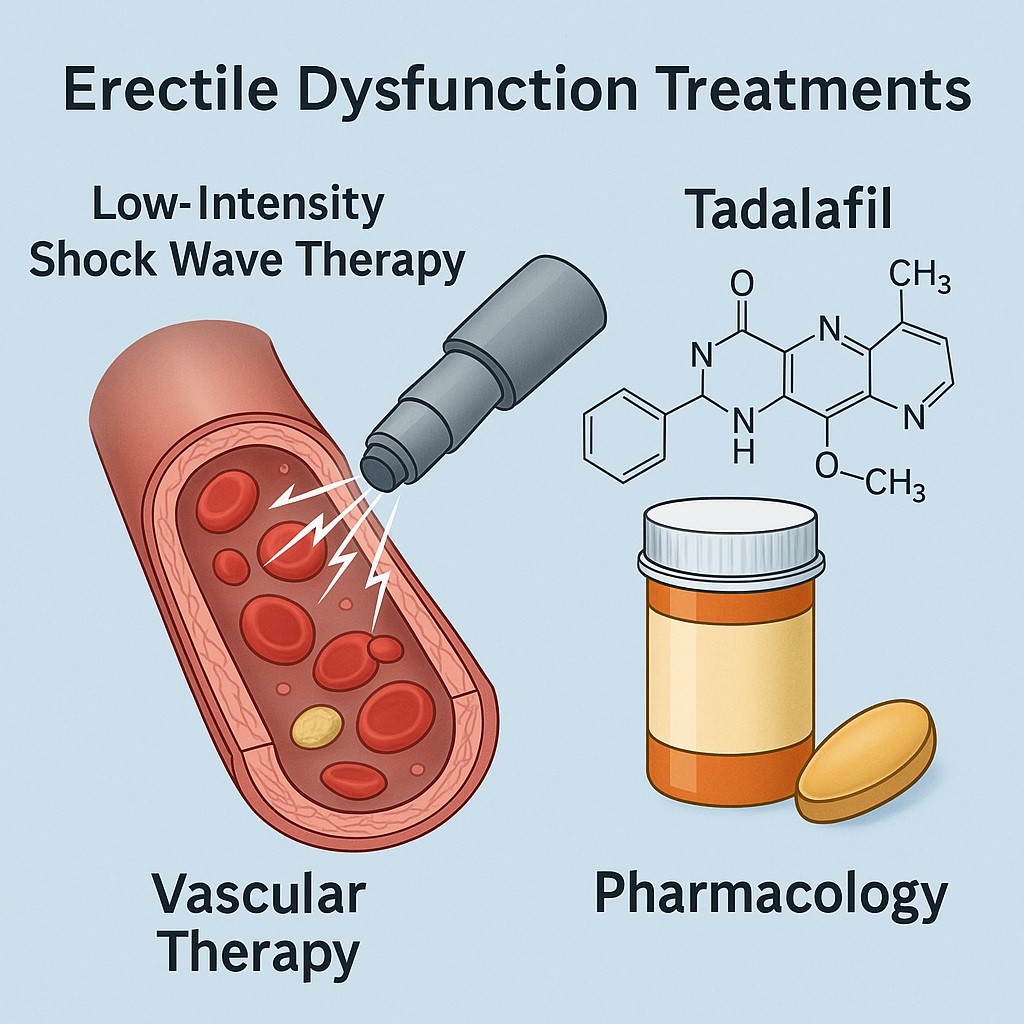
In contrast, low-intensity extracorporeal shock wave therapy (LIESWT) has emerged as a novel non-invasive intervention, promising something the PDE5I class never could: tissue regeneration and restoration of erectile physiology. This therapy utilizes acoustic waves to stimulate angiogenesis, improve blood flow, and potentially reverse the underlying microvascular pathology responsible for ED. The recent comparative trial by Zanaty et al. (2022) offers a compelling head-to-head evaluation of these two distinctly different therapeutic philosophies — one symptomatic, one restorative.
Rationale and Mechanistic Distinction Between Tadalafil and LIESWT
At first glance, tadalafil and shock wave therapy seem to inhabit separate universes of medical logic. Yet both address the same pathophysiological bottleneck: impaired penile perfusion.
Tadalafil, a long-acting PDE5 inhibitor, enhances cyclic guanosine monophosphate (cGMP) signaling by preventing its degradation. The result is relaxation of cavernosal smooth muscle and improved arterial inflow — but only when nitric oxide is available, and only transiently. Its strength lies in its reliability: predictable pharmacodynamics, rapid onset, and sustained duration of up to 36 hours. However, tadalafil’s mechanism remains fundamentally reactive; it does not mend the vascular damage nor improve endothelial health.
LIESWT, by contrast, operates as a regenerative therapy. The low-intensity shock waves create controlled mechanical stress within penile tissue, inducing a cascade of biological responses: upregulation of angiogenic factors (such as vascular endothelial growth factor), recruitment of endothelial progenitor cells, and remodeling of microvasculature. Essentially, it teaches the penis to heal itself. The therapy’s intent is curative — to stimulate neovascularization and restore spontaneous erectile function without continuous pharmacologic assistance.
Thus, while tadalafil acts like a skilled technician improving a malfunctioning engine’s output, LIESWT functions more like a mechanic rebuilding the engine altogether.
Study Design: A Balanced Clinical Comparison
The prospective study conducted by Menoufia University Hospitals, Egypt, between July 2021 and January 2022, provides valuable comparative insight. Fifty-one men suffering from ED for at least one year were enrolled and randomized into two treatment groups:
- LIESWT group (n = 25): Received six sessions (two per week) using the PiezoWave2 system, each session delivering 6,000 shockwaves — half directed to the crura and half to the penile shaft, totaling 36,000 impulses across the therapy course.
- Tadalafil group (n = 26): Self-administered 20 mg tadalafil on-demand approximately one hour before sexual activity.
The study meticulously excluded patients with confounding conditions such as prior pelvic surgery or radiation, coagulopathy, neurological disorders, or unstable psychiatric disease. Importantly, all participants were in stable relationships — a prerequisite for reliable sexual performance assessment.
The primary outcome measures were:
- International Index of Erectile Function (IIEF-5)
- Erection Hardness Score (EHS)
- Self-Esteem and Relationship (SEAR) questionnaire
Assessments were made at baseline, 6 weeks, and 12 weeks post-treatment. Additionally, side effects and overall treatment cost were recorded — a particularly relevant consideration in resource-limited settings.
Efficacy Outcomes: Comparable Gains, Divergent Mechanisms
Improvements in Erectile Function
Both tadalafil and LIESWT demonstrated statistically significant improvement in erectile function by week 6, with further enhancement by week 12.
- The IIEF-5 score in the LIESWT group rose from 11.16 ± 4.2 at baseline to 17.64 ± 4.0 at week 12.
- In the tadalafil group, scores increased from 10.08 ± 3.8 to 15.72 ± 3.6 over the same period.
This means both interventions effectively shifted many patients from moderate ED toward mild or near-normal function. Interestingly, tadalafil showed slightly faster initial improvement (by week 6), while LIESWT’s gains continued to accumulate — hinting at ongoing biological repair rather than transient pharmacologic support.
Erection Hardness and Psychosocial Indices
Parallel results were observed with the Erection Hardness Score (EHS), where both groups advanced from an average of 1.5–1.6 (insufficient rigidity) to around 3.1–3.2, denoting erections firm enough for penetration.
Equally important, the SEAR questionnaire, which captures emotional and relational well-being, improved markedly in both cohorts. This reinforces the interconnectedness between physiological and psychological recovery — as erectile confidence returns, so too does self-esteem and intimacy.
Safety and Tolerability: A Clear Winner Emerges
The contrast between the two treatments was most pronounced in safety outcomes.
In the LIESWT group, adverse effects were minimal:
- Two patients (8%) reported mild penile discomfort during treatment.
- One patient (4%) developed a transient bruise that resolved spontaneously.
No systemic symptoms or medication-related complications occurred.
In the tadalafil group, however, 44% of participants reported side effects — predominantly mild but nonetheless bothersome:
- Muscle pain (20%)
- Headache (16%)
- Nausea (8%)
No participants required hospitalization, but discomfort led some to dose reductions. While such effects are well-documented for PDE5Is, their frequency remains a barrier to consistent use, particularly in patients with cardiovascular comorbidities or drug sensitivities.
In essence, LIESWT offered a safer, non-pharmacologic alternative — virtually free from systemic adverse reactions.
Cost Analysis: Accessibility Versus Sustainability
Therapeutic decision-making seldom occurs in a financial vacuum, especially in developing nations, where patient affordability can dictate adherence. In this study, the average cost of the shock wave regimen was approximately USD 500, compared to USD 62.5 for tadalafil tablets over the same period. This stark cost disparity (p < 0.001) underscores a critical barrier: while LIESWT is biologically appealing, its upfront expense may limit widespread adoption.
However, a deeper look complicates the narrative. Tadalafil represents a recurring cost, dependent on continued purchase and usage. LIESWT, though expensive initially, aims to reduce long-term dependency. From a lifetime health economics perspective, especially if efficacy persists beyond the short term, the investment may prove worthwhile. Future studies with extended follow-up are needed to evaluate the cost-effectiveness horizon more rigorously.
Discussion: Where Biology Meets Behavior
Rehabilitative vs. Symptomatic Approaches
This comparative trial elegantly highlights two opposing paradigms in sexual medicine. Tadalafil exemplifies symptomatic pharmacotherapy — effective, predictable, but ultimately temporary. LIESWT symbolizes regenerative medicine — slower to manifest, but potentially capable of disease reversal.
One might say that PDE5 inhibitors borrow an erection, while LIESWT attempts to earn one.
By promoting neovascularization, LIESWT may restore basal penile perfusion even in the absence of medication. This concept aligns with findings from meta-analyses showing sustained improvement in IIEF and EHS scores up to six months post-therapy. The mechanistic underpinning — microtrauma-induced angiogenesis — echoes techniques long used in orthopedics and cardiology to rejuvenate ischemic tissue.
Psychological and Relational Implications
The improvement in SEAR scores carries profound psychosocial implications. The restoration of erectile function does more than enable intercourse; it reconfigures a man’s self-concept. The relief of performance anxiety, enhancement of intimacy, and improved communication with partners collectively strengthen relational dynamics. Moreover, LIESWT’s non-pharmacologic nature aligns well with the growing patient preference for naturalistic, device-based treatments over chronic drug intake.
Limitations and Future Outlook
Admittedly, the study’s short follow-up (12 weeks) restricts conclusions about long-term durability. Additionally, the small sample size precluded stratified analyses by ED etiology or severity. Future multicenter randomized controlled trials should extend observation periods to 6–12 months and investigate the potential synergistic effects of combining LIESWT with PDE5Is — a strategy already under exploration in other urological contexts.
Clinical Implications: How Should Urologists Approach This Choice?
In contemporary practice, treatment selection must align with patient expectations, physiology, and economic capacity. Based on current evidence, the following guiding principles may be proposed:
- For mild-to-moderate vasculogenic ED, LIESWT offers a promising restorative option, particularly in patients averse to pharmacotherapy or those experiencing PDE5I-related side effects.
- For psychogenic or situational ED, tadalafil remains the first-line, given its rapid onset and user-controlled nature.
- Combination therapy — employing LIESWT as foundational therapy with tadalafil as supportive — may provide optimal outcomes by merging restoration with reliability.
- Patient counseling is critical: while tadalafil works immediately, LIESWT requires patience and adherence to session schedules to yield lasting benefit.
Ultimately, the choice is not binary. These therapies occupy complementary niches within the continuum of ED management.
The Broader Context: Redefining “Cure” in Erectile Dysfunction
For decades, ED has been viewed as a chronic, static condition managed through lifelong pharmacologic dependence. The advent of LIESWT challenges that assumption, introducing the notion that certain cases can be rehabilitated, not merely managed. This represents a paradigm shift from control to correction.
If subsequent longitudinal studies confirm sustained benefit, shock wave therapy could become the first true disease-modifying treatment for vasculogenic ED — a transition reminiscent of how revascularization transformed the prognosis of ischemic heart disease.
Moreover, LIESWT may democratize therapy for patients unable to tolerate PDE5Is due to drug interactions or cardiovascular concerns. In an aging population with overlapping metabolic disorders, such flexibility is not merely advantageous — it is essential.
Limitations and Real-World Considerations
Despite its promise, LIESWT should not be mistaken for a universal panacea. Several practical and scientific caveats remain:
- Lack of standardization: Protocols vary in energy density, frequency, and session number, complicating cross-study comparison.
- Uncertain long-term efficacy: Most studies, including the present one, assess outcomes only up to 12 weeks.
- Cost and availability: Equipment and operator training may limit accessibility outside specialized centers.
- Patient selection bias: Responders may predominantly be those with early-stage or purely vasculogenic ED.
Until larger, controlled trials with longer follow-up are available, clinicians should position LIESWT as an adjunctive or alternative therapy, not yet a definitive replacement for PDE5Is.
Conclusion
The comparative evaluation of low-intensity extracorporeal shock wave therapy and on-demand tadalafil paints an encouraging yet nuanced picture. Both interventions significantly improve erectile function, hardness, and psychosocial well-being over 12 weeks.
However, LIESWT distinguishes itself by its superior safety profile and regenerative potential, albeit at a higher upfront cost. Tadalafil remains a reliable, accessible, and cost-effective first-line therapy, but its effects are transient and pharmacologically dependent.
In the evolving landscape of men’s sexual health, the future likely belongs to hybrid approaches that blend the immediate efficacy of pharmacologic agents with the long-term restoration offered by regenerative technologies. For now, clinicians and patients alike should welcome LIESWT not as a rival to tadalafil, but as its most promising ally in the ongoing effort to reclaim natural erectile function.
FAQ
1. How does shock wave therapy improve erectile function?
LIESWT delivers acoustic energy to penile tissue, promoting microvascular remodeling, increased nitric oxide synthesis, and neovascularization. These processes enhance blood flow and tissue oxygenation, leading to improved natural erectile capacity.
2. Is LIESWT a permanent cure for ED?
While it may produce long-lasting benefits in vasculogenic ED, data beyond one year are limited. Maintenance sessions may be necessary. Its efficacy is strongest in early-stage or moderate disease rather than severe structural dysfunction.
3. Which treatment should a patient choose first — tadalafil or LIESWT?
For most men, tadalafil remains the practical first-line choice due to its affordability and immediate effect. LIESWT is ideal for those seeking a non-drug, restorative solution, or for patients who do not respond well to PDE5 inhibitors.
