

Introduction
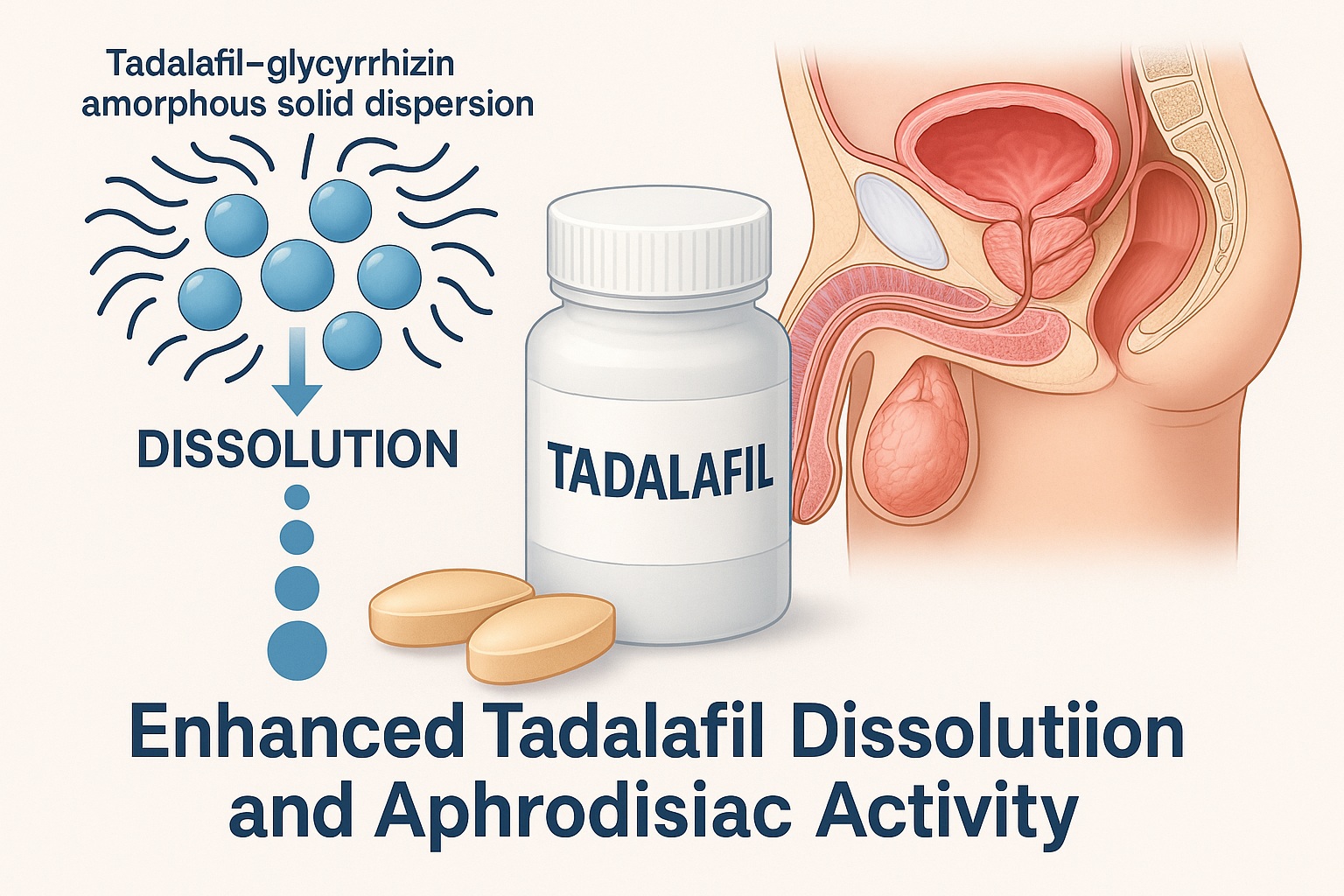
Pharmaceutical science often wrestles with a paradox — the molecules that show great therapeutic potential on paper often fail in practice because they simply refuse to dissolve. Among these stubborn compounds is tadalafil, a selective phosphodiesterase-5 (PDE5) inhibitor known for its long-acting efficacy in erectile dysfunction (ED) and pulmonary hypertension. While its pharmacodynamics are admirable, its biopharmaceutical behavior leaves much to be desired. Classified as a Biopharmaceutics Classification System (BCS) Class II drug, tadalafil’s low aqueous solubility severely limits its absorption and bioavailability, posing a persistent challenge to formulation scientists.
To bridge this gap, researchers have turned to the concept of amorphous solid dispersions (ASDs) — a strategy that transforms crystalline drugs into amorphous, higher-energy forms using suitable carriers. By increasing surface area, improving wettability, and preventing recrystallization, ASDs enhance dissolution rates and consequently bioavailability. Among the various technologies available to prepare ASDs, spray-drying stands out as a scalable, efficient, and thermally gentle process, ideal for producing uniform particles with desirable physicochemical characteristics.
In a recent study published in the Saudi Pharmaceutical Journal, researchers developed spray-dried amorphous solid dispersions of tadalafil using glycyrrhizin (GLZ) — a natural triterpenoid saponin extracted from licorice root (Glycyrrhiza glabra). Glycyrrhizin’s amphiphilic nature and micelle-forming ability make it a particularly attractive carrier for poorly soluble drugs. Beyond solubility enhancement, it exhibits antiviral, antioxidant, and membrane-permeabilizing properties, further augmenting drug bioavailability.
This article examines the rationale, methodology, and implications of developing tadalafil–glycyrrhizin ASDs, exploring not only their impact on dissolution enhancement but also on the aphrodisiac efficacy of tadalafil in preclinical models.
The Challenge of Poor Solubility in Modern Drug Development
Pharmaceutical innovation faces a significant bottleneck: while new chemical entities (NCEs) continue to proliferate, a striking 40–50% of them suffer from inadequate aqueous solubility. These molecules may possess excellent receptor affinity or metabolic stability, but if they do not dissolve in the biological milieu, they never reach their target.
This dilemma is particularly critical for drugs like tadalafil, whose crystalline form exhibits a dissolution rate too low to achieve optimal therapeutic plasma concentrations. Despite its long duration of action (up to 36 hours) and favorable side-effect profile, the drug’s absorption remains restricted by its physicochemical rigidity. Traditional formulation strategies — micronization, salt formation, and lipid-based systems — have offered incremental improvements but rarely overcome the solubility barrier completely.
Hence, solid dispersion technology has emerged as an elegant and adaptable solution. By dispersing the hydrophobic drug within a hydrophilic carrier matrix, solid dispersions convert crystalline molecules into an amorphous state characterized by higher Gibbs free energy and superior dissolution kinetics. The resulting product dissolves more readily, ensuring rapid and efficient systemic absorption.
The Role of Glycyrrhizin: From Licorice Root to Drug Carrier
Among various hydrophilic carriers used for ASD preparation, glycyrrhizin occupies a unique niche. Derived from licorice root, this triterpenoid saponin combines hydrophilic glucuronic acid residues with a lipophilic glycyrrhetic acid moiety, granting it amphiphilic characteristics that facilitate micelle formation in aqueous environments.
Glycyrrhizin’s pharmaceutical virtues extend well beyond solubility enhancement:
- Micellar solubilization: GLZ forms self-associated aggregates capable of encapsulating hydrophobic molecules like tadalafil, thus increasing their apparent solubility.
- Membrane permeability modulation: The saponin fraction of GLZ can extract cholesterol from cell membranes, enhancing drug transport across biological barriers.
- Stabilization of amorphous drugs: GLZ’s network-forming properties prevent recrystallization and degradation, maintaining the amorphous form’s thermodynamic stability.
Furthermore, glycyrrhizin is known for its antioxidant, anti-inflammatory, and antiviral activities, making it a biocompatible, multifunctional excipient that can complement the therapeutic effects of the active pharmaceutical ingredient (API).
The idea of pairing tadalafil — a drug limited by solubility — with glycyrrhizin — a natural solubilizer and bioenhancer — presents a compelling formulation strategy that merges pharmacological potency with formulation intelligence.
Spray-Drying: The Engineering of Dissolution Enhancement
The spray-drying technique is the backbone of this innovation. It involves atomizing a solution containing the drug and carrier into a stream of hot gas, which rapidly evaporates the solvent, producing dry, fine particles in a single step. This technique not only ensures homogeneity but also enables precise control over particle morphology, size distribution, and surface properties.
In this study, tadalafil and glycyrrhizin were dissolved in a binary solvent system of acetone and acetic acid. Three formulations (ASD1, ASD2, and ASD3) were prepared with increasing drug-to-carrier ratios of 1:0.5, 1:1, and 1:2, respectively. The optimized parameters — inlet temperature of 80°C, outlet temperature of 60°C, and a feed rate of 3 mL/min — ensured complete solvent evaporation without compromising drug integrity.
Among these, ASD3, with the highest glycyrrhizin content, demonstrated superior particle uniformity, yield (97.8%), and drug content (85%). The particle size averaged 1.9 μm with a low polydispersity index (PDI = 0.32), reflecting a narrow and consistent distribution — essential for predictable dissolution behavior.
Characterization of Amorphous Solid Dispersions
Spectroscopic and Thermal Analysis
The physicochemical integrity of the ASDs was confirmed using Fourier Transform Infrared (FTIR) spectroscopy, Differential Scanning Calorimetry (DSC), and X-ray Diffraction (XRD).
- FTIR analysis revealed that characteristic tadalafil peaks were preserved but attenuated in intensity, indicating physical entrapment within the glycyrrhizin matrix without chemical interaction.
- DSC thermograms showed the disappearance of tadalafil’s sharp melting endotherm at 302°C, confirming its conversion from crystalline to amorphous form.
- XRD patterns further supported this finding, displaying the loss of distinct Bragg peaks and the emergence of broad halos typical of amorphous solids.
These complementary analyses collectively confirmed that tadalafil existed in a stable amorphous state within the glycyrrhizin matrix — a prerequisite for enhanced dissolution.
Morphological Insights
Scanning Electron Microscopy (SEM) revealed the transformation from tadalafil’s spiked crystalline morphology to smooth, dented-spherical microstructures in the ASDs. This morphological change, driven by rapid solvent evaporation during spray-drying, increased surface area and wettability — key determinants of faster dissolution.
In Vitro Dissolution Performance
The dissolution profiles underscored the success of the formulation strategy. In acidic medium (0.1 N HCl), the ASDs exhibited a marked improvement in dissolution rate compared to pure tadalafil:
- ASD1: 68.6%
- ASD2: 88.0%
- ASD3: 97.8% (within 60 minutes)
- Pure Tadalafil: 24.0%
Thus, the optimized ASD3 demonstrated a 4-fold increase in dissolution rate, directly attributable to amorphization, reduced particle size, and the solubilizing effect of glycyrrhizin. The improved dissolution kinetics imply not only faster onset of action but also higher bioavailability and therapeutic consistency.
In Vivo Aphrodisiac Activity: Beyond Solubility
To evaluate whether improved dissolution translated into enhanced pharmacological efficacy, the researchers conducted sexual behavior studies in male rats. The animals were divided into three groups:
- Group I: Control (vehicle)
- Group II: Marketed tadalafil formulation (Herox®)
- Group III: Optimized ASD3 formulation (Tadalafil-GLZ)
Sexual parameters — including mount latency, intromission latency, ejaculation latency, and copulatory efficiency — were meticulously recorded. The results were telling:
- ASD3 significantly reduced mount and intromission latencies, indicating enhanced libido and erection quality.
- Ejaculation latency increased, suggesting prolonged sexual performance.
- Copulatory efficiency reached 75.5%, surpassing both control (58%) and marketed formulation (66%).
In short, the amorphous dispersion not only improved tadalafil’s pharmacokinetics but also potentiated its aphrodisiac efficacy, reinforcing the principle that better solubility often translates into better performance — both pharmacologically and, in this case, physiologically.
Stability Assessment: Sustaining Amorphous Integrity
Amorphous systems, while advantageous, are often plagued by instability — the tendency of high-energy forms to recrystallize over time. To evaluate this, the optimized ASD3 was subjected to accelerated stability testing at 40°C and 75% relative humidity for one month.
The results were encouraging. Drug content decreased only marginally (from 85.0% to 83.4%), and the dissolution profile remained statistically equivalent (f₂ = 51.5). No signs of recrystallization or degradation were observed, demonstrating that glycyrrhizin provided effective physical stabilization, preserving the amorphous nature and therapeutic potential of tadalafil.
Mechanistic Interpretation: How Glycyrrhizin Works
The formulation’s success hinges on the multifaceted actions of glycyrrhizin:
- Amorphization and stabilization: Its hydrogen-bonding and micelle-forming capacity disrupt tadalafil’s crystalline lattice, maintaining an amorphous state.
- Micellar solubilization: In aqueous environments, GLZ forms rod-like micelles that encapsulate tadalafil molecules, increasing the effective solubility.
- Permeability enhancement: Saponin components transiently alter membrane fluidity, improving drug transport across intestinal barriers.
- Synergistic pharmacodynamics: GLZ’s intrinsic anti-inflammatory and antioxidant effects may complement tadalafil’s vascular benefits, particularly in conditions like ED and cardiovascular dysfunction.
Thus, glycyrrhizin serves not merely as a carrier but as a biofunctional excipient — a partner in pharmacological synergy.
Clinical Implications and Translational Perspective
While these findings are confined to preclinical settings, they hold promising translational potential. Enhanced dissolution and bioavailability could allow lower tadalafil doses to achieve comparable or superior therapeutic outcomes, minimizing adverse effects and cost.
Moreover, the concept of natural carrier-assisted amorphous solid dispersions opens new avenues for reengineering other poorly soluble drugs — from antihypertensives to anticancer agents — using biocompatible natural excipients.
In the context of erectile dysfunction, improved dissolution means faster onset of action and more reliable therapeutic response, addressing one of the key limitations of oral PDE5 inhibitors.
Limitations and Future Directions
While compelling, the study leaves several open questions. First, the long-term stability of the amorphous form under varied environmental conditions remains to be explored. Second, scaling up the spray-drying process while preserving physicochemical uniformity warrants industrial validation. Lastly, clinical pharmacokinetic studies are needed to confirm whether in vitro dissolution enhancements translate into in vivo bioavailability gains in humans.
Future investigations might also explore co-amorphous systems — pairing tadalafil with synergistic agents like antioxidants or vasodilators — to further optimize pharmacodynamics and therapeutic breadth.
Conclusion
The study by Ahmed et al. represents a significant advancement in the formulation of poorly soluble drugs. By leveraging the natural amphiphilicity and stabilizing power of glycyrrhizin, the researchers successfully transformed tadalafil into a highly soluble, stable, and therapeutically superior amorphous solid dispersion.
The optimized formulation (ASD3) achieved:
- A fourfold increase in dissolution rate,
- Substantial improvement in aphrodisiac efficacy, and
- Excellent short-term stability under stress conditions.
In essence, this work exemplifies how intelligent excipient selection and precise process engineering can convert pharmacological potential into clinical performance. The marriage of natural carriers with advanced formulation techniques may very well define the next generation of bioavailable therapeutics.
FAQ
1. Why was glycyrrhizin chosen as the carrier for tadalafil?
Glycyrrhizin is a natural amphiphilic compound capable of forming micelles that encapsulate hydrophobic drugs like tadalafil. Its dual hydrophilic–lipophilic structure enhances solubility and prevents recrystallization, while its biological safety and membrane-modifying properties improve bioavailability.
2. What advantages does spray-drying offer over other ASD techniques?
Spray-drying provides precise control over particle size, morphology, and moisture content. It is scalable, fast, and suitable for heat-sensitive drugs. Most importantly, it produces uniform amorphous dispersions that are easy to reproduce industrially.
3. Does enhanced dissolution always mean better therapeutic efficacy?
Generally, yes — provided the drug’s absorption is dissolution-rate limited. In tadalafil’s case, improved dissolution through amorphization and micellar encapsulation led directly to enhanced aphrodisiac performance in vivo, demonstrating a clear correlation between formulation and pharmacological outcome.
