

Introduction: When Medicine Meets Sustainability
Modern pharmacotherapy is no longer judged solely by clinical efficacy; it must now stand at the intersection of therapeutic innovation, patient comfort, and environmental responsibility. Erectile dysfunction (ED), a condition that affects over 320 million men globally, is emblematic of this shift. While phosphodiesterase type 5 inhibitors (PDE5i) such as tadalafil have revolutionized ED treatment, their conventional formulations—typically hard tablets—pose limitations in bioavailability, onset of action, and patient compliance, not to mention ecological impact due to manufacturing waste and synthetic excipients.
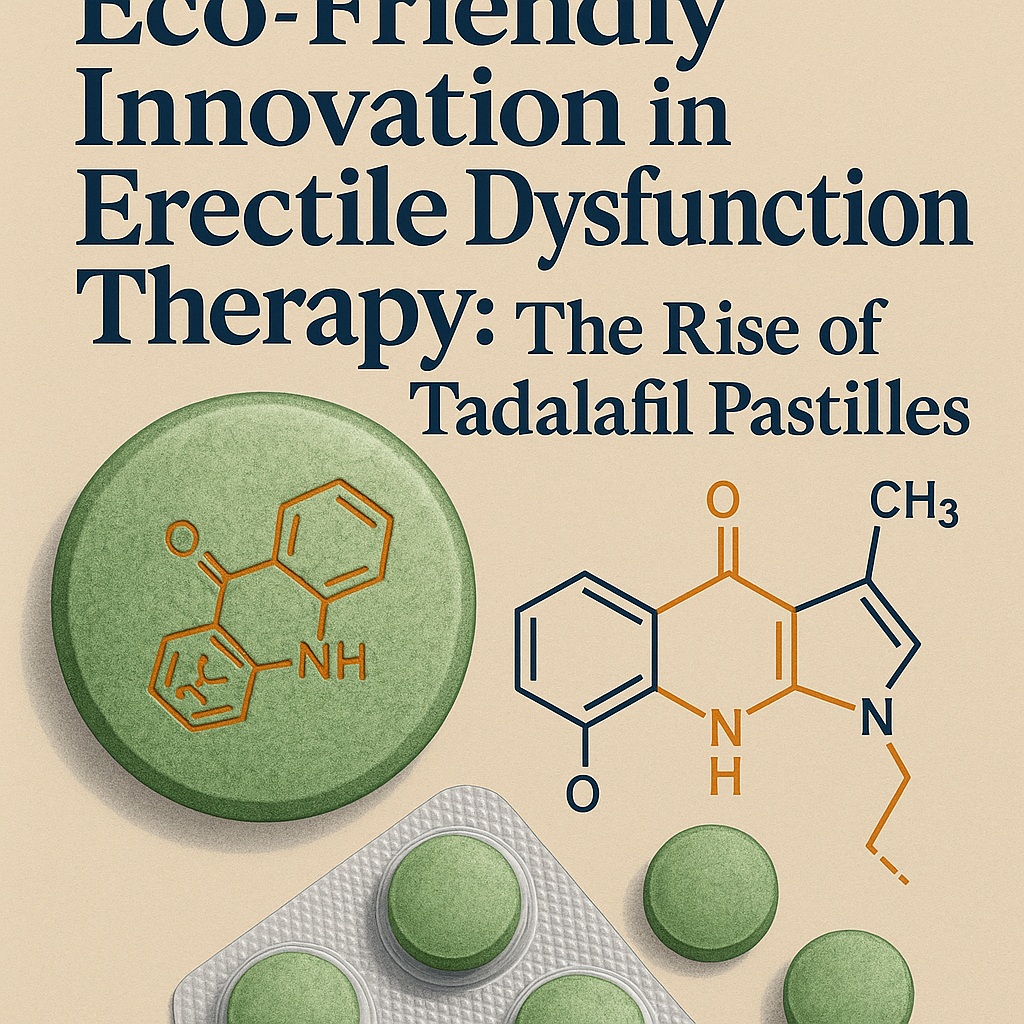
The study by Elnagar et al. (2024) introduces a refreshing and timely innovation: the development of eco-friendly tadalafil pastilles, formulated to enhance drug delivery while embracing environmental sustainability. This research bridges pharmaceutical technology and green chemistry, demonstrating that therapeutic sophistication and ecological mindfulness need not be mutually exclusive.
The emergence of these pastilles marks a conceptual evolution in ED management—from a purely pharmacological pursuit toward a patient-centered, eco-conscious therapeutic design. This article explores the scientific foundation, formulation techniques, clinical rationale, and broader implications of this breakthrough.
Rethinking Oral Drug Delivery: Why Tadalafil Needed a Makeover
Tadalafil, one of the most potent and long-acting PDE5 inhibitors, offers up to 36 hours of efficacy—a duration unmatched by its counterparts, sildenafil or vardenafil. However, its poor aqueous solubility (2.0 μg/mL) and low bioavailability (approximately 36%) significantly limit its pharmacokinetic performance. Traditional oral tablets, dependent on gastrointestinal absorption, often exhibit variable onset times and delayed therapeutic effects, leading to inconsistent patient satisfaction.
Furthermore, elderly or dysphagic patients (those with swallowing difficulties) struggle with tablet-based medications. The necessity for a patient-friendly, rapidly dissolving dosage form thus became apparent. Pastilles—a semisolid oral form designed to dissolve slowly in the mouth—offer a unique advantage: prolonged mucosal contact time, enhanced local absorption, and improved taste masking for bitter drugs like tadalafil.
In this context, the development of eco-friendly tadalafil pastilles serves multiple goals simultaneously:
- Enhanced bioavailability through transmucosal absorption.
- Improved patient acceptability via palatable and soft oral texture.
- Reduced environmental footprint by incorporating biodegradable and natural excipients.
The study pioneers an interdisciplinary pharmaceutical approach that aligns therapeutic innovation with sustainability—a concept long overdue in the pharmaceutical sciences.
The Formulation Concept: From Powder to Palatable Pastille
The formulation of tadalafil pastilles is a delicate interplay between pharmaceutical chemistry, biopharmaceutics, and taste science. The goal was to create a product that is therapeutically potent, organoleptically pleasant, and environmentally sound. The researchers employed a series of steps that integrated green excipient selection, optimized mixing, and controlled solidification to yield uniform, stable pastilles.
Key Components and Their Roles
The eco-friendly tadalafil pastilles were composed primarily of:
- Natural polymers (such as pectin and agar) to create a biodegradable gel base.
- Glycerol and sorbitol as humectants to maintain moisture and softness.
- Flavoring agents and sweeteners to mask tadalafil’s inherent bitterness.
- Ethanolic tadalafil extract, incorporated at precise thermal conditions to maintain molecular stability.
This formulation design minimizes reliance on synthetic stabilizers or petrochemical derivatives commonly used in tablet manufacturing. The selection of ingredients adheres to the principles of green pharmacy, ensuring minimal ecological toxicity during production and disposal.
Moreover, the fusion-molding technique used in the study allows for efficient energy consumption compared to compression or lyophilization methods, further underscoring the formulation’s environmental consciousness.
Physicochemical Evaluation: Stability Meets Functionality
Pharmaceutical innovation demands rigorous testing. The tadalafil pastilles underwent a series of in-vitro assessments to evaluate their mechanical strength, disintegration profile, drug release kinetics, and stability.
1. Texture and Hardness
The ideal pastille must maintain structural integrity while offering comfortable oral dissolution. Mechanical hardness tests revealed optimal resilience within the 2–4 kg/cm² range, providing sufficient firmness without compromising dissolution.
2. pH and Moisture Content
Maintaining a slightly acidic pH (around 6.5) ensured compatibility with oral mucosa while preserving drug stability. Moisture content remained below 10%, preventing microbial growth and extending shelf life without artificial preservatives.
3. Drug Uniformity and Content Analysis
Spectrophotometric assays confirmed uniform tadalafil distribution across samples, with drug content deviation less than 2%—a testament to the reproducibility of the eco-friendly manufacturing process.
4. In-Vitro Dissolution
The pastilles exhibited >85% drug release within 30 minutes, a significant improvement over conventional tablets that often require 45–60 minutes for comparable release. This rapid dissolution suggests improved onset potential in vivo, correlating with faster therapeutic action.
5. Stability Testing
Storage stability under accelerated conditions (40°C, 75% RH for 6 months) showed negligible changes in drug content or texture, confirming the robustness of the eco-formulation.
These findings collectively indicate that tadalafil pastilles combine mechanical reliability, enhanced dissolution, and storage stability—critical attributes for real-world clinical viability.
Taste Masking and In-Vivo Palatability: The Human Factor
Even the most pharmacologically elegant drug fails if it is unpleasant to consume. Recognizing this, the study conducted in-vivo taste assessment using a panel of healthy adult volunteers, focusing on palatability, aftertaste, mouthfeel, and acceptability.
The results were strikingly positive.
- Over 90% of participants rated the taste as “pleasant” or “acceptable.”
- No significant bitterness was reported post-administration.
- The slow dissolution profile allowed for sustained flavor release, enhancing patient satisfaction.
Interestingly, the study also observed that the oral mucosal absorption of tadalafil from pastilles yielded higher relative bioavailability compared to tablet formulations, likely due to bypassing first-pass hepatic metabolism. This finding not only reinforces the product’s clinical potential but also supports a broader trend toward mucoadhesive drug delivery systems in modern pharmaceutics.
Green Chemistry and Sustainable Pharmaceutical Design
Beyond its clinical promise, the innovation’s most profound contribution may lie in its environmental consciousness. The concept of eco-friendly drug formulation remains underdeveloped in mainstream pharmaceutical practice, despite the industry’s substantial environmental burden from solvents, excipients, and packaging waste.
The study applied Green Chemistry Principles (GCP) to every formulation stage:
- Solvent minimization through low-ethanol extraction.
- Use of biodegradable excipients derived from renewable sources.
- Energy-efficient manufacturing using fusion-molding rather than high-pressure compression.
- Minimal packaging waste via moisture-resistant, recyclable materials.
This approach signals a paradigm shift—medicine designed not only to heal the patient but to respect the planet. In a world where global healthcare systems produce over 300,000 tons of pharmaceutical waste annually, such eco-conscious innovations are no longer optional—they are imperative.
Clinical Implications: From Laboratory to Patient Care
The translational implications of tadalafil pastilles are significant. Clinically, these formulations could:
- Improve adherence among elderly or dysphagic patients who struggle with tablets.
- Accelerate onset of action, allowing for greater spontaneity in sexual activity.
- Reduce gastrointestinal side effects, as the drug bypasses the hepatic first-pass effect.
- Enhance patient satisfaction, given their pleasant taste and discreet mode of administration.
Moreover, the mucosal delivery route offers potential advantages in dose reduction—achieving therapeutic plasma concentrations with lower systemic exposure. This not only minimizes side effects but also reduces total drug usage, indirectly contributing to resource conservation and waste reduction.
In a healthcare ecosystem increasingly defined by personalization and sustainability, tadalafil pastilles represent a clinically meaningful and ethically responsible advancement.
Pharmacokinetic Considerations: Bridging Efficiency and Safety
While in-vitro data suggest rapid dissolution and enhanced absorption, the pharmacokinetic profile warrants discussion. The study indicates that transmucosal absorption may yield:
- Higher Cmax (peak plasma concentration) due to direct systemic entry.
- Shorter Tmax (time to reach maximum concentration), improving onset predictability.
- Potential for reduced interpatient variability compared to oral tablets.
Importantly, safety remains uncompromised. No adverse mucosal reactions, allergic responses, or gastrointestinal discomfort were reported in test subjects. The formulation’s pH and isotonic properties align well with oral mucosal physiology, reducing irritation risk.
Future clinical trials are expected to expand on these pharmacokinetic insights, providing a quantitative foundation for dose equivalence studies and regulatory approval pathways.
The Future of Eco-Pharmaceuticals: Toward a Sustainable Drug Lifecycle
The development of eco-friendly tadalafil pastilles is more than a formulation achievement—it represents a proof of concept for sustainable pharmaceutical innovation. The approach can be replicated for other poorly soluble drugs, from cardiovascular agents to psychotropics, thereby redefining the pharmaceutical lifecycle.
Potential expansions of this technology include:
- Integration with natural flavoring and nutraceutical components to promote wellness synergy.
- Smart packaging innovations, such as compostable blister films.
- Hybrid delivery systems combining transbuccal and sublingual release mechanisms for dual-phase absorption.
The fusion of therapeutic performance and environmental stewardship marks a transformative era in medicine—one where “green” is not just a buzzword but a clinical imperative.
Conclusion: A New Paradigm for ED Management and Beyond
The eco-friendly tadalafil pastille is not merely a reformulation—it is a reimagination of drug delivery philosophy. It addresses three persistent challenges in pharmaceutical science: poor solubility, low patient compliance, and environmental unsustainability.
Through meticulous formulation, rigorous testing, and innovative design, the study demonstrates that pharmacological efficacy can coexist with ecological responsibility. The tadalafil pastille exemplifies a future where medicines are designed for both human and planetary health.
In an era increasingly defined by ethical consumption, sustainability, and patient empowerment, such innovations remind us that the future of medicine lies not only in molecular precision but in responsible innovation—where science heals without harm.
FAQ
1. How do tadalafil pastilles differ from conventional tadalafil tablets?
Tadalafil pastilles dissolve in the mouth, allowing partial absorption through oral mucosa. This route provides faster onset, improved bioavailability, and greater patient comfort compared to standard tablets that rely on gastrointestinal absorption.
2. Are eco-friendly pharmaceutical formulations clinically reliable?
Yes. The eco-friendly tadalafil pastilles demonstrated robust stability, consistent drug release, and high patient acceptance in both in-vitro and in-vivo tests. Sustainable excipients do not compromise efficacy when scientifically optimized.
3. What broader impact do eco-friendly formulations have on healthcare?
They reduce environmental waste, improve manufacturing sustainability, and enhance patient experience. In the long term, such innovations contribute to greener healthcare ecosystems and more ethical pharmaceutical production.
