

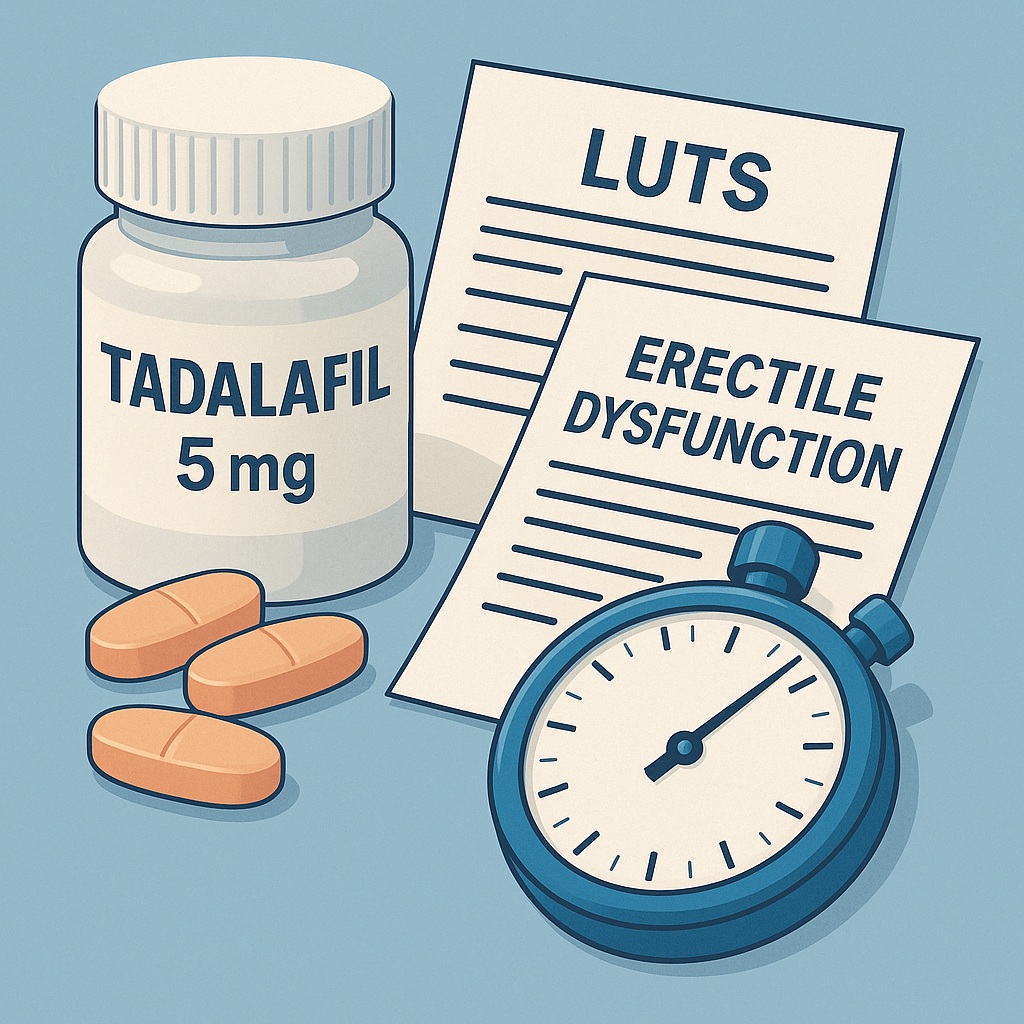
Premature ejaculation, erectile dysfunction, and lower urinary tract symptoms form a clinical triad that many men know too well but seldom discuss openly. These seemingly distinct disorders frequently overlap, share physiological mechanisms, exacerbate one another, and collectively reduce sexual confidence, quality of life, and emotional well-being. Yet despite their common coexistence, treatment strategies often address them separately—fragmenting care and overlooking the possibility that one intervention could improve all three.
A new retrospective clinical study provides a compelling reminder that urological symptoms do not exist in isolation. By evaluating daily tadalafil 5 mg in 60 men diagnosed with erectile dysfunction (ED), researchers demonstrate that this single PDE5 inhibitor meaningfully improves ejaculation latency, erectile performance, and lower urinary tract symptoms (LUTS) at the same time. These findings reinforce the idea that PDE5 inhibitors have broader therapeutic potential than originally recognized and offer a unifying approach to conditions long treated in silos.
This article distills and expands the meaning of the study’s results, translating the data into an engaging, clinically relevant narrative. The objective is to provide not only a summary but also a broader understanding of why tadalafil improves these parameters, who benefits most, and how these findings fit into the modern management of male sexual and urological dysfunction.
The Interconnected Nature of Ejaculatory Control, LUTS, and Erectile Dysfunction
Modern understanding of male sexual health emphasizes that ejaculation, erection, and urinary function share overlapping neural, vascular, and smooth muscle control systems. While textbooks treat them as separate processes, real-world physiology ties them together more closely than expected.
Ejaculatory dysfunction and ED as reciprocal conditions
Premature ejaculation (PE) is one of the most common male sexual disorders, with a prevalence between 9% and 30% depending on the population studied. But its relationship to ED is reciprocal and occasionally vicious. Men with ED often intensify stimulation to achieve penetration, increasing sympathetic drive and thereby accelerating ejaculation. Conversely, men with PE may avoid full arousal or maintain an overly cautious mental state to delay ejaculation—reducing erectile rigidity and promoting ED. This relationship is supported by large international surveys demonstrating that at least one-third of men with ED report PE as well.
LUTS as a contributor to sexual dysfunction
Lower urinary tract symptoms—urgency, increased nocturia, weak stream, incomplete emptying—may seem unrelated to sexual performance, yet their impact on male sexual health is substantial. The multinational MSAM-7 study found a strong correlation between LUTS severity and both ED and ejaculatory disorders. Dysfunction in pelvic smooth muscle tone, chronic prostatic inflammation, and heightened sympathetic activity appear to underlie these connections.
PDE5 inhibitors as a physiologic bridge
Because erection, ejaculation, and urinary flow share endothelial nitric oxide (NO) regulation and smooth muscle relaxation pathways, PDE5 inhibitors have a theoretical ability to improve all three. NO/cGMP signaling supports cavernous vasodilation, prostatic smooth muscle relaxation, and modulation of seminal vesicle contraction—explaining why a single medication might simultaneously influence erectile rigidity, LUTS, and ejaculation latency.
This study therefore addresses a clinically important and physiologically sensible question: can once-daily tadalafil 5 mg improve all three outcomes at once?
Study Overview: A Real-World Evaluation of Daily Tadalafil
The retrospective study analyzed 60 heterosexual men with confirmed ED who received tadalafil 5 mg daily for 3 months.
Inclusion and assessment methods
Participants were evaluated using validated tools:
- IIEF-5 for erectile function
- Intravaginal Ejaculatory Latency Time (IELT) via stopwatch measurement
- IPSS for LUTS severity
Serum metabolic markers—including testosterone, fasting glucose, LDL/HDL cholesterol—were also recorded to provide context regarding metabolic health.
Baseline characteristics
Baseline data depict a population with:
- Mean age 50.4 years
- Mean testosterone 444.6 ng/dL
- Mean baseline IELT 2.2 minutes
- Mean IIEF-5 9.5 (moderate ED range)
- IPSS 14.1, indicating moderate LUTS
These values are representative of a typical mid-aged ED population, where metabolic disturbances and urological symptoms coexist frequently.
Erectile Function: Substantial Improvement Across All Severity Groups
Erectile function improved significantly across all categories (severe, moderate, mild ED). The mean IIEF-5 increased from 9.5 to 16.1, a highly significant jump.
Why tadalafil works well in this dosage
Daily tadalafil provides steady cGMP elevation, enhancing NO-mediated vasodilation and reducing cavernosal smooth muscle tone. This facilitates increased arterial inflow and reduced venous occlusion leakage—crucial in ED.
Moreover:
- The daily regimen avoids timing pressure associated with on-demand use.
- Steady concentrations improve endothelial function over time.
- Chronic dosing may reduce performance anxiety, indirectly improving IIEF-5.
Benefits across severity levels
Importantly, severe, moderate, and mild subgroups all demonstrated similar proportional improvements:
- Severe ED: IIEF-5 increased from 2.3 to 3.1 min (IELT)—but IIEF scores also rose significantly.
- Moderate ED: IELT improved from 2.09 to 3.50 min.
- Mild ED: IELT improved from 2.35 to 3.88 min.
Even men with poor baseline function benefited, supporting tadalafil’s capacity to reverse complex vascular and psychological ED components.
Ejaculatory Control: Meaningful Increases in IELT
One of the most clinically relevant—and often overlooked—findings is the significant rise in IELT from 2.2 to 3.4 minutes (p < 0.001).
While a minute may seem trivial on paper, an improvement from ~2 minutes to >3 minutes often marks the difference between distressing PE and functional ejaculatory control.
Mechanisms through which tadalafil enhances IELT
Several physiological pathways may explain tadalafil’s effect:
- Reduced sympathetic overactivity:
Ejaculation is primarily a sympathetic event. PDE5 inhibitors reduce sympathetic tone, delaying climax. - Smooth muscle relaxation:
Tadalafil relaxes smooth muscle in the vas deferens, seminal vesicles, and prostate—modulating the contraction intensity required for ejaculation. - Improved erection quality increases control:
Better erectile rigidity allows more confidence and reduces the anxious overstimulation that accelerates ejaculation. - Central NO/cGMP mediation:
Animal data indicate NO-mediated modulation of ejaculatory reflexes via central pathways.
Comparison with literature
Previous studies with sildenafil showed improved sexual satisfaction but limited IELT increase. Tadalafil’s longer half-life and steady pharmacokinetics may explain the more robust IELT improvements seen here.
Furthermore, this is the first study to systematically examine tadalafil’s effect on ejaculation in men with ED, making its findings particularly valuable.
Lower Urinary Tract Symptoms: Significant Improvement in IPSS
The improvement in LUTS is one of the most consistent findings across PDE5 inhibitor research. Here, IPSS scores decreased significantly from 14.1 to 10.4.
Why tadalafil improves LUTS
Several interwoven mechanisms contribute:
- Prostatic smooth muscle relaxation reduces bladder outlet obstruction.
- Enhanced pelvic blood flow improves detrusor oxygenation.
- Reduced prostatic inflammation supports lower sympathetic tone.
- Modulation of cGMP pathways decreases afferent nerve hyperexcitability.
Consistency with prior studies
Meta-analyses show PDE5 inhibitors reduce IPSS by ~4 points, which matches the 4-point reduction observed here. This reinforces tadalafil as an established therapeutic option for LUTS, particularly when combined with ED.
Moreover, ED and LUTS often share risk factors—diabetes, hypertension, dyslipidemia—making PDE5 inhibitors especially useful in this demographic.
Safety, Tolerability, and Real-World Feasibility
Daily tadalafil was well tolerated. The most common side effects included:
- GI upset (10%)
- Headache (8.3%)
- Flushing (5%)
- Back pain (3.3%)
Most were mild and transient. No patient discontinued treatment due to side effects.
Given the variety of comorbidities in the cohort—diabetes, hypertension, dyslipidemia—the favorable safety profile is clinically reassuring.
Integrating These Findings Into Clinical Practice
A single therapy for multiple symptoms
The key strength of tadalafil 5 mg daily is its multifunctionality:
- improves ED,
- prolongs ejaculation latency,
- reduces LUTS,
- enhances sexual confidence,
- improves patient–partner satisfaction.
This unified approach simplifies treatment in patients who would otherwise require three separate therapies (SSRIs, alpha-blockers, on-demand PDE5 inhibitors).
Ideal candidates
Patients who may benefit most include:
- men with combined ED + PE,
- men with ED + moderate LUTS,
- those preferring a daily routine over event-based dosing,
- patients with anxiety-related sexual dysfunction,
- men who do not tolerate SSRIs or alpha-blockers.
Strength of daily vs. on-demand dosing
Daily dosing:
- maintains stable endothelial benefit,
- reduces performance pressure,
- allows spontaneous sexual activity,
- prolongs IELT more effectively than event-based PDE5i use.
Study Limitations
The authors note several limitations:
- absence of placebo control group,
- relatively small sample size,
- retrospective design,
- reliance on stopwatch-based IELT measurement,
- exclusion of patients with severe comorbidities.
Nevertheless, the internal consistency and statistically robust improvements across all parameters make the findings clinically meaningful.
Conclusion: A Comprehensive Therapy Through a Single Daily Pill
This study contributes significantly to the growing recognition that tadalafil 5 mg daily is not merely an ED medication—it is a multidimensional therapeutic tool capable of improving ejaculation latency, erectile function, and LUTS simultaneously.
Few treatments in sexual medicine demonstrate meaningful outcomes across such diverse physiological domains. By stabilizing endothelial function, reducing smooth muscle hypertonicity, modulating sympathetic pathways, and improving pelvic blood flow, tadalafil provides synergistic benefits that align closely with modern pathophysiological understanding.
For urologists, andrologists, endocrinologists, and sexual medicine specialists, this evidence reinforces tadalafil 5 mg daily as a rational, effective, and well-tolerated option for men with overlapping sexual and urinary complaints.
FAQ
1. Can tadalafil 5 mg daily be used specifically to treat premature ejaculation?
Yes—this study shows a significant increase in IELT, even in men whose primary complaint was ED. While SSRIs remain the first-line therapy for lifelong PE, tadalafil is an effective option for PE associated with ED, anxiety, or LUTS.
2. How long does it take for daily tadalafil to improve urinary symptoms?
Most improvements in LUTS appear within the first 4–6 weeks of therapy. The 3-month outcomes in this study reflect the cumulative benefits of ongoing pelvic smooth muscle relaxation and improved blood flow.
3. Is daily tadalafil safe for long-term use?
Yes. Tadalafil 5 mg has been extensively studied in long-term trials for ED and LUTS, demonstrating an excellent safety profile. Side effects are generally mild, transient, and rarely require discontinuation.
