

The Modern Prostatectomy Patient: Cancer Survival Is Not Enough
Robot-assisted laparoscopic radical prostatectomy (RALP) has transformed the surgical management of localized prostate cancer. It offers oncological precision, reduced blood loss, shorter hospitalization, and—most importantly for many men—the possibility of nerve preservation. Yet even in the era of robotic surgery, erectile dysfunction (ED) remains one of the most persistent and distressing sequelae.
The paradox is clear. We cure the cancer, but we often compromise sexual function. Even when bilateral nerve-sparing (NS) techniques are meticulously performed, neurapraxia, neuropraxic injury, and temporary ischemia of the neurovascular bundles can lead to profound erectile impairment.
The study conducted at Dong-A University Hospital provides valuable one-year follow-up data on the efficacy and safety of tadalafil 5 mg administered once daily after NS RALP. The results offer both practical guidance and mechanistic insight into postoperative penile rehabilitation.
The clinical question is straightforward: can daily low-dose tadalafil meaningfully improve erectile recovery over one year after robot-assisted prostatectomy? The answer, based on careful data analysis, is cautiously optimistic.
Study Design and Patient Selection: A Focused Cohort
The investigation retrospectively evaluated 92 men who underwent NS RALP for organ-confined prostate cancer. All patients had normal preoperative erectile function, clinical stage T2 or lower, Gleason score below 8, and PSA under 20 ng/mL . These criteria ensured a relatively homogeneous oncologic and functional baseline.
Forty-seven patients received tadalafil 5 mg once daily beginning 2–3 weeks after surgery, shortly after Foley catheter removal. Forty-five patients did not receive tadalafil and served as a comparison group. Within each cohort, patients were stratified according to nerve-sparing status: bilateral or unilateral.
Erectile function was assessed using the Korean version of the IIEF-5 questionnaire at three time points:
- Preoperative baseline
- Six months postoperatively
- One year postoperatively
A “positive responder” was defined rigorously: combined scores ≥8 on questions assessing penetration hardness and maintenance after penetration. This stringent definition deserves attention. It ensures that recovery meant functional intercourse, not merely improved rigidity perception.
One-Year Erectile Outcomes: Numbers That Matter
The data reveal a clear separation between groups over time.
At six months:
- Tadalafil group: mean IIEF-5 = 10.0 ± 3.4
- Non-tadalafil group: mean IIEF-5 = 7.0 ± 4.0
At one year:
- Tadalafil group: mean IIEF-5 = 13.2 ± 5.6
- Non-tadalafil group: mean IIEF-5 = 7.7 ± 4.8
The difference at one year was highly significant (p < 0.0001) .
Positive responder rates provide even more practical insight. At 12 months:
- 32% of tadalafil patients achieved erections sufficient for intercourse.
- Only 9% of non-tadalafil patients did so.
Kaplan–Meier curves (page 4, Figure 1) clearly demonstrate progressive divergence over the first postoperative year .
In clinical language: daily tadalafil nearly tripled the rate of functional recovery.
Bilateral Versus Unilateral Nerve-Sparing: The Crucial Modifier
The most compelling finding of the study is the influence of nerve preservation.
Among tadalafil users:
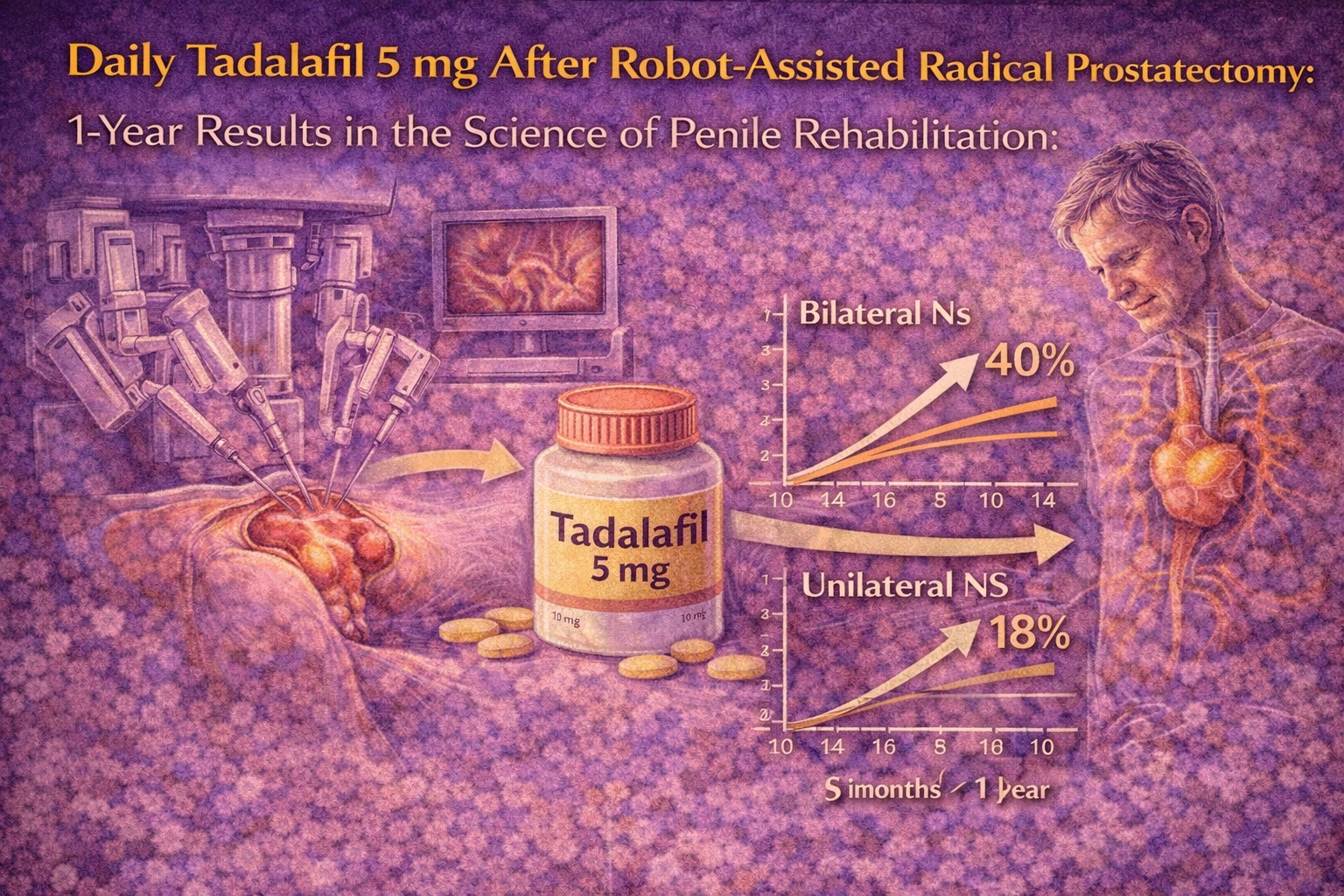
- Bilateral NS: 40% potency recovery at one year
- Unilateral NS: 18% potency recovery
Among non-tadalafil patients:
- Bilateral NS: 11%
- Unilateral NS: 6%
Table 3 (page 5) demonstrates significantly higher IIEF-5 domain scores in bilateral NS patients receiving tadalafil .
This finding reinforces a central biological principle: PDE5 inhibitors amplify nitric oxide–cGMP signaling, but they cannot generate it in the absence of neural input. If neural integrity is severely compromised, the pharmacologic substrate is limited.
In simpler terms: tadalafil works best when there are still nerves to work with.
The Biology of Post-Prostatectomy Erectile Dysfunction
Understanding the mechanism clarifies the rationale for daily therapy.
After prostatectomy, even when nerve-sparing techniques are used, temporary neural dysfunction reduces nitric oxide release. This leads to decreased cGMP production, impaired smooth muscle relaxation, and diminished nocturnal erections.
The absence of spontaneous erections has consequences. Cavernosal tissue becomes hypoxic. Hypoxia promotes smooth muscle apoptosis and collagen deposition. Fibrosis begins quietly but relentlessly.
PDE5 inhibitors prevent degradation of cGMP. When administered early and continuously, they may:
- Maintain corporal oxygenation
- Reduce hypoxia-induced fibrosis
- Preserve smooth muscle architecture
- Facilitate long-term erectile recovery
This is the principle of penile rehabilitation—not merely symptom control, but structural preservation.
The longer half-life of tadalafil (approximately 17.5 hours) offers a theoretical advantage over shorter-acting agents such as sildenafil or vardenafil . Continuous PDE5 inhibition ensures sustained enhancement of cGMP signaling.
In practice, this may translate to better tissue protection.
Safety Profile: Reassuringly Predictable
Daily tadalafil 5 mg was well tolerated.
Reported adverse events over one year included:
- Flushing (8.5%)
- Headache (4.3%)
- Dizziness (2.1%)
All were mild or moderate and transient .
The dropout rate was 8%, with discontinuation attributed to medication cost or perceived lack of efficacy—not safety concerns.
Importantly, no serious adverse events were reported.
In an elderly population (mean age approximately 68 years), tolerability is a critical parameter. The safety findings align with broader tadalafil literature.
Interpreting the Modest Potency Rate
A 32% overall recovery rate at one year may appear modest compared to some earlier studies. However, context matters.
The study employed a stringent responder definition requiring functional intercourse capability. Some prior reports classified “positive response” more loosely, sometimes based on subjective improvement without confirmed penetrative function.
Additionally, patient age was relatively high. Age negatively influences erectile recovery due to vascular and endothelial factors.
Finally, the cohort included both bilateral and unilateral NS procedures, which inherently affect recovery probability.
When examined under rigorous criteria, a 40% recovery rate in bilateral NS patients receiving tadalafil represents meaningful clinical benefit.
Early Initiation: Timing as a Therapeutic Variable
In this study, tadalafil therapy began 2–3 weeks after surgery—immediately following Foley catheter removal .
Early initiation is not arbitrary. The window of hypoxia-induced structural remodeling begins soon after nerve injury. Delayed intervention risks allowing irreversible fibrosis to progress.
Experimental literature suggests that early PDE5 inhibition mitigates cavernosal hypoxia. Clinically, this translates into better preservation of erectile potential.
Timing, therefore, is not merely logistical—it is pathophysiological.
Daily Versus On-Demand: The Psychological Dimension
Beyond pharmacokinetics, daily dosing offers psychological advantages.
On-demand therapy requires anticipation and planning. This may:
- Reinforce performance anxiety
- Emphasize dysfunction
- Reduce spontaneity
Daily dosing, in contrast, integrates therapy into routine. Sexual activity becomes less medication-centric.
Patient preference studies outside this cohort have shown high satisfaction with daily regimens. Sexual rehabilitation is as much psychological as physiological.
In many men, reducing the cognitive burden improves adherence and confidence.
Study Limitations: Intellectual Honesty Matters
This investigation was retrospective and non-randomized . Absence of placebo control introduces potential bias.
The sample size was moderate (n=92), limiting subgroup statistical power.
Baseline Gleason scores were slightly higher in the tadalafil group, though clinically minor.
Furthermore, spontaneous recovery after NS RALP can continue beyond one year. Longer follow-up would clarify sustained benefit.
Despite these limitations, the internal consistency of IIEF-5 improvements across all five domains strengthens credibility.
Clinical Implications: Who Should Receive Daily Tadalafil?
Based on the evidence, ideal candidates include:
- Patients undergoing bilateral nerve-sparing RALP
- Men with good preoperative erectile function
- Patients motivated for sexual rehabilitation
- Individuals able to initiate therapy early postoperatively
Unilateral NS patients may derive benefit, though recovery rates are lower.
Non-nerve-sparing patients should be counseled that PDE5 inhibitors are less likely to restore spontaneous erectile function.
Therapy should be individualized, but daily tadalafil deserves consideration as first-line rehabilitation in appropriately selected patients.
The Broader Rehabilitation Strategy
Penile rehabilitation should not rely solely on pharmacotherapy.
Comprehensive management includes:
- Early PDE5 inhibition
- Cardiovascular risk optimization
- Glycemic control
- Pelvic floor training
- Psychological support
Erectile recovery is a multidisciplinary outcome.
In modern urology, cancer control and quality of life are equally essential endpoints.
Conclusion
The one-year follow-up data from Dong-A University demonstrate that tadalafil 5 mg once daily significantly improves erectile function recovery after nerve-sparing robot-assisted radical prostatectomy.
At one year:
- 32% overall potency recovery in tadalafil users
- 40% recovery in bilateral NS patients
- Significant improvement across all IIEF-5 domains
- Mild, manageable adverse events
The magnitude of benefit is strongly influenced by nerve preservation status.
Daily tadalafil represents not merely symptomatic treatment but a strategic component of penile rehabilitation.
The message is clear: early, sustained PDE5 inhibition can meaningfully alter the trajectory of postoperative erectile recovery—particularly when neurovascular integrity is preserved.
FAQ
1. When should tadalafil be started after RALP?
In this study, therapy began 2–3 weeks after surgery, immediately following Foley catheter removal . Early initiation may help prevent cavernosal hypoxia and fibrosis.
2. Is daily tadalafil more effective than on-demand dosing?
This study evaluated daily dosing only. However, continuous PDE5 inhibition theoretically supports tissue preservation and may offer psychological advantages.
3. Does nerve-sparing status matter?
Yes. Bilateral nerve-sparing patients achieved a 40% recovery rate with daily tadalafil compared to 18% in unilateral NS patients . Neural integrity significantly influences drug efficacy.
