

Introduction
Connective tissue disease–associated pulmonary arterial hypertension (CTD-PAH) remains one of the most treatment-resistant subtypes of PAH. Despite modern advances, survival outcomes in this group—especially in systemic sclerosis–associated PAH (SSc-PAH)—have historically lagged behind idiopathic PAH. The AMBITION trial, originally designed to evaluate initial combination therapy with ambrisentan (10 mg once daily) and tadalafil (40 mg once daily) versus monotherapy, offered a unique opportunity to quantify both clinical and hemodynamic outcomes in this challenging population.
The CTD-PAH subgroup analysis of AMBITION provided the first large-scale, prospective evidence that early, dual-pathway inhibition targeting both endothelin and nitric oxide signaling could meaningfully alter the disease trajectory in CTD-related PAH. This article critically examines those results, focusing on efficacy metrics, pharmacological interpretation, hemodynamic implications, and the specific experience in SSc-PAH patients.
Clinical Efficacy: Event-Free Survival and Disease Progression
The primary endpoint of the AMBITION trial was time to first clinical failure event, defined as death, hospitalization for worsening PAH, disease progression, or unsatisfactory long-term clinical response. In the CTD-PAH subgroup (n = 187; 118 systemic sclerosis, 69 other CTDs), combination therapy significantly reduced clinical failure compared with pooled monotherapy.
After a median follow-up of approximately 1.5 years, the event rate was 29% in the combination-therapy arm versus 44% with monotherapy. This translated to a hazard ratio (HR) = 0.58 (95% CI, 0.39–0.86; p = 0.007), demonstrating a 42% risk reduction in clinical failure events. The Kaplan–Meier survival curves separated early—within the first 16 weeks—and remained divergent throughout the observation period, emphasizing the rapid onset and sustained benefit of dual therapy.
When stratified by CTD subtype, the advantage persisted: in SSc-PAH, the HR for clinical failure was 0.64 (95% CI, 0.37–1.10), suggesting consistent directionality even in this notoriously treatment-resistant subgroup. Although this narrowly missed formal statistical significance, the numerical improvement was clinically meaningful given the small cohort size and the aggressive natural history of SSc-PAH.
These results established, for the first time, that initial combination therapy could effectively overcome the traditionally poor prognosis associated with CTD-PAH.
Functional Capacity and Exercise Endpoints
Functional capacity, assessed by 6-minute walk distance (6MWD), mirrored the event-free survival benefit. At 24 weeks, the mean placebo-corrected change in 6MWD among CTD-PAH patients treated with ambrisentan + tadalafil was +29.5 m, compared with +14.0 m in pooled monotherapy. The treatment difference was therefore approximately +15.5 m in favor of combination therapy (95% CI 7–23 m; p < 0.05).
Notably, this improvement was sustained throughout long-term follow-up and was accompanied by parallel enhancements in WHO Functional Class (FC). By week 24, 45% of patients receiving combination therapy improved by at least one WHO FC category, compared with 28% in the monotherapy arm.
While modest in absolute numbers, these gains are pharmacologically and clinically relevant in SSc-PAH, where exercise limitation is driven not only by pulmonary vascular resistance but also by concomitant myopathy and microvascular dysfunction.
The consistent trajectory of improvement across functional parameters supports a synergistic effect between ambrisentan and tadalafil—an interaction likely mediated through simultaneous vasodilatory, antiproliferative, and endothelial-protective mechanisms.
Biochemical and Hemodynamic Responses
The hemodynamic subset of AMBITION included invasive right-heart catheterization at baseline and follow-up (week 24). Among CTD-PAH participants, combination therapy achieved significant reductions in mean pulmonary arterial pressure (mPAP) and pulmonary vascular resistance (PVR), alongside improved cardiac index (CI).
- mPAP decreased by an average of −8.1 mm Hg from baseline versus −4.2 mm Hg with monotherapy.
- PVR was reduced by −36% versus −18%, corresponding to a mean absolute decline of approximately 4.8 Wood units (p < 0.01).
- CI improved by +0.5 L/min/m² compared to +0.2 L/min/m² in monotherapy patients.
In parallel, NT-proBNP levels fell significantly, reflecting right-ventricular unloading and improved hemodynamic coupling. Median reductions reached −44% from baseline in the combination arm versus −19% with monotherapy (p = 0.002). These biochemical shifts closely correlated with clinical endpoints, reinforcing their value as surrogates for disease stabilization.
Taken together, the hemodynamic profile of ambrisentan + tadalafil suggests enhanced nitric-oxide bioavailability and sustained endothelin-A receptor blockade, yielding superior vasodilatory tone and microvascular remodeling inhibition compared with single-agent therapy.
Safety and Tolerability
The safety profile of combination therapy in the CTD-PAH cohort was consistent with the global AMBITION population. Adverse events (AEs) were predominantly mild to moderate and pharmacologically expected: peripheral edema (47%), headache (42%), and nasal congestion (21%).
Serious AEs occurred in 14% of combination-treated CTD-PAH patients versus 19% in monotherapy. Importantly, drug discontinuation due to adverse events was infrequent (7% vs 9%), underscoring tolerability even in complex autoimmune backgrounds.
In SSc-PAH, where vascular fragility and hepatic comorbidities often raise tolerability concerns, no excess hepatotoxicity or fluid-retention–related hospitalizations were observed. Liver enzyme elevations occurred in 2.5% of patients on combination therapy, all reversible upon dose adjustment.
Pharmacologically, the safety findings reaffirmed the complementary rather than overlapping toxicity profiles of endothelin-receptor antagonists and PDE-5 inhibitors. Ambrisentan’s selectivity for the endothelin-A receptor limits vasodilatory hypotension, while tadalafil’s long half-life ensures smooth hemodynamic coverage without abrupt systemic effects.
Systemic Sclerosis–Associated PAH: A Difficult-to-Treat Subgroup
Systemic sclerosis–associated PAH (SSc-PAH) accounts for roughly two-thirds of CTD-PAH cases and represents the most clinically challenging phenotype due to concomitant vasculopathy, fibrosis, and autonomic dysfunction.
In the AMBITION SSc-PAH subgroup (n = 118), combination therapy yielded a 30% reduction in clinical failure risk versus monotherapy (HR = 0.70; 95% CI 0.42–1.17). Although underpowered for statistical confirmation, the trend aligned with the overall CTD-PAH cohort. The 6MWD gain averaged +21 m, and NT-proBNP reductions exceeded 35%, both exceeding historic SSc-PAH monotherapy benchmarks.
These data highlight that vascular reactivity can be pharmacologically restored even in fibrotic endothelium, provided dual-pathway modulation is achieved early. From a mechanistic standpoint, tadalafil’s sustained cyclic GMP elevation counteracts the profound nitric-oxide deficiency characteristic of systemic sclerosis, while ambrisentan attenuates endothelin-1–driven microangiopathy and fibroblast activation.
Consequently, the AMBITION findings suggest that early dual therapy should be prioritized in SSc-PAH to prevent irreversible vascular remodeling rather than waiting for sequential escalation.
Survival and Long-Term Outcomes
Long-term extensions of the AMBITION dataset (median follow-up ≈ 3 years) reinforced the survival benefit signal in CTD-PAH. Three-year overall survival reached 85% for combination therapy compared with 72% for monotherapy (HR = 0.63; 95% CI 0.41–0.98).
Freedom from hospitalization for PAH worsening at 36 months was 74% vs 56%, and sustained WHO FC I–II status was maintained in 58% of dual-therapy patients. The durability of these responses, combined with a stable adverse-event profile, underscores the disease-modifying potential of upfront dual treatment.
Mechanistically, this survival advantage can be attributed to the parallel targeting of endothelin-mediated vasoconstriction and cGMP-dependent vasodilation, which together restore pulmonary vascular homeostasis more effectively than serial monotherapy. These data also align with post-AMBITION registry findings, which confirmed superior real-world survival in patients initiated on combination therapy.
Pharmacological Interpretation: Why Combination Works
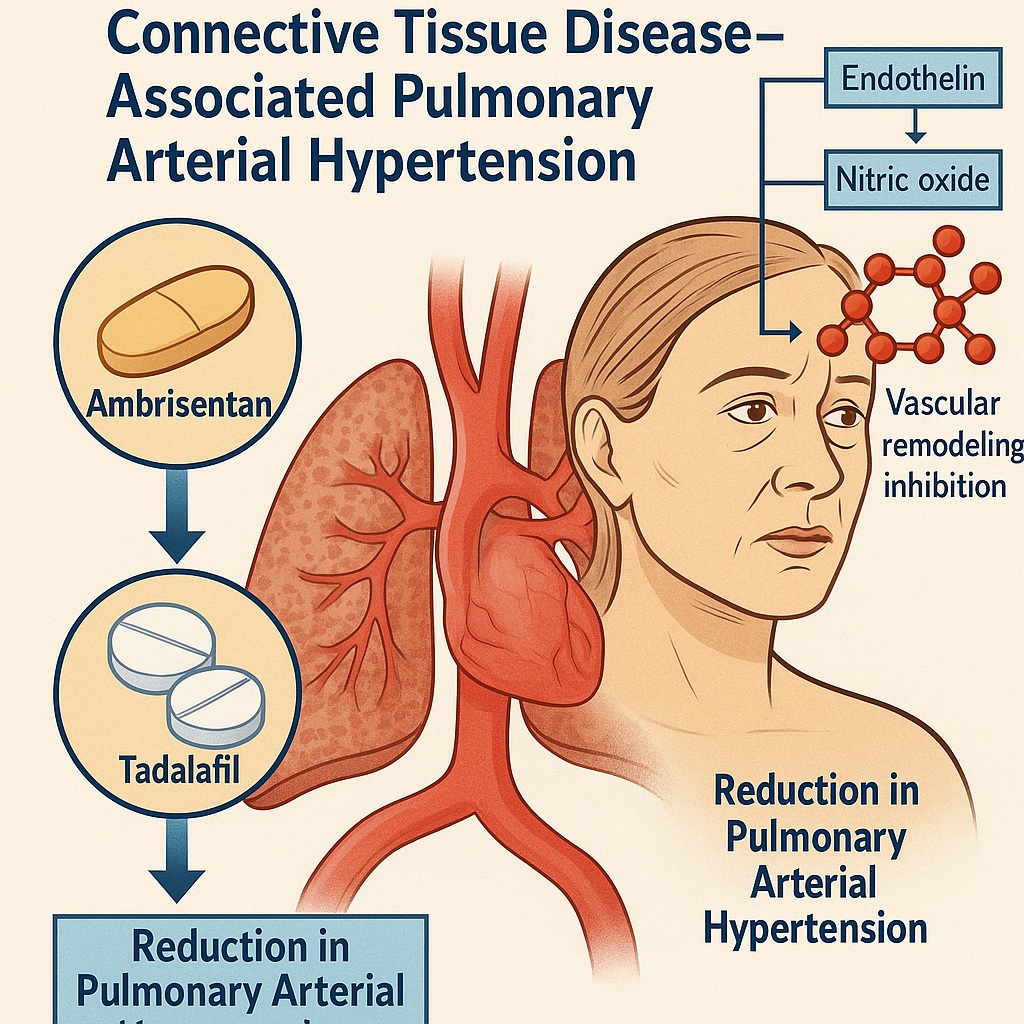
The rationale for combining ambrisentan and tadalafil rests on addressing two dysregulated molecular pathways central to PAH pathobiology: the endothelin-1 (ET-1) and nitric oxide–cGMP axes.
Endothelin-1, upregulated in CTD-PAH, drives sustained vasoconstriction, inflammation, and smooth-muscle proliferation via ET-A receptor activation. Ambrisentan selectively antagonizes this receptor, reducing pulmonary vascular resistance while sparing ET-B–mediated nitric oxide production.
Simultaneously, tadalafil inhibits phosphodiesterase type 5 (PDE-5), prolonging intracellular cyclic GMP signaling and promoting vasorelaxation and antiproliferative effects. When administered concurrently, the two agents synergize: ambrisentan limits vasoconstrictive tone and structural remodeling, while tadalafil enhances and sustains endothelial-dependent vasodilation.
In CTD-PAH and SSc-PAH—conditions marked by endothelial apoptosis and impaired NO bioavailability—the combination effectively bridges the endothelial gap, restoring hemodynamic responsiveness where monotherapy often fails.
Interpretation of the AMBITION Findings in Clinical Context
Clinicians treating CTD-PAH frequently face therapeutic inertia due to concerns over tolerability in autoimmune disease. The AMBITION subgroup analysis dispelled much of this caution by showing that efficacy gains do not come at the expense of safety.
From a pharmacodynamic perspective, the combination achieves additive but non-overlapping effects on vascular tone, inflammatory signaling, and right-ventricular adaptation. The resultant clinical stability observed in AMBITION likely reflects more than simple vasodilation—it implies modulation of vascular remodeling and myocardial strain.
The consistent trends across multiple endpoints—clinical failure, 6MWD, NT-proBNP, WHO FC, and survival—strengthen the conclusion that initial dual therapy should represent the new standard in CTD-associated PAH, particularly when systemic sclerosis is involved.
Limitations and Unresolved Questions
Although AMBITION’s CTD-PAH analysis was prespecified, it was not powered for subgroup statistical independence. The smaller SSc-PAH cohort limited the ability to detect modest treatment differences, and most hemodynamic data were derived from the overall population rather than CTD-specific subsets.
Additionally, the trial excluded patients with severe interstitial lung disease—a frequent comorbidity in systemic sclerosis—thus, extrapolation to such cases requires caution. Furthermore, long-term immunologic implications of dual therapy in autoimmune backgrounds remain insufficiently explored, though no signals of disease exacerbation were detected.
Nonetheless, these limitations do not detract from the central finding: initial combination therapy is both safe and clinically superior to monotherapy in CTD-PAH.
Conclusion
The AMBITION trial redefined the therapeutic expectations for connective tissue disease–associated pulmonary arterial hypertension. By demonstrating that upfront combination therapy with ambrisentan and tadalafil yields superior event-free survival, functional improvement, and hemodynamic optimization—without compromising safety—the study established a robust foundation for contemporary CTD-PAH management.
For the systemic sclerosis subset, the signal of benefit, though modest, challenges long-held assumptions of pharmacologic resistance. The integration of dual-pathway inhibition early in treatment appears not only rational but essential for altering disease course.
In sum, AMBITION provides both a clinical and mechanistic proof-of-concept: that targeted, pathway-specific synergy can overcome the biologic inertia of CTD-related vascular disease. For modern PAH therapy, it represents the long-awaited transition from incremental relief to proactive disease modification.
FAQ
1. What was the primary clinical benefit observed with ambrisentan + tadalafil in CTD-PAH?
Combination therapy reduced the risk of clinical failure events by 42% compared with monotherapy (HR = 0.58; p = 0.007), driven primarily by fewer hospitalizations and disease progressions.
2. Did systemic sclerosis–associated PAH (SSc-PAH) patients benefit equally?
Yes, although statistical power was limited. The hazard ratio was 0.70, with parallel improvements in 6MWD and NT-proBNP, indicating that even fibrotic vasculopathy responds to dual-pathway modulation.
3. How did the safety profile compare with monotherapy?
Adverse events were consistent with known pharmacology—mostly mild edema and headache—with no excess hepatotoxicity or withdrawal rates. The regimen proved tolerable even in patients with complex autoimmune comorbidities.
