

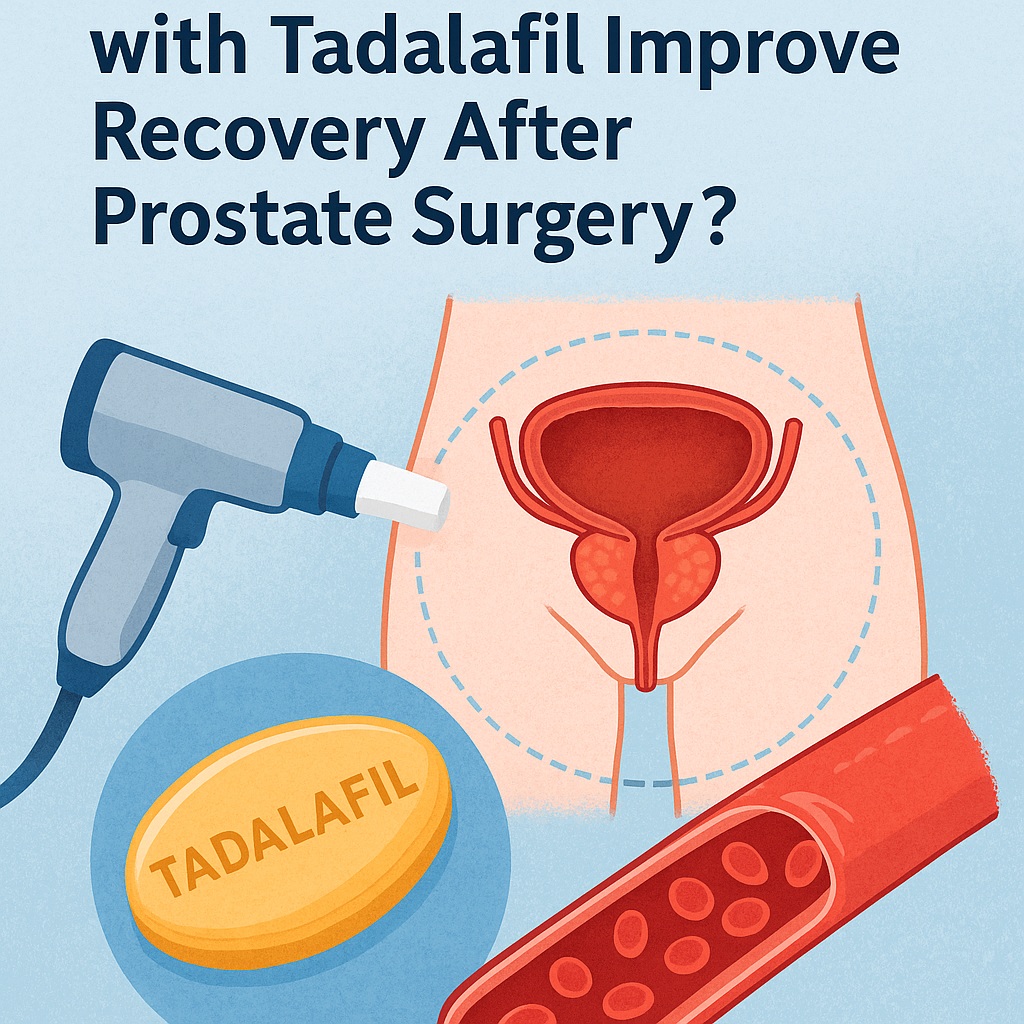
Erectile dysfunction (ED) after radical prostatectomy remains one of the most distressing postoperative complications for men, affecting both quality of life and psychological well-being. Despite major advances in robotic-assisted prostatectomy techniques, the preservation of erectile function is far from guaranteed. Even in nerve-sparing procedures, the transient or lasting damage to cavernous nerves and penile microvasculature often leads to significant impairment in penile hemodynamics.
In 2022, a prospective randomized clinical trial published in Prostate Cancer and Prostatic Diseases explored a novel approach to expedite erectile recovery after surgery: early low-intensity shock wave therapy (LI-SWT) in combination with tadalafil 5 mg daily. The results, both statistically significant and clinically meaningful, suggest a potential paradigm shift in post-prostatectomy rehabilitation.
Understanding Post-Prostatectomy Erectile Dysfunction
Radical prostatectomy—particularly the robot-assisted type—remains a cornerstone of curative treatment for localized prostate cancer. Despite refined surgical precision, neurovascular bundle manipulation, ischemic stress, and microstructural fibrosis of the penile tissue contribute to prolonged erectile dysfunction.
The physiological cascade involves temporary or permanent neuropraxia, leading to reduced nitric oxide (NO) signaling in the corpus cavernosum. The subsequent hypoxia-induced fibrosis diminishes smooth muscle content and impairs endothelial responsiveness. This pathophysiology explains why spontaneous recovery of erectile function can take months or even years after surgery, if it occurs at all.
The cornerstone of current penile rehabilitation has been the use of phosphodiesterase type 5 inhibitors (PDE5Is) such as tadalafil. However, even daily administration is often insufficient to overcome the structural and neurogenic deficits caused by surgery. This clinical gap led to the exploration of adjunctive physical modalities like low-intensity shock wave therapy, which may trigger angiogenic and neurotrophic regeneration.
The Rationale for Combining LI-SWT and Tadalafil
Tadalafil, a long-acting PDE5 inhibitor, functions by maintaining elevated levels of cyclic guanosine monophosphate (cGMP) within penile smooth muscle cells, facilitating vasodilation and erection in response to sexual stimulation. However, its efficacy depends on intact or partially functional neural signaling and endothelial integrity—both of which are compromised after radical prostatectomy.
LI-SWT, in contrast, delivers acoustic microtrauma to penile tissue that stimulates the expression of vascular endothelial growth factor (VEGF), endothelial nitric oxide synthase (eNOS), and various angiogenic mediators. These biological effects have been demonstrated in animal models to enhance neovascularization and nerve regeneration.
Thus, the combination of daily tadalafil (to sustain cGMP activity) and LI-SWT (to restore vascular and neural integrity) offers a synergistic mechanism: one biochemical, the other regenerative. This approach aims not only to facilitate temporary erections but to restore the physiological substrate of erectile function.
Design of the 2022 Study
The randomized, open-label study enrolled 80 men with localized prostate cancer undergoing robot-assisted radical prostatectomy (RARP) with bilateral nerve-sparing technique. Participants were randomized into two groups:
- Group A (Combination therapy): Tadalafil 5 mg daily plus early LI-SWT.
- Group B (Control): Tadalafil 5 mg daily alone.
LI-SWT was initiated within one week postoperatively, using a protocol of five weekly sessions. Each session applied 300 shocks per site across five penile sites (total of 1,500 shocks per session) at an energy flux density of 0.09 mJ/mm² and a frequency of 120 shocks/min.
The study’s primary endpoint was the recovery of erectile function, defined as an IIEF-5 score ≥17 at 6 and 12 months postoperatively. Secondary endpoints included Erection Hardness Score (EHS) improvement, penile hemodynamic assessment via Doppler, and safety outcomes.
Clinical Outcomes: Quantitative Results
Erectile Function Recovery
At 6 months, the combination group demonstrated markedly higher erectile recovery:
- Mean IIEF-5 score:
- Group A (LI-SWT + tadalafil): 14.1 ± 4.6
- Group B (tadalafil only): 9.3 ± 3.8
- p = 0.003
At 12 months, the difference became even more pronounced:
- Mean IIEF-5 score:
- Group A: 17.8 ± 5.1
- Group B: 12.7 ± 4.9
- p < 0.001
Moreover, recovery to baseline preoperative erectile function (IIEF-5 ≥17) was achieved by:
- 51.5% of patients in the combination group
- 27.6% of patients in the control group
- Relative risk = 1.86; 95% CI, 1.02–3.42
Erection Hardness Score (EHS)
The proportion of men achieving EHS ≥3 at 12 months was:
- 63% in the combination group
- 36% in the control group
- p = 0.01
These data suggest not only statistical significance but clinical relevance—nearly twofold improvement in achieving functional erections capable of penetration.
Hemodynamic and Structural Benefits
Penile duplex Doppler ultrasonography revealed that patients receiving LI-SWT exhibited a significant increase in peak systolic velocity (PSV) at 12 months compared to baseline (27.2 ± 6.4 cm/s vs. 21.3 ± 5.9 cm/s, p < 0.01). The control group demonstrated a modest, nonsignificant improvement.
This vascular enhancement aligns with the biological rationale of LI-SWT-induced neovascularization. Furthermore, penile rigidity and nocturnal tumescence were qualitatively superior in the combination group, indicating improved tissue responsiveness to both neural and vascular stimuli.
No structural penile fibrosis or plaque formation was observed during follow-up, supporting the safety and tolerability of early LI-SWT initiation post-surgery.
Safety Profile and Tolerability
Throughout the two-year follow-up, no serious adverse events were reported. Mild transient erythema or penile discomfort occurred in less than 10% of patients, resolving spontaneously. No treatment discontinuation was required due to side effects.
Serum testosterone levels, hemodynamic parameters, and voiding function remained stable across both groups. Importantly, there was no evidence of increased urinary incontinence, a potential concern when introducing rehabilitative interventions soon after prostatectomy.
The study’s adherence rate exceeded 95%, reflecting strong patient acceptability—likely owing to the noninvasive, painless nature of shock wave therapy and the convenience of once-daily tadalafil dosing.
Mechanistic Insights: Why the Combination Works
The dual-modality approach targets both vascular and neurological recovery pathways.
Tadalafil maintains elevated cGMP by inhibiting PDE5, thereby promoting vasodilation, endothelial function, and smooth muscle preservation. Continuous administration mitigates corporal hypoxia and fibrosis, which are critical determinants of long-term erectile tissue viability.
Simultaneously, LI-SWT induces controlled microtrauma that stimulates a cascade of molecular responses:
- Upregulation of VEGF and FGF (fibroblast growth factor)
- Enhanced recruitment of endothelial progenitor cells
- Activation of Schwann cell-mediated nerve repair
This regenerative signaling may accelerate the restoration of the cavernous nerve-endothelium axis, which is typically slow to recover after RARP.
The synergy arises because tadalafil optimizes the hemodynamic environment necessary for angiogenesis, while LI-SWT provides the biological trigger. Together, they transform the penile microenvironment from hypoxic and fibrotic to one of regenerative homeostasis.
Comparison with Previous Research
Earlier studies of LI-SWT in vasculogenic ED—independent of prostatectomy—reported improvements in IIEF scores ranging from +4 to +7 points. However, these gains typically plateaued after 12 weeks.
By contrast, the 2022 RARP cohort demonstrated sustained improvement through 12 months, suggesting that early initiation post-surgery may extend and amplify the regenerative benefits of LI-SWT.
Furthermore, prior trials assessing PDE5Is alone after prostatectomy yielded modest outcomes, with full recovery rates rarely exceeding 30% at one year. The 51.5% recovery rate observed here underlines the potential clinical advantage of combination therapy.
Clinical Implications and Future Perspectives
The findings have significant implications for the standard of postoperative care in prostate cancer survivors. Traditionally, rehabilitation begins several weeks after surgery, once continence stabilizes. This study challenges that paradigm, demonstrating that early, noninvasive intervention can accelerate recovery without jeopardizing surgical outcomes.
From a practical perspective, LI-SWT is office-based, time-efficient, and does not interfere with concurrent treatments. When coupled with tadalafil’s favorable safety profile, the regimen represents an accessible and patient-friendly option for early rehabilitation.
However, the study’s authors caution that larger multicenter trials are warranted to validate the findings, optimize the treatment schedule, and identify patient subgroups most likely to benefit—particularly those with partial nerve sparing or vascular comorbidities.
Limitations and Considerations
While the results are promising, several methodological constraints must be acknowledged. The study’s sample size (80 patients) limits its statistical power for subgroup analysis. The open-label design may introduce expectation bias, although the objective hemodynamic measurements mitigate this risk.
Moreover, long-term outcomes beyond 12 months remain to be defined. While the trajectory suggests continued improvement, the durability of vascular and neural regeneration warrants further observation.
Lastly, the absence of a sham LI-SWT control group prevents definitive attribution of all effects to the therapy itself. Nonetheless, the magnitude and consistency of improvement support a genuine physiological benefit rather than a placebo response.
Integrating the Findings into Clinical Practice
For clinicians, the take-home message is pragmatic: initiating penile rehabilitation within the first postoperative week—combining tadalafil and LI-SWT—can significantly improve the likelihood and speed of erectile recovery.
This approach demands interdisciplinary coordination between urologic surgeons, rehabilitation specialists, and sexual medicine practitioners. Patient education remains crucial, as adherence to daily medication and scheduled therapy sessions directly influences outcomes.
In addition, objective monitoring (IIEF, EHS, and penile Doppler) should guide therapy continuation or escalation. The data support a minimum of 5 LI-SWT sessions for meaningful results, with potential benefit from maintenance therapy at 3 and 6 months.
Conclusion
The 2022 study by Chung et al. provides compelling clinical evidence that early low-intensity shock wave therapy combined with daily tadalafil significantly enhances erectile function recovery after robot-assisted radical prostatectomy.
By addressing both vascular and neural mechanisms of injury, this combination offers a synergistic and safe pathway toward functional rehabilitation. With mean IIEF-5 improvements of nearly +8 points and doubled rates of recovery, the therapy represents more than incremental progress—it signals a new standard in postoperative care.
While further validation is required, the biological plausibility, reproducible efficacy, and patient acceptability make this strategy a promising frontier in the management of post-prostatectomy erectile dysfunction.
FAQ: Key Clinical Questions
1. When should shock wave therapy be initiated after prostatectomy?
The study demonstrated optimal results when LI-SWT began within one week postoperatively. Early initiation appears critical for preventing hypoxia-induced fibrosis and promoting early vascular regeneration.
2. How long should tadalafil therapy be continued in this context?
Continuous daily administration for at least 6–12 months is recommended. Sustained PDE5 inhibition preserves penile oxygenation and complements the regenerative effects of LI-SWT.
3. Is this combination safe for all post-prostatectomy patients?
Yes, provided the patient has stable urinary continence and no contraindications to PDE5 inhibitors. LI-SWT is painless, noninvasive, and demonstrated no adverse impact on continence, hemodynamics, or surgical recovery.
Reference: Chung E. et al. “Can early low-intensity shock wave therapy combined with tadalafil improve erectile recovery after robot-assisted radical prostatectomy?” Prostate Cancer and Prostatic Diseases. 2022;25:1–9. DOI: 10.1007/s41443-022-00560-3
