

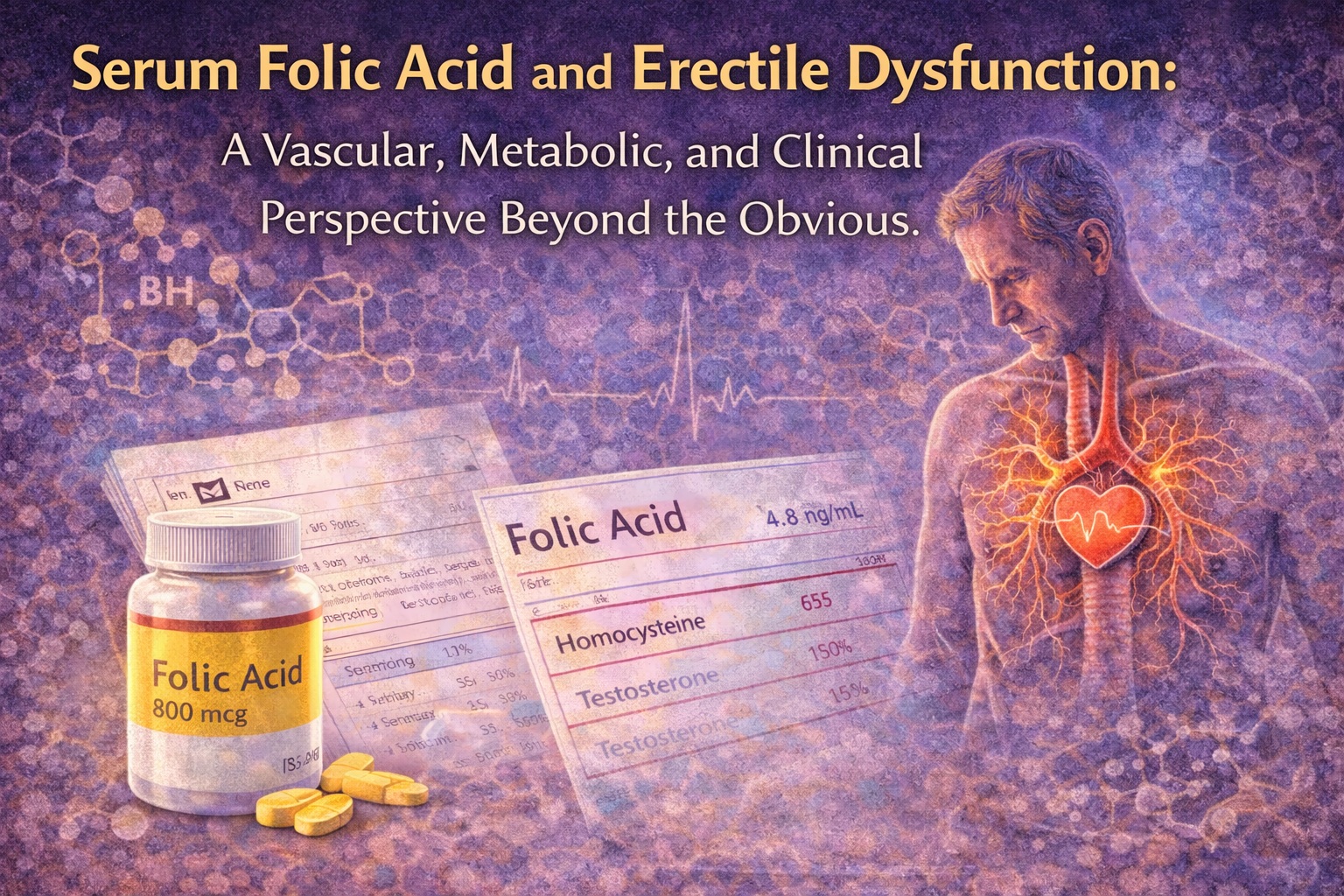
Introduction: Erectile Dysfunction as a Metabolic Signal, Not a Local Problem
Erectile dysfunction (ED) is often misinterpreted as an isolated disorder of sexual performance. In reality, it represents one of the most sensitive clinical indicators of systemic vascular health. The penile circulation, characterized by small-caliber arteries and a high dependence on endothelial function, is frequently the first vascular territory to reveal metabolic and endothelial disturbances that may later manifest as overt cardiovascular disease.
Over the past two decades, research has firmly established endothelial dysfunction as a central mechanism linking erectile dysfunction with diabetes mellitus, hypertension, dyslipidemia, metabolic syndrome, and smoking. Nitric oxide (NO) deficiency, impaired vasodilation, and reduced bioavailability of endothelial cofactors collectively disrupt the delicate hemodynamic balance required for normal erection.
Within this framework, folic acid has traditionally been viewed as a nutritional factor of interest mainly in hematology and obstetrics. However, growing evidence suggests that serum folic acid levels may play a clinically relevant role in vascular health, endothelial integrity, and, consequently, erectile function. The question is no longer whether folic acid is biologically relevant, but whether it represents an independent and clinically actionable factor in the pathophysiology of erectile dysfunction.
Folic Acid: More Than a Vitamin, Less Than a Drug
Folic acid is an essential water-soluble B vitamin involved in one-carbon metabolism, DNA synthesis, and methylation reactions. Its deficiency has long been associated with megaloblastic anemia and neural tube defects. Yet, its vascular implications extend far beyond classical deficiency syndromes.
At the endothelial level, folic acid participates in nitric oxide metabolism through multiple mechanisms. It contributes to the regeneration and stabilization of tetrahydrobiopterin (BH₄), a critical cofactor for endothelial nitric oxide synthase (eNOS). Adequate BH₄ availability ensures proper coupling of eNOS, allowing efficient NO production rather than the generation of reactive oxygen species.
When folic acid levels are insufficient, eNOS becomes uncoupled. Instead of producing nitric oxide, the enzyme generates superoxide, amplifying oxidative stress and further impairing endothelial function. This mechanism places folic acid at a strategic intersection between oxidative balance and vascular tone regulation.
Importantly, these processes occur independently of homocysteine levels, challenging the oversimplified view that folic acid acts solely by lowering homocysteine. While hyperhomocysteinemia is a recognized vascular risk factor, folic acid appears to exert direct endothelial effects that are not fully explained by homocysteine metabolism alone.
Endothelial Dysfunction as the Common Denominator in Erectile Dysfunction
Erectile function is fundamentally a vascular event. Sexual stimulation initiates a cascade of neural signals leading to endothelial release of nitric oxide within the corpora cavernosa. NO activates guanylate cyclase, increases cyclic guanosine monophosphate (cGMP), and induces smooth muscle relaxation, allowing rapid arterial inflow and veno-occlusive trapping of blood.
Endothelial dysfunction disrupts this sequence at its earliest stage. Reduced NO availability, increased oxidative stress, and impaired vasodilatory responsiveness translate into insufficient arterial inflow and incomplete erection. Notably, this dysfunction often precedes structural vascular disease, making ED a potential early warning sign of systemic pathology.
The meta-analytic data reviewed demonstrate a consistent association between lower serum folic acid levels and erectile dysfunction. More importantly, folic acid levels decline progressively with increasing severity of ED. This dose–response relationship strongly suggests a pathophysiological link rather than a coincidental association.
From a clinical standpoint, this reinforces the concept of ED as a continuum of vascular impairment rather than a binary condition. Mild ED may reflect early endothelial stress, while severe ED corresponds to more advanced dysfunction—mirrored by progressively lower folic acid concentrations.
Serum Folic Acid Levels and Erectile Dysfunction Severity
One of the most compelling findings across analyzed studies is the graded relationship between folic acid levels and erectile dysfunction severity. Patients with mild ED exhibit folic acid concentrations closer to those of healthy controls, whereas moderate and severe ED are associated with significantly lower levels.
This gradient carries important implications. First, it argues against folic acid deficiency being merely a secondary consequence of chronic illness or lifestyle factors. Instead, it supports the hypothesis that folic acid status may actively influence endothelial performance and erectile capacity.
Second, the absence of a significant difference between healthy individuals and patients with mild ED suggests a threshold effect. Endothelial compensation may initially preserve function despite modest folic acid reduction. Once this compensatory reserve is exhausted, clinical symptoms emerge and worsen.
Third, the consistency of this association across diverse populations and study designs strengthens its external validity. Although individual studies vary in sample size and methodology, the pooled data reveal a remarkably stable signal.
Folic Acid Supplementation and Erectile Function: Promise and Prudence
Beyond observational associations, the therapeutic question naturally arises: can folic acid supplementation improve erectile function?
Limited interventional studies suggest that folic acid administration leads to statistically significant improvements in International Index of Erectile Function (IIEF-5) scores. These improvements are particularly notable in patients with documented endothelial dysfunction and metabolic comorbidities.
However, statistical significance does not automatically translate into clinical relevance. While improvements in erectile scores are measurable, their magnitude often falls short of what is typically achieved with first-line pharmacological therapies such as phosphodiesterase type 5 inhibitors.
This does not diminish the potential value of folic acid. Rather, it redefines its role. Folic acid should not be viewed as a standalone treatment for erectile dysfunction, but as a metabolic and endothelial modulator that may enhance vascular responsiveness and support other therapies.
Synergistic Effects: Folic Acid and Phosphodiesterase-5 Inhibitors
The most intriguing therapeutic data emerge from studies examining folic acid in combination with phosphodiesterase-5 inhibitors, particularly tadalafil. In these settings, patients receiving combined therapy demonstrate greater improvements in erectile function scores compared to those receiving PDE5 inhibitors alone.
This synergy is mechanistically plausible. PDE5 inhibitors act downstream in the NO–cGMP pathway by preventing cGMP degradation. Their efficacy depends on adequate upstream NO availability. By improving endothelial NO production through eNOS coupling and oxidative stress reduction, folic acid may potentiate the pharmacodynamic effect of PDE5 inhibition.
Clinically, this suggests that folic acid supplementation could convert suboptimal responders into responders, particularly in patients with diabetes mellitus or metabolic syndrome, where endothelial dysfunction is pronounced.
Importantly, folic acid supplementation is associated with a favorable safety profile, minimal adverse effects, and low cost—characteristics that make it an attractive adjunct rather than a replacement therapy.
Clinical Implications: Should Serum Folic Acid Be Measured in ED Patients?
Current diagnostic evaluation of erectile dysfunction typically includes assessment of testosterone levels, glycemic control, lipid profile, and cardiovascular risk factors. Serum folic acid is rarely included in routine workups.
The accumulated evidence suggests this omission may deserve reconsideration. Low serum folic acid appears to be an independent risk factor for erectile dysfunction and correlates with disease severity. Identifying deficiency or suboptimal levels could uncover a modifiable contributor to endothelial impairment.
From a practical perspective, measuring serum folic acid is inexpensive, widely available, and minimally invasive. Its inclusion could refine risk stratification and support a more personalized therapeutic strategy.
However, indiscriminate supplementation without documented deficiency is not advisable. The goal is not blanket vitamin therapy, but targeted metabolic optimization based on objective findings.
Limitations of Current Evidence and the Risk of Overinterpretation
Despite compelling associations, caution remains essential. The number of interventional studies evaluating folic acid supplementation in ED is limited, and heterogeneity among studies is significant. Variations in dosage, duration, patient selection, and outcome measures complicate direct comparisons.
Furthermore, most studies rely on questionnaire-based diagnosis of erectile dysfunction rather than objective hemodynamic assessments. While validated and clinically relevant, questionnaires cannot fully capture vascular dynamics.
Another limitation lies in the multifactorial nature of erectile dysfunction. Folic acid deficiency rarely exists in isolation. It often coexists with other nutritional, metabolic, and lifestyle factors that collectively influence endothelial health.
Therefore, folic acid should be viewed as one piece of a complex puzzle rather than a singular causal agent.
A Broader Perspective: Erectile Dysfunction as Preventive Cardiology
Perhaps the most important implication of the folic acid–ED relationship lies outside sexual medicine. Erectile dysfunction is increasingly recognized as an early marker of cardiovascular disease. Identifying and correcting endothelial stressors at this stage may offer preventive benefits beyond sexual function.
Folic acid, by improving endothelial function, may contribute modestly to vascular risk reduction. While it is not a cardiovascular drug, its role as a metabolic cofactor positions it within a broader preventive strategy that includes lifestyle modification, glycemic control, lipid management, and blood pressure optimization.
In this context, addressing folic acid deficiency is not about treating erections—it is about restoring vascular balance at a stage where intervention may have long-term systemic benefits.
Conclusion: A Subtle Factor with Disproportionate Implications
The relationship between serum folic acid and erectile dysfunction highlights the nuanced interplay between nutrition, endothelial biology, and clinical symptoms. Evidence indicates that low folic acid levels are associated with erectile dysfunction severity and may contribute to endothelial dysfunction through mechanisms independent of homocysteine metabolism.
While folic acid supplementation alone is unlikely to replace established therapies, it represents a rational adjunct in selected patients, particularly those with metabolic or vascular comorbidities. Its role is supportive rather than curative, preventive rather than dramatic.
For clinicians, the message is clear: erectile dysfunction deserves metabolic curiosity, not just pharmacological reflex. In that curiosity, folic acid has earned a quiet but legitimate place.
FAQ
Is low folic acid an independent risk factor for erectile dysfunction?
Yes. Current evidence suggests that low serum folic acid is independently associated with erectile dysfunction and correlates with disease severity.
Can folic acid supplementation cure erectile dysfunction?
No. Folic acid alone is unlikely to produce clinically significant improvement comparable to PDE5 inhibitors, but it may enhance endothelial function and support other treatments.
Should folic acid be routinely tested in men with erectile dysfunction?
Routine testing is not yet standard, but measuring serum folic acid may be reasonable in patients with vascular or metabolic risk factors, especially when response to therapy is suboptimal.
