

Introduction
Chronic kidney disease (CKD) has long been recognized as a systemic condition that reaches far beyond impaired renal function. Among its many burdens, sexual dysfunction—especially erectile dysfunction (ED)—remains one of the least discussed yet most devastating complications. In fact, up to 90% of men on chronic hemodialysis report some degree of ED. Unlike hypertension or anemia, this complication is often overlooked in consultations, dismissed as an unfortunate byproduct of illness or aging. Yet, its impact on quality of life, relationships, and psychological well-being cannot be overstated.
The advent of phosphodiesterase type 5 (PDE5) inhibitors revolutionized the treatment of ED. Sildenafil was the pioneer, later joined by vardenafil and tadalafil. While these drugs are widely used in the general population, their role in patients with end-stage renal disease (ESRD) is less clear. Altered pharmacokinetics, comorbid conditions, and concerns about safety have limited robust research in this group. Most existing studies in dialysis patients have centered around sildenafil, leaving a gap in evidence regarding tadalafil.
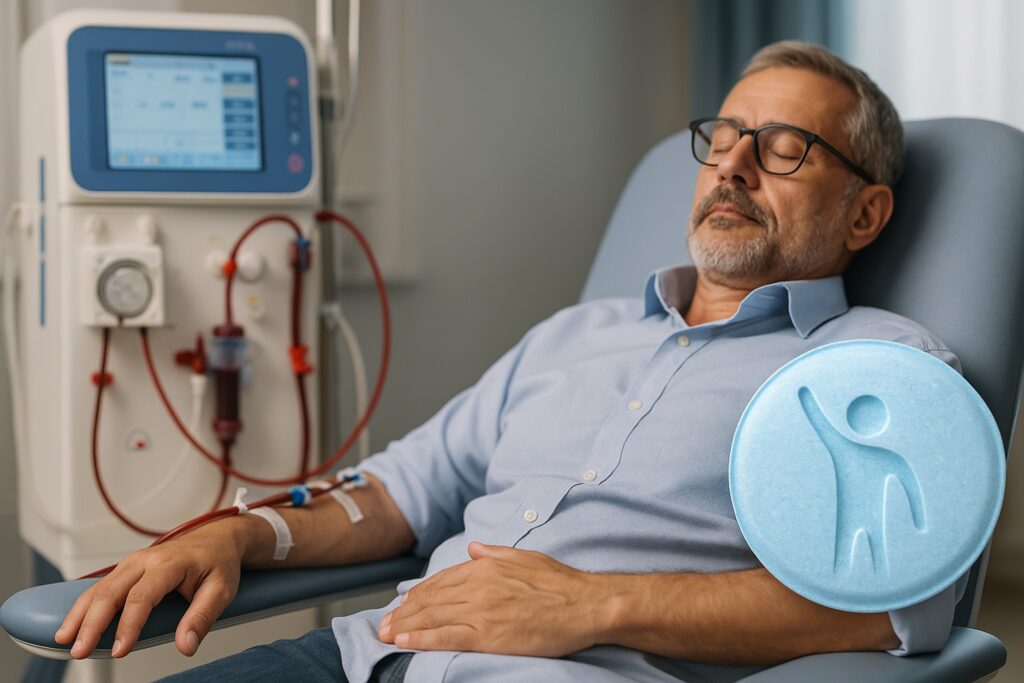
The study at hand bridges this gap. Conducted as a randomized, double-blind, placebo-controlled trial, it evaluated the efficacy and safety of adjusted-dose tadalafil—5 mg every 72 hours—in men undergoing hemodialysis. Its findings shed light on whether this long-acting PDE5 inhibitor can safely restore erectile function in a population often excluded from clinical trials.
Pathophysiology of Erectile Dysfunction in Hemodialysis
Understanding why ED is nearly universal in dialysis patients requires an appreciation of the complex interplay between vascular, hormonal, neurologic, and psychological factors.
First, vascular impairment is central. CKD accelerates atherosclerosis and causes endothelial dysfunction, both of which restrict penile blood flow. Nitric oxide bioavailability is reduced, undermining the fundamental vasodilatory mechanism required for erection.
Second, hormonal disturbances contribute significantly. Many dialysis patients suffer from hypogonadism, with low testosterone levels that blunt libido and erectile capacity. Uremia itself interferes with hypothalamic-pituitary-gonadal signaling.
Third, neurologic factors are relevant. Uremic toxins may impair peripheral nerve conduction, diminishing the sensory inputs necessary for arousal and erection.
Lastly, psychological dimensions must not be neglected. Depression, anxiety, low self-esteem, and relationship strain all accumulate in the life of a dialysis patient. Add to this the fatigue, dietary restrictions, and time-consuming nature of dialysis, and sexual activity often becomes marginalized.
In short, ED in this context is multifactorial. Treating it requires a drug that not only restores penile hemodynamics but is also tolerable in a physiologically fragile population.
Why Tadalafil?
Tadalafil differs from its PDE5 counterparts in several important ways. Its half-life of 17.5 hours is nearly double that of sildenafil, offering a therapeutic window of up to 36 hours. This allows for less rigid timing around sexual activity, providing spontaneity—a precious commodity for men whose lives are already tightly scheduled around dialysis sessions.
Pharmacologically, tadalafil is highly selective for PDE5, minimizing off-target effects. Yet, in patients with impaired renal clearance, drug exposure is significantly increased. For this reason, standard daily dosing is inappropriate in hemodialysis patients. Instead, international guidelines recommend a reduced schedule: 5 mg every 72 hours. This dosing maintains therapeutic efficacy while avoiding excessive plasma accumulation.
Thus, tadalafil offers both a pharmacokinetic advantage and a practical solution: fewer pills, sustained effect, and preserved safety margins.
Study Design and Patient Cohort
The trial enrolled 58 male patients aged 18–60 years, all undergoing maintenance hemodialysis for at least 12 months. Inclusion criteria required the presence of ED, defined by an International Index of Erectile Function (IIEF) score below 26, and a stable sexual partner. Importantly, men with pre-existing ED prior to starting dialysis, prior ED treatments, or significant cardiac comorbidities were excluded.
Participants were randomized into two groups:
- Tadalafil group: 29 patients receiving 5 mg every 72 hours for one month.
- Placebo group: 29 patients receiving an identical-looking placebo on the same schedule.
All patients completed the full IIEF questionnaire, which assesses five domains: erectile function, intercourse satisfaction, orgasmic function, sexual desire, and overall satisfaction. Scores were recorded before and after the four-week intervention. Safety monitoring included documentation of side effects such as headache, back pain, myalgia, and fatigue.
The trial adhered to rigorous standards: double-blind methodology, placebo control, and ethics committee approval in accordance with the Declaration of Helsinki.
Results: Efficacy of Adjusted-Dose Tadalafil
The findings were striking. At baseline, mean IIEF scores were similar between groups (approximately 21 in placebo and 20.9 in tadalafil). After one month, the divergence was dramatic.
- Erectile function: Scores improved from 9.28 ± 4.17 to 21.07 ± 5.99 in the tadalafil group (p = 0.037), while placebo remained unchanged.
- Intercourse satisfaction: Increased significantly from a median of 8 to 10 (p < 0.001) in the tadalafil group, compared to negligible change with placebo.
- Orgasmic function: Doubled in the tadalafil group (from 4 to 8; p < 0.001), with no significant shift in placebo.
- Sexual desire: Improved robustly in both groups, but more markedly with tadalafil (4 to 7; p < 0.001). Placebo showed a smaller rise, likely reflecting expectation effects.
- General satisfaction: Rose modestly in the tadalafil group (from 5 to 6; p < 0.001), while placebo showed no change.
The total IIEF score leaped from 20.87 ± 8.84 to 30.75 ± 7.04 in the tadalafil group (p < 0.001). In contrast, placebo scores barely moved, from 21.13 ± 7.73 to 21.99 ± 7.04 (p = 0.771).
These improvements were not abstract numbers but tangible gains in sexual performance, intimacy, and quality of life. For men often burdened by fatigue and restricted lifestyles, such improvements hold immense psychosocial value.
Safety and Tolerability
Equally important as efficacy is tolerability. PDE5 inhibitors are notorious for side effects such as headache, flushing, nasal congestion, and myalgia. In hemodialysis patients, any added discomfort could tip the balance toward discontinuation.
In this study, tadalafil was generally well tolerated. Reported side effects included:
- Headache in 10.3%
- Myalgia in 10.3%
- Backache in 6.8%
- Unusual tiredness in 6.8%
These were mild, transient, and none led to treatment discontinuation. Side effects were similar in type and frequency to those observed in the placebo group, underscoring that tadalafil at adjusted dosing is safe in this vulnerable population.
Given the increased drug exposure expected in ESRD, this is reassuring evidence that careful dose adjustment can preserve both efficacy and safety.
Broader Clinical Implications
This study carries several implications for clinical practice. First, it highlights the need to routinely address sexual dysfunction in dialysis patients. Too often, clinicians prioritize laboratory targets—hemoglobin, phosphorus, Kt/V—while neglecting quality-of-life dimensions. Yet for many patients, restoring sexual function is as important as managing biochemical markers.
Second, it demonstrates that tadalafil, at adjusted intervals, is both effective and safe. This challenges the reluctance to prescribe PDE5 inhibitors in dialysis patients. Physicians can now discuss tadalafil as a viable option, reassuring patients that the drug has been studied specifically in their context.
Third, it underscores the importance of tailored dosing. Standard regimens are inappropriate in ESRD, but pharmacological prudence—spacing doses every 72 hours—delivers therapeutic benefits without undue risk.
Finally, the trial offers hope. In a population often defined by restrictions, complications, and comorbidities, the possibility of reclaiming sexual function is profoundly meaningful. It shifts the narrative from survival to living.
Limitations and Future Directions
While this study breaks new ground, its limitations must be acknowledged. The sample size was modest, with only 58 patients completing the protocol. A larger cohort would provide greater statistical power and allow subgroup analyses (e.g., age, duration of dialysis, etiology of renal failure).
The study duration was short—just four weeks. Long-term outcomes, including sustainability of efficacy and cumulative safety data, remain unknown. Future studies should extend follow-up to six months or longer, ideally incorporating partner-reported outcomes.
Hormonal parameters, such as testosterone and prolactin levels, were not evaluated, leaving gaps in mechanistic understanding. Moreover, cultural and psychosocial differences may influence sexual behavior, limiting generalizability across populations.
Nevertheless, as the first placebo-controlled trial of tadalafil in dialysis patients, it provides an essential foundation for future research.
Conclusion
Erectile dysfunction in hemodialysis patients is common, underreported, and undertreated. Adjusted-dose tadalafil—5 mg every 72 hours—emerges as a safe and effective therapy, significantly improving erectile function, intercourse satisfaction, orgasmic function, sexual desire, and overall satisfaction after just one month. Side effects are minimal and tolerable, with no treatment discontinuations.
For clinicians, the message is clear: sexual health deserves attention even in the shadow of ESRD, and tailored use of tadalafil can meaningfully restore quality of life. For patients, the message is hopeful: intimacy and sexual function are not lost causes, even amidst the demands of dialysis.
In the delicate balance of efficacy and safety, adjusted-dose tadalafil tips the scale toward genuine improvement in both function and well-being.
FAQ
1. Is tadalafil safe for men on hemodialysis?
Yes. At an adjusted dose of 5 mg every 72 hours, tadalafil is safe and well tolerated. Side effects are mild and transient, with no cases requiring discontinuation.
2. How effective is tadalafil for ED in dialysis patients?
Very effective. In the study, total IIEF scores improved significantly, with notable gains in erectile function, intercourse satisfaction, orgasmic function, and sexual desire within just four weeks.
3. Why not use the standard daily tadalafil regimen?
Because renal clearance is impaired in dialysis patients, standard dosing would lead to excessive drug accumulation and higher risk of side effects. The recommended schedule is 5 mg every 72 hours, which balances efficacy and safety.
