

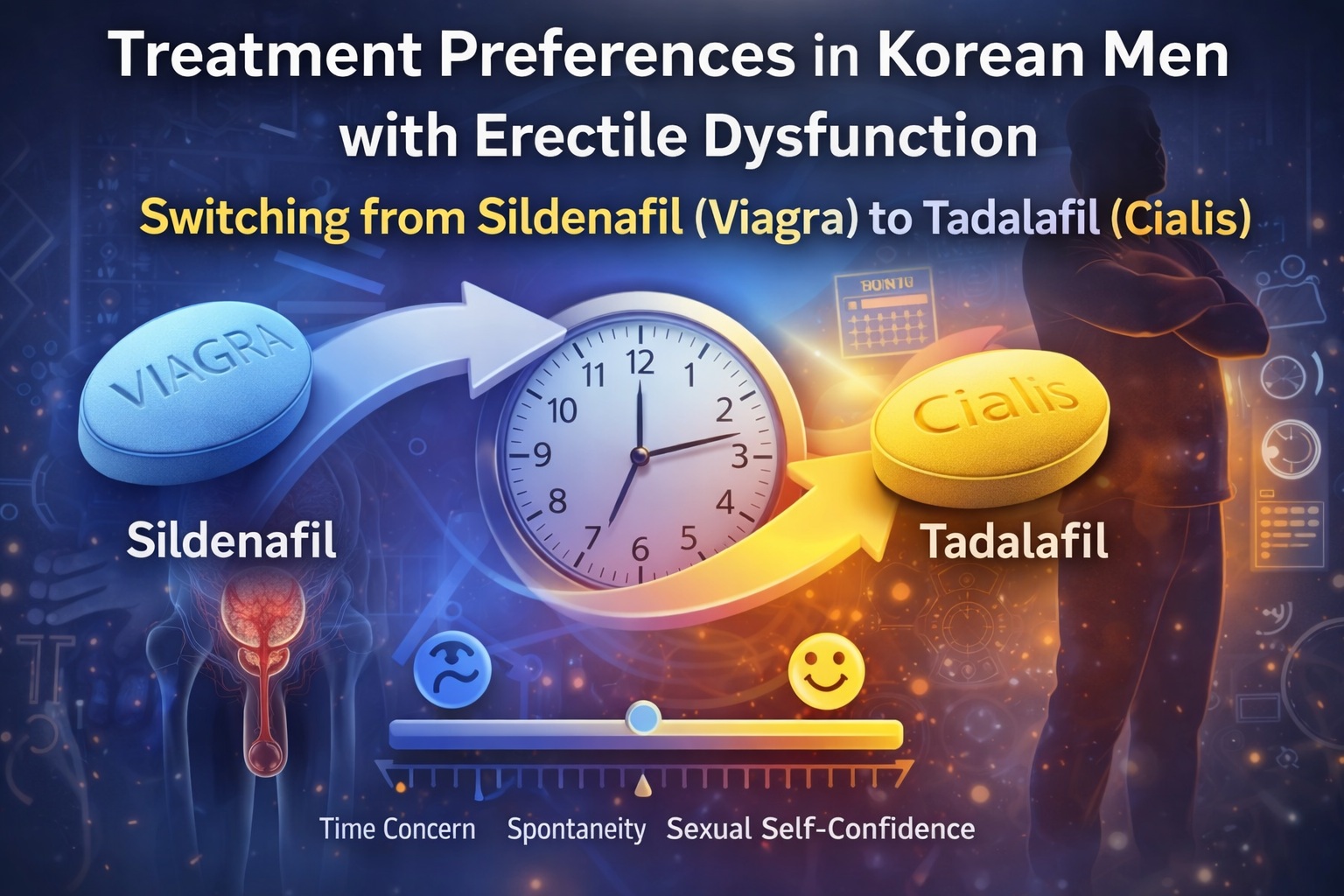
Introduction: Beyond Erection Hardness — The Psychology of Choice
Erectile dysfunction (ED) is often described in vascular terms: impaired nitric oxide signaling, endothelial dysfunction, reduced cavernosal smooth muscle relaxation. These explanations are biologically accurate. Yet they are clinically incomplete. An erection, after all, is not merely a hemodynamic event. It is a relational, psychological, and temporal experience.
The open-label Korean study published in the Asian Journal of Andrology explored an essential but frequently underestimated question: when men who have long used sildenafil are given the opportunity to try tadalafil, which do they prefer—and why?
The results were striking. After sequential exposure to both agents, nearly three-quarters of patients elected to continue tadalafil rather than return to sildenafil. The preference was statistically significant and consistent with international findings. Yet what makes this study particularly instructive is not only the preference pattern, but the attempt to understand the psychosocial drivers behind that decision.
This article dissects the clinical, psychological, behavioral, and cultural dimensions of that transition. We will examine what changes when a man moves from a short-acting PDE-5 inhibitor to one with a longer half-life—and why preference sometimes transcends pharmacodynamics.
The Clinical Landscape: A Population Experienced in Sildenafil
The study enrolled 160 Korean men with a mean age of 55 years, all of whom had been using sildenafil for a median duration of 585 days before study entry . This was not a naïve population experimenting with PDE-5 inhibitors for the first time. These men were experienced users, many on 50 mg or 100 mg doses, with established expectations and dosing routines.
This detail is critical. The investigators did not compare two theoretical options; they invited patients to contrast a familiar, long-used therapy with a new alternative. The design involved a sildenafil assessment phase, a washout, an 8-week tadalafil phase, and finally an extension phase in which patients selected their preferred medication .
The fixed sequence—sildenafil first, tadalafil second—could theoretically bias results. However, because these men had been using sildenafil for years, novelty alone is unlikely to explain the magnitude of the shift. When over 73% of experienced users elect to switch permanently, one must consider that the experience of treatment—not simply the molecule—has changed.
Pharmacological Contrast: Half-Life and the Window of Opportunity
Sildenafil and tadalafil share the same fundamental mechanism: inhibition of phosphodiesterase type 5, leading to sustained cGMP levels and enhanced erectile response to sexual stimulation. Their efficacy and tolerability profiles are broadly comparable. Yet pharmacokinetics differentiate them in clinically meaningful ways.
Sildenafil has a half-life of approximately 4–5 hours. Its recommended use is roughly 30–60 minutes before sexual activity, with a practical window that most patients interpret as several hours. Tadalafil, by contrast, has a half-life of approximately 17.5 hours and has demonstrated efficacy up to 24–36 hours post-dose .
The implications are subtle but profound. A shorter half-life encourages planning. A longer half-life allows temporal flexibility. Whether that flexibility translates into real behavioral change is another matter—one that this study carefully evaluated.
Preference Outcomes: A Clear Majority Chooses Tadalafil
At the point of choice, 115 of 156 evaluable patients (73.7%) selected tadalafil for the 12-week extension phase, compared with 26.3% who chose sildenafil . The difference was highly statistically significant (P < 0.001).
Baseline characteristics between preference groups did not reveal dramatic demographic divergences. The majority of men had moderate ED. Etiologies were mixed—organic, psychogenic, or combined. Both groups had extensive prior sildenafil exposure .
The preference, therefore, cannot be easily attributed to disease severity or baseline characteristics. Instead, the investigators explored psychological constructs and behavioral timing patterns to uncover underlying mechanisms.
The Role of Time Concern: The Quiet Driver of Preference
One of the study’s most revealing findings lies in the Psychological and Interpersonal Relationship Scales (PAIRS), particularly the “time concern” domain .
Time concern encompasses statements such as:
- Feeling rushed before planned sexual activity
- Worrying that medication might wear off
- Perceiving pressure to have sex quickly after dosing
- Disrupting mood due to awareness of medication timing
When patients switched from sildenafil to tadalafil, mean time concern scores decreased significantly (P = 0.002) . Lower scores indicate reduced temporal anxiety. In practical terms, men felt less hurried, less pressured, and less preoccupied with the clock.
Interestingly, reductions in time concern occurred regardless of eventual treatment preference. However, numerically better time concern scores were associated with tadalafil use during the extension phase. This suggests that although other variables influence final choice, relief from time pressure is a tangible and valued benefit.
If sildenafil requires men to schedule intimacy within a narrow window, tadalafil appears to dissolve some of that urgency. For many couples, the difference between “We must” and “We can” is clinically meaningful.
Spontaneity and Self-Confidence: Cultural Nuance and Unexpected Findings
Unlike prior multinational studies, this Korean cohort did not demonstrate statistically significant improvements in spontaneity or sexual self-confidence when switching from sildenafil to tadalafil .
This is intriguing. Studies conducted in Western populations and other Asian regions have often shown increased spontaneity with tadalafil. Why not here?
Several hypotheses emerge:
- Cultural attitudes toward sexuality may modulate perceived spontaneity.
- Patients may not have fully utilized the extended pharmacological window.
- Established behavioral patterns may persist despite new pharmacokinetics.
While mean spontaneity scores did not differ significantly, a noteworthy pattern appeared in sexual self-confidence. When analyzed by preference group, men who ultimately chose tadalafil demonstrated improvement in self-confidence between assessment phases, whereas those who preferred sildenafil showed a decline .
This divergence suggests that self-confidence may influence preference, even if average population-level differences appear muted. Confidence in sexual ability is not merely about erection quality; it reflects predictability, emotional comfort, and perceived control.
Behavioral Reality: Did Men Use the Extended Window?
One might expect that longer half-life leads to markedly different sexual timing patterns. The data offer a nuanced answer.
Median time from dose to sexual attempt increased modestly from 1 hour during sildenafil use to 1.5 hours during tadalafil use . Statistically significant, yes. Clinically dramatic, no.
However, the distribution tells a more compelling story. During sildenafil assessment, only 4.5% of sexual attempts occurred more than 4 hours after dosing. During tadalafil assessment, this rose to 17.5% .
This suggests that while the median behavior remained similar, a meaningful minority of men explored later windows of activity with tadalafil. The possibility of delayed intimacy existed—and some couples embraced it.
Yet most men did not radically change their habits. Cultural expectations, established routines, and relationship dynamics likely shape behavior more powerfully than pharmacology alone.
Safety and Tolerability: Not a Decisive Factor
Adverse event rates were similar across treatment phases. Flushing, headache, and nasal congestion were reported with both agents at comparable frequencies .
Only one patient discontinued due to adverse events during the tadalafil initiation phase. No serious adverse events occurred.
Given similar tolerability profiles, safety appears unlikely to have driven the preference shift. The decision, therefore, rests predominantly on experiential factors rather than side-effect avoidance.
Psychological Architecture of Preference
Why do men choose one PDE-5 inhibitor over another when efficacy is similar? The answer likely resides in a combination of factors:
- Perceived freedom from scheduling constraints
- Reduced anxiety about medication timing
- Subtle shifts in self-confidence
- Partner perceptions and relational comfort
- Cultural norms regarding spontaneity
The study authors acknowledged that additional measures—such as International Index of Erectile Function (IIEF) or Sexual Encounter Profile (SEP) outcomes—might have further clarified motivations . Nonetheless, the available data strongly implicate time-related psychological burden as a key differentiator.
ED treatment is often framed as restoring function. In reality, patients seek restoration of normalcy. A therapy that integrates more seamlessly into daily life may be preferred even if physiological efficacy is equivalent.
Cultural Context: Why Korean Findings Matter
The exclusively Korean population is both a limitation and a strength. It limits generalizability but illuminates cultural specificity.
In this cohort, spontaneity did not emerge as a dominant differentiator, contrary to Western data. It is plausible that cultural attitudes toward planned intimacy, marital expectations, or communication styles influence how men interpret “spontaneity.”
Moreover, Asian populations in previous research have shown smaller shifts in dose-timing behavior when switching to tadalafil compared to Western populations . Habit and cultural norms may temper experimentation.
For clinicians practicing in multicultural environments, this underscores a critical principle: patient preference is not universally predictable. It must be explored individually.
Study Limitations and Interpretive Caution
The open-label design inherently introduces bias. Patients knew which drug they were taking and received drug-specific instructions. The sequence—sildenafil first, tadalafil second—may also have influenced preference .
However, prior crossover studies have demonstrated that sequence alone does not consistently determine preference. Additionally, because participants had extensive sildenafil experience before enrollment, novelty bias may be attenuated.
Another limitation is the absence of direct efficacy comparison within this report. Successful intercourse rates were not analyzed in depth. It remains possible that subtle differences in perceived reliability influenced choice.
Despite these constraints, the preference magnitude—nearly three-quarters favoring tadalafil—demands attention.
Practical Implications for Clinicians
When discussing PDE-5 inhibitor options with patients who are stable on sildenafil yet curious about alternatives, several principles emerge from this study:
- Explore time-related anxiety and scheduling pressure.
- Assess how medication timing affects relational dynamics.
- Clarify expectations regarding window of opportunity.
- Discuss that flexibility does not mandate delayed use—it merely permits it.
Importantly, the goal is not to declare one agent superior. Rather, it is to align pharmacology with lifestyle. For some men, the predictability of a short-acting agent is reassuring. For others, extended duration feels liberating.
Clinical conversations should therefore move beyond dose and onset time. They should inquire: How does your medication fit into your life?
Conclusion: Preference Is an Experience, Not a Statistic
The Korean open-label study offers an essential reminder: effective treatment does not automatically equal optimal treatment. After experiencing both sildenafil and tadalafil, a clear majority of men chose tadalafil .
The preference appears linked to reduced time concern and, in some individuals, improved sexual self-confidence. Although spontaneous behavior did not change dramatically, the broader window of opportunity likely altered perception—even when behavior remained similar.
In the management of erectile dysfunction, pharmacodynamics matter. But so do mood, timing, confidence, and cultural context. An erection restored is valuable. An experience normalized is transformative.
FAQ
1. If sildenafil works well, why would a patient switch to tadalafil?
Many men switch not because sildenafil fails, but because tadalafil offers a longer duration of action. This extended window may reduce time pressure and improve comfort with intimacy scheduling, even if erection quality is similar.
2. Does tadalafil automatically increase spontaneity?
Not necessarily. While tadalafil allows greater temporal flexibility, actual behavioral change depends on individual and cultural factors. In this Korean study, spontaneity scores did not significantly change despite preference for tadalafil.
3. Should physicians routinely offer a switch to tadalafil?
Physicians should individualize decisions. If a patient reports time-related anxiety or scheduling pressure with sildenafil, discussing tadalafil as an alternative may be appropriate. Shared decision-making remains central to optimal ED management.
