

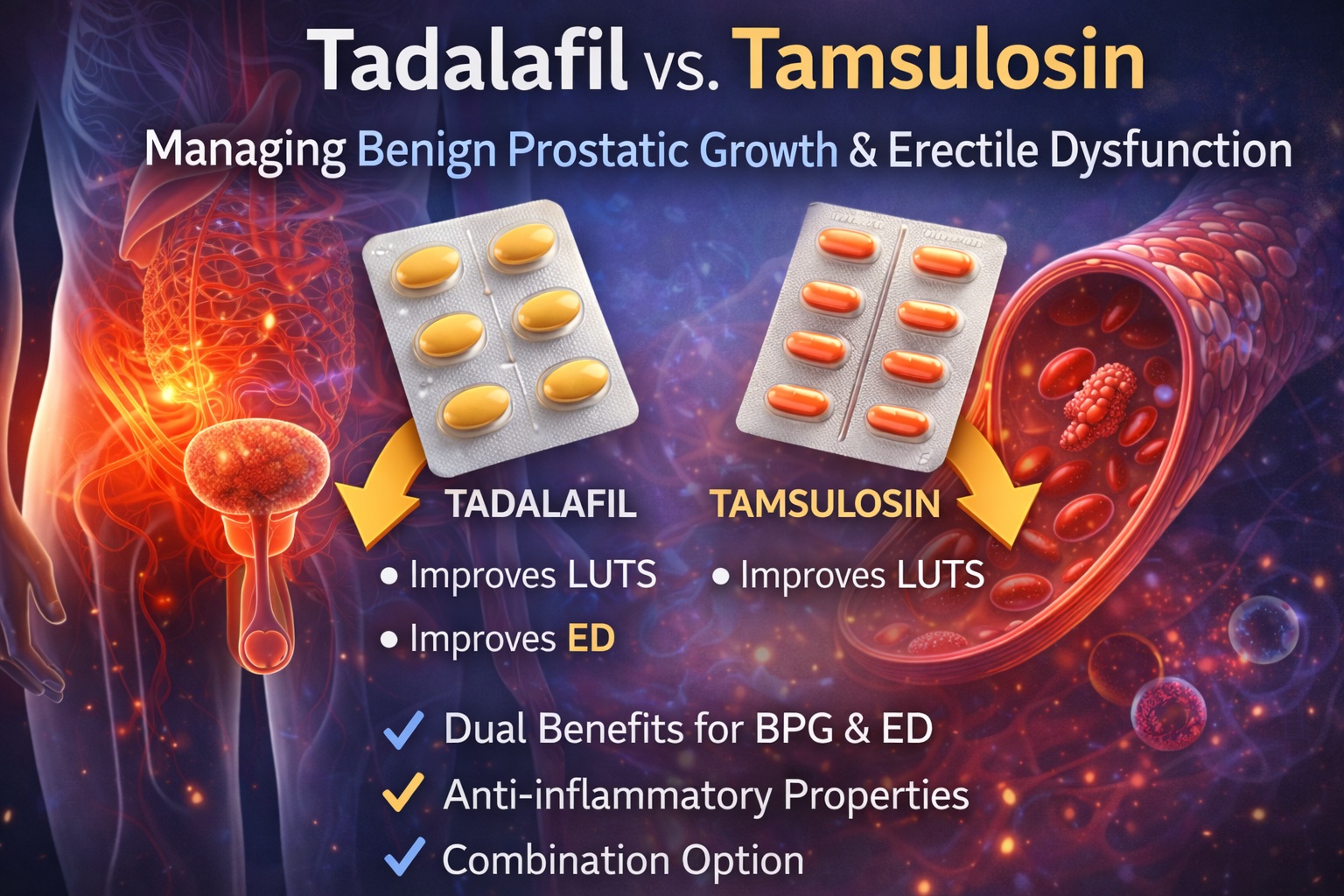
Introduction: Two Conditions, One Pathophysiological Thread
Benign prostatic growth (BPG), often clinically expressed as benign prostatic hyperplasia (BPH), and erectile dysfunction (ED) are among the most prevalent conditions affecting aging men. Epidemiological data suggest that by the age of 60, approximately half of men demonstrate histological evidence of prostatic enlargement, and this prevalence rises dramatically beyond the age of 70 . In parallel, ED affects a substantial proportion of the same population. The coexistence of these disorders is not incidental.
The review published in Revista Médica Clínica Las Condes in 2025 emphasizes that BPG and ED share key pathophysiological mechanisms, including chronic inflammation, oxidative stress, endothelial dysfunction, and impaired pelvic blood flow . This overlap compels a therapeutic strategy that goes beyond isolated symptom control. Treating urinary obstruction while neglecting sexual function is incomplete medicine; conversely, restoring erectile capacity without addressing obstructive urinary symptoms leaves the patient only partially improved.
Traditionally, tamsulosin, a selective alpha-1 adrenergic receptor antagonist, has been widely used as first-line pharmacologic therapy for lower urinary tract symptoms (LUTS). However, its impact is confined to dynamic obstruction. It does not improve erectile function and may, in some cases, compromise sexual satisfaction. In contrast, tadalafil—a phosphodiesterase type 5 inhibitor (PDE5i)—offers a dual mechanism that targets both LUTS and ED. This article synthesizes the comparative evidence between tadalafil and tamsulosin, and explores whether tadalafil should be considered a comprehensive therapeutic alternative rather than a secondary option.
Pathophysiological Convergence: Why BPH and ED Travel Together
Benign prostatic growth arises primarily through androgen-mediated cellular proliferation and chronic inflammatory remodeling within the transition zone of the prostate . Dihydrotestosterone (DHT), derived from testosterone via 5-alpha reductase, stimulates stromal and epithelial growth. Concurrently, inflammatory cytokines and fibrotic remodeling contribute to urethral compression and bladder outlet obstruction.
ED, in contrast, is fundamentally a vascular disorder in most older men. Erection requires nitric oxide (NO) release, cyclic guanosine monophosphate (cGMP) accumulation, smooth muscle relaxation, arterial inflow, and venous occlusion. Degradation of cGMP by PDE5 terminates erection .
The bridge between BPH and ED lies in pelvic vascular health. Prostatic enlargement may increase sympathetic tone and compromise endothelial function, impairing cavernosal blood flow. Chronic pelvic ischemia and inflammation further exacerbate both urinary and sexual dysfunction. Men with ED have significantly higher odds of developing BPH compared with the general population . In short, the pelvis behaves as a single hemodynamic unit.
A rational therapeutic approach must therefore address smooth muscle tone, vascular integrity, inflammatory activity, and patient quality of life simultaneously.
Mechanistic Contrast: Tamsulosin and Tadalafil Under the Microscope
Tamsulosin exerts its effects through selective blockade of alpha-1 adrenergic receptors in prostatic and bladder neck smooth muscle. By reducing sympathetic-mediated contraction, it improves urinary flow and reduces urethral resistance. Its action is local, rapid, and focused on dynamic obstruction. However, it does not influence erectile physiology, nor does it address inflammatory or fibrotic processes within prostatic tissue .
Tadalafil, by contrast, inhibits PDE5, thereby increasing intracellular cGMP levels. This enhances nitric oxide–mediated smooth muscle relaxation in the corpora cavernosa, prostate, bladder, and urethra . The consequences are twofold: improved erectile function and amelioration of LUTS.
Pharmacokinetically, tadalafil offers a prolonged half-life of approximately 17.5 hours, with therapeutic activity extending up to 36 hours . This extended duration supports once-daily dosing, enhances adherence, and allows greater sexual spontaneity compared to shorter-acting PDE5 inhibitors.
Mechanistically, therefore, tadalafil operates at the intersection of vascular and urinary physiology, while tamsulosin remains confined to adrenergic modulation.
Tadalafil Versus Placebo: Establishing Dual Efficacy
In the pivotal randomized phase 3 trial referenced in the review (Zhang et al., 2019), 909 men with LUTS secondary to BPH were assigned to tadalafil 5 mg daily, tamsulosin 0.2 mg daily, or placebo for 12 weeks .
Tadalafil demonstrated a significant reduction in total International Prostate Symptom Score (IPSS) (−5.49) compared to placebo (−1.41; p<0.001). Moreover, erectile function measured by the International Index of Erectile Function (IIEF) improved significantly with tadalafil (+5.24; p<0.001), whereas placebo showed only modest change .
These findings confirm that tadalafil provides clinically meaningful improvement in both urinary and sexual domains. Importantly, the improvement in erectile function is not incidental but integral to its pharmacodynamic profile.
The dual efficacy distinguishes tadalafil from purely urological agents and positions it uniquely for patients in whom sexual restoration is a priority.
Tadalafil Versus Tamsulosin: Divergence in Sexual Outcomes
Direct comparison between tadalafil and tamsulosin reveals nuanced differences. While both agents improve LUTS, their effects on sexual function diverge sharply.
In the same phase 3 study, tamsulosin reduced IPSS modestly (−4.9), but the change was not significantly different from placebo (p=0.105) . More importantly, tamsulosin did not produce significant improvement in erectile function. Tadalafil, however, demonstrated robust gains in IIEF scores.
Meta-analyses summarized in the review (e.g., Guo et al., 2020) indicate no significant difference between tadalafil and tamsulosin in storage subscores or maximum urinary flow (Qmax), but confirm that only tadalafil consistently improves erectile function .
Prospective studies such as Pogula et al. (2019) further highlight that while tamsulosin may be superior in reducing post-void residual volume (PVR), tadalafil yields significant improvement in sexual health indices .
In practical terms, tamsulosin may excel in relieving obstructive voiding metrics, whereas tadalafil offers comprehensive symptomatic relief when ED coexists.
Combination Therapy: Synergy Rather Than Competition
Combination therapy with tadalafil and tamsulosin has demonstrated additive or synergistic effects.
Early crossover studies (Bechara et al., 2008) showed that combination therapy reduced IPSS more than tamsulosin alone (−9.2 vs −6.7; p<0.05) and improved quality of life indices more significantly . Notably, erectile improvement occurred only with the combination.
A subsequent meta-analysis of six randomized controlled trials involving 441 patients confirmed a significantly greater reduction in total IPSS with combination therapy (mean difference −1.95; p<0.0001) .
The combination appears particularly suitable for patients with moderate-to-severe LUTS and concomitant ED. Although mild adverse events are more frequent with combination therapy, they are generally well tolerated.
In clinical practice, the choice between monotherapy and combination depends on symptom severity, patient priorities, and tolerance.
Beyond Symptom Control: Anti-Inflammatory and Antiproliferative Potential
One of the most intriguing aspects of tadalafil highlighted in the review is its potential antifibrotic and anti-inflammatory properties .
Experimental studies demonstrate that PDE5 inhibition reduces pro-inflammatory cytokine expression and suppresses stromal fibroblast-to-myofibroblast differentiation. In animal models, PDE5 inhibitors decreased prostatic fibrosis and inflammation.
If confirmed in long-term human studies, these effects suggest that tadalafil may not merely alleviate symptoms but also modulate disease progression. In contrast, tamsulosin does not appear to influence inflammatory or proliferative pathways.
Such disease-modifying potential would elevate tadalafil from symptomatic therapy to strategic intervention.
Safety and Tolerability Considerations
Tadalafil is generally well tolerated at a daily dose of 5 mg. Reported adverse effects include mild headache, flushing, and dyspepsia . Discontinuation rates are low.
Tamsulosin, while effective for urinary symptoms, may cause postural hypotension, dizziness, asthenia, and ejaculatory disturbances. Sexual side effects are particularly relevant in men already experiencing ED.
Combination therapy increases the incidence of mild adverse effects but maintains an acceptable safety profile in most studies.
Treatment selection must therefore consider cardiovascular status, comorbidities, and patient expectations.
Clinical Decision-Making: Individualization Over Algorithm
Although evidence supports tadalafil as a comprehensive option, therapy must remain individualized.
Patients with predominant obstructive symptoms and minimal sexual concern may respond adequately to tamsulosin alone. Conversely, men prioritizing restoration of sexual function alongside urinary relief may benefit more from tadalafil.
Combination therapy should be reserved for moderate-to-severe LUTS with persistent symptoms despite monotherapy.
A shared decision-making model, informed by IPSS severity and IIEF scores, remains essential.
Limitations of Current Evidence
The review acknowledges methodological limitations across studies . Many trials have relatively short follow-up durations (8–12 weeks), limiting long-term outcome assessment. Populations often exclude men with significant comorbidities, restricting generalizability.
Variability in dosing, inclusion criteria, and outcome measures complicates direct comparison and meta-analytic synthesis.
Future large-scale, long-term randomized studies are necessary to determine whether tadalafil’s anti-inflammatory properties translate into measurable slowing of BPH progression.
Conclusion: Toward a More Integrated Therapeutic Model
The comparative evidence summarized in the 2025 review supports tadalafil as a dual-action agent capable of improving both LUTS and erectile function . While tamsulosin remains effective for dynamic urinary obstruction, it lacks sexual benefit and disease-modifying potential.
Tadalafil offers:
- Significant improvement in IPSS and IIEF scores
- Sustained pharmacokinetic profile with once-daily dosing
- Potential anti-inflammatory and antifibrotic effects
- Compatibility with combination therapy for enhanced symptom control
In men with concomitant BPH and ED, tadalafil represents more than an alternative; it may be the logical first-line choice when sexual restoration is integral to quality of life.
Ultimately, optimal management requires integration rather than fragmentation. The prostate and the penis share vascular and inflammatory pathways. Our treatments should reflect that unity.
FAQ
1. Is tadalafil more effective than tamsulosin for urinary symptoms?
Both medications improve LUTS. However, while urinary symptom reduction is comparable in many studies, tadalafil uniquely improves erectile function, giving it an advantage in men with coexisting ED.
2. Does combination therapy provide additional benefit?
Yes. The combination of tadalafil and tamsulosin has demonstrated greater reductions in IPSS and improved quality of life compared with monotherapy, particularly in moderate-to-severe cases.
3. Can tadalafil slow the progression of benign prostatic growth?
Preclinical and mechanistic data suggest anti-inflammatory and antifibrotic effects that may influence disease progression. However, long-term clinical studies are needed to confirm this potential.
