

Introduction: Erectile Dysfunction as a Silent Burden of Chronic Renal Failure
Chronic renal failure (CRF) is no longer viewed solely as a disorder of impaired filtration and metabolic imbalance. Modern clinical practice increasingly recognizes CRF as a systemic disease with profound endocrine, vascular, neurological, and sexual consequences. Among these, erectile dysfunction (ED) stands out not only for its high prevalence, but also for its deep impact on quality of life, psychological well-being, and intimate relationships.
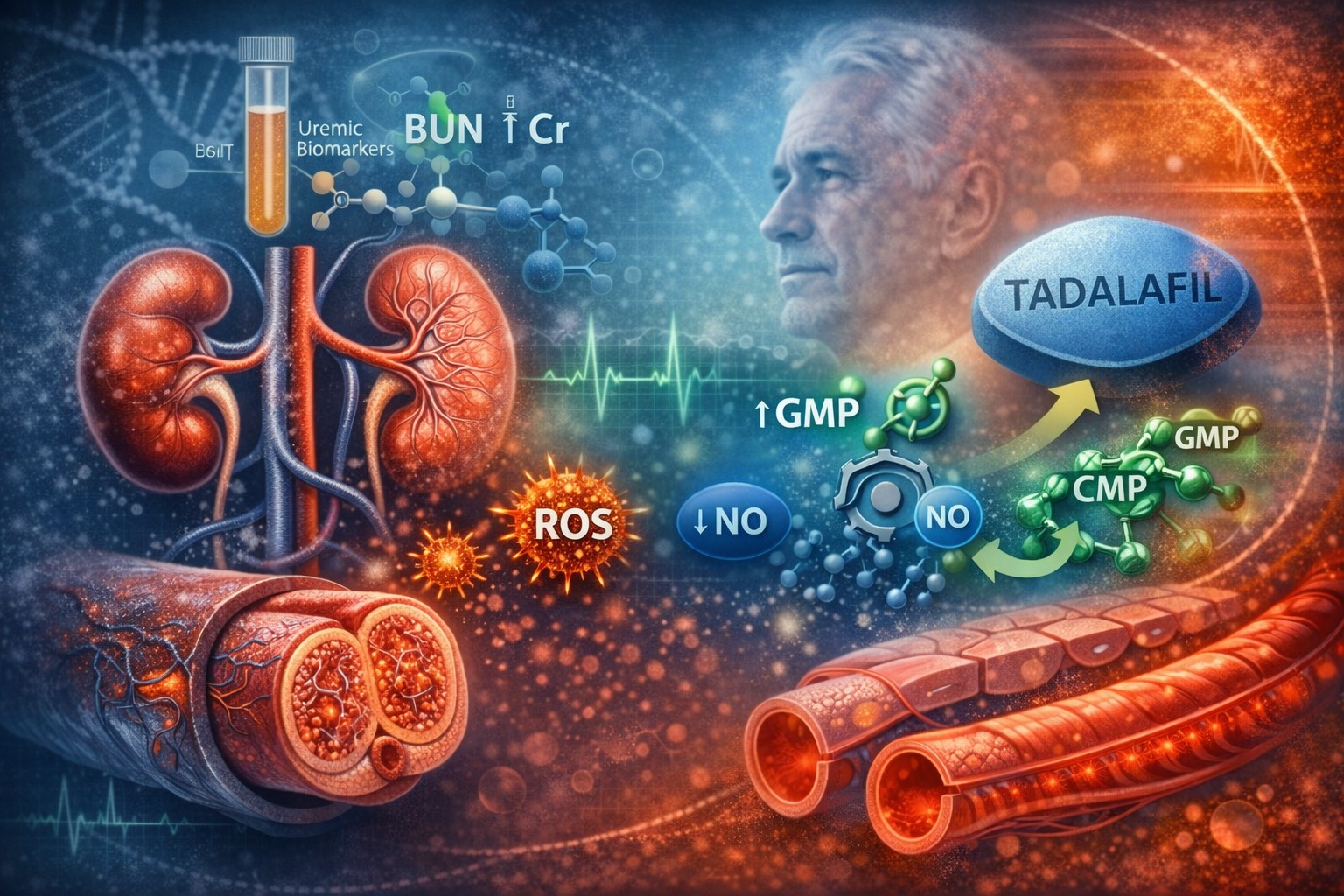
In men with advanced renal disease, erectile dysfunction is remarkably common, affecting the majority of patients long before dialysis or transplantation becomes inevitable. Importantly, ED in this population is not merely an age-related coincidence. It represents a complex interaction between uremic toxicity, endothelial dysfunction, autonomic neuropathy, hormonal disturbances, and impaired nitric oxide signaling. As a result, conventional approaches to ED may yield inconsistent outcomes unless the underlying pathophysiology is clearly understood.
Phosphodiesterase type 5 (PDE5) inhibitors have transformed the treatment of erectile dysfunction in the general population. However, their role in CRF-associated ED requires careful evaluation. This article explores the mechanistic rationale and experimental evidence supporting the use of tadalafil in the context of chronic renal failure, focusing on its effects on cyclic guanosine monophosphate (cGMP) signaling and cavernosal smooth muscle relaxation.
Pathophysiology of Erectile Dysfunction in Chronic Renal Failure
Penile erection is a finely regulated neurovascular process dependent on intact endothelial function, smooth muscle responsiveness, and intracellular signaling pathways. In chronic renal failure, several of these components are simultaneously compromised, creating a hostile environment for normal erectile physiology.
One of the central abnormalities in CRF-related ED is impaired nitric oxide (NO) bioavailability. Uremia is associated with oxidative stress, inflammation, and endothelial dysfunction, all of which reduce NO synthesis and accelerate its degradation. As NO serves as the primary trigger for cGMP production in cavernosal smooth muscle cells, its deficiency directly limits the molecular cascade required for erection.
Additionally, CRF disrupts intracellular signaling by reducing cGMP concentrations within the corpus cavernosum. This reduction weakens smooth muscle relaxation, limits arterial inflow, and prevents effective veno-occlusion. Over time, repeated failure of adequate relaxation contributes to structural changes within penile tissue, further worsening erectile capacity.
Beyond vascular factors, hormonal imbalances common in CRF—such as hypogonadism and hyperprolactinemia—compound erectile dysfunction. However, even when hormonal levels are corrected, many patients continue to experience ED, highlighting the dominant role of impaired smooth muscle signaling and intracellular second messenger pathways.
cGMP Signaling: A Critical Molecular Deficit in CRF-Related ED
Cyclic guanosine monophosphate is the pivotal intracellular messenger that translates endothelial nitric oxide release into smooth muscle relaxation. Under physiological conditions, NO activates soluble guanylyl cyclase, converting guanosine triphosphate into cGMP. This molecule then initiates a cascade leading to reduced intracellular calcium, smooth muscle relaxation, and increased penile blood flow.
Experimental evidence demonstrates that chronic renal failure significantly reduces basal cGMP levels within cavernosal tissue. This reduction reflects both diminished NO production and accelerated cGMP degradation. The consequence is a blunted erectile response, even in the presence of intact neural stimulation.
From a therapeutic standpoint, restoring cGMP availability represents a rational target in CRF-related ED. Strategies that merely provide NO donors may be insufficient if cGMP is rapidly hydrolyzed. Conversely, inhibiting cGMP breakdown offers a more durable means of amplifying endogenous signaling, even when NO production is suboptimal.
This molecular insight provides the foundation for considering PDE5 inhibitors, particularly those with sustained pharmacokinetics, as promising agents in the treatment of erectile dysfunction associated with renal failure.
Tadalafil as a Selective PDE5 Inhibitor: Pharmacological Advantages
Among available PDE5 inhibitors, tadalafil possesses unique pharmacological characteristics that distinguish it from earlier agents. Its high selectivity for PDE5, minimal interaction with food intake, and prolonged half-life confer both practical and biological advantages.
Tadalafil inhibits the enzymatic degradation of cGMP within cavernosal smooth muscle cells, allowing intracellular levels to rise and persist. Unlike nonspecific phosphodiesterase inhibitors, it does not significantly interfere with other cyclic nucleotide pathways, reducing the risk of off-target effects.
The extended half-life of tadalafil allows for sustained enhancement of cGMP signaling, potentially compensating for the chronic deficiency observed in CRF. From a clinical perspective, this prolonged window of action offers greater flexibility, reduced performance pressure, and improved treatment adherence—factors that are particularly relevant in patients burdened by chronic illness.
Importantly, tadalafil’s pharmacodynamic profile suggests that its benefits may extend beyond immediate erectile facilitation, influencing smooth muscle responsiveness and vascular function at a more fundamental level.
Experimental Evidence from Chronic Renal Failure Animal Models
Animal models of chronic renal failure provide valuable insight into the mechanistic underpinnings of CRF-related erectile dysfunction. In experimental settings, surgically induced renal failure reliably reproduces the biochemical and functional alterations observed in human disease, including elevated uremic markers and impaired erectile tissue signaling.
Studies using CRF rabbit models demonstrate a marked reduction in cavernosal cGMP concentrations compared with healthy controls. This finding confirms that renal failure directly compromises the intracellular pathways required for erection, independent of psychological or hormonal influences.
When cavernosal smooth muscle from CRF animals is exposed to tadalafil, a pronounced relaxation response is observed. Notably, this response exceeds that produced by nonspecific phosphodiesterase inhibitors and nitric oxide donors at equivalent concentrations. The superiority of tadalafil becomes particularly evident at higher concentrations, where its selective PDE5 inhibition maximally preserves intracellular cGMP.
These observations suggest that tadalafil effectively bypasses upstream NO deficiencies by stabilizing downstream signaling, thereby restoring smooth muscle relaxation capacity even in the context of renal impairment.
Comparative Effects of Tadalafil, Papaverine, and NO Donors
To appreciate the therapeutic relevance of tadalafil, it is essential to compare its effects with those of traditional agents used to induce cavernosal relaxation. Papaverine, a nonspecific phosphodiesterase inhibitor, and sodium nitroprusside, an NO donor, have long been employed in experimental and clinical settings.
Papaverine promotes smooth muscle relaxation by inhibiting multiple phosphodiesterase isoforms, increasing both cAMP and cGMP levels. While effective, its lack of selectivity limits its potency and increases the risk of adverse effects. Sodium nitroprusside, by releasing NO, depends on intact downstream signaling to exert its effects—a condition not consistently met in CRF.
Experimental data indicate that tadalafil induces significantly greater relaxation of cavernosal smooth muscle than either papaverine or sodium nitroprusside at comparable concentrations. This enhanced efficacy underscores the importance of selectively targeting PDE5 in disease states characterized by cGMP depletion.
Clinically, these findings suggest that tadalafil may offer superior therapeutic benefits in CRF-related ED by addressing the most critical molecular bottleneck in erectile physiology.
Clinical Implications for Erectile Dysfunction in Renal Failure
The translational relevance of these findings is substantial. Erectile dysfunction in patients with chronic renal failure is often refractory to conventional treatments, leading to frustration for both patients and clinicians. Understanding the molecular basis of treatment resistance allows for more rational therapeutic choices.
Tadalafil’s ability to restore smooth muscle relaxation in CRF models supports its use as a first-line pharmacological option in this population. Its efficacy does not depend solely on optimal NO production, making it particularly suitable for uremic patients with endothelial dysfunction.
Furthermore, the favorable safety profile of tadalafil, combined with its prolonged duration of action, aligns well with the needs of patients managing complex chronic diseases. While dose adjustments and careful monitoring remain essential, existing evidence supports its tolerability in renal populations when used appropriately.
Broader Perspectives: Erectile Dysfunction as a Marker of Systemic Health
Erectile dysfunction in chronic renal failure should not be viewed in isolation. It reflects widespread vascular and cellular dysfunction affecting multiple organ systems. As such, successful treatment of ED may signal broader improvements in endothelial and smooth muscle function.
By enhancing cGMP signaling, tadalafil may exert beneficial effects beyond the penis, potentially influencing vascular tone, tissue perfusion, and cellular signaling in other organs. While such effects remain speculative, they highlight the need for a holistic approach to sexual dysfunction in systemic disease.
Recognizing ED as a meaningful clinical endpoint encourages proactive assessment and intervention, rather than dismissing sexual symptoms as secondary concerns.
Limitations and Future Research Directions
Despite compelling experimental evidence, several limitations warrant discussion. Animal models, while informative, cannot fully replicate the complexity of human chronic renal failure. Factors such as psychological stress, hormonal variability, and long-term comorbidities require clinical validation.
Future studies should focus on long-term tadalafil administration in patients with varying stages of renal disease, assessing not only erectile outcomes but also vascular biomarkers and quality-of-life measures. Comparative trials with other PDE5 inhibitors would further clarify drug-specific advantages.
Additionally, exploring the interaction between tadalafil and renal replacement therapies may yield valuable insights into optimizing sexual health across the spectrum of renal disease.
Conclusion
Erectile dysfunction in chronic renal failure is driven by profound disturbances in intracellular signaling, particularly reduced cGMP availability within cavernosal smooth muscle. Experimental evidence demonstrates that tadalafil effectively restores smooth muscle relaxation by selectively inhibiting PDE5 and preserving cGMP signaling, even in the setting of renal impairment.
These findings provide a strong mechanistic rationale for the use of tadalafil in CRF-related erectile dysfunction. More broadly, they reinforce the importance of targeted molecular therapy in addressing complex sexual dysfunction associated with systemic disease.
In an era of personalized medicine, such insights allow clinicians to move beyond symptomatic treatment toward interventions grounded in pathophysiological understanding.
FAQ
1. Why is erectile dysfunction so common in chronic renal failure?
CRF impairs nitric oxide production, reduces cGMP signaling, and causes endothelial and smooth muscle dysfunction, all of which are essential for normal erection.
2. What makes tadalafil particularly suitable for CRF-related ED?
Tadalafil selectively inhibits PDE5, preserves cGMP levels, has a long half-life, and remains effective even when nitric oxide availability is reduced.
3. Can findings from animal models be applied to human patients?
Animal models provide strong mechanistic evidence, but clinical trials are necessary to confirm long-term efficacy and safety in humans with renal disease.
