

Introduction: When Urology Intersects with Cardiology
Lower urinary tract symptoms (LUTS) are often treated as a localized urological problem—weak stream, urgency, nocturia, incomplete emptying. Yet epidemiological data have repeatedly shown that men with moderate to severe LUTS carry a higher risk of cardiovascular events. The relationship is not coincidental. Vascular dysfunction, endothelial impairment, chronic inflammation, and autonomic dysregulation form a shared biological substrate linking the prostate, bladder, and heart.
Major adverse cardiac events (MACE)—including myocardial infarction and stroke—remain the leading cause of mortality in the United States. Venous thromboembolism (VTE) adds another dimension of vascular risk. Men with LUTS appear disproportionately represented among those who later experience such events.
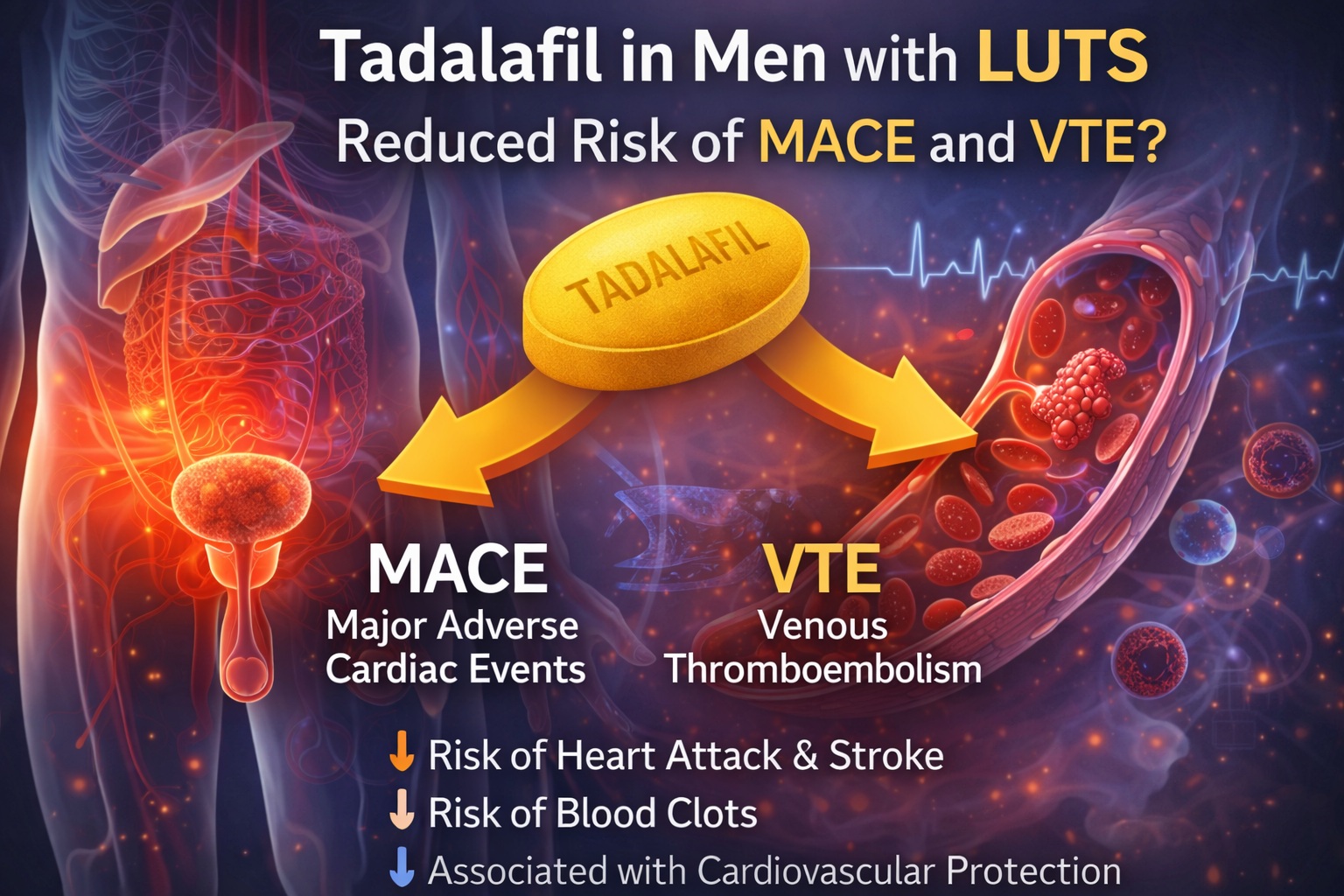
Against this backdrop, the 2022 study published in World Journal of Urology asked a clinically provocative question: is tadalafil, a phosphodiesterase-5 inhibitor (PDE5I) approved for LUTS, associated with a decreased risk of MACE or VTE?
The findings suggest that tadalafil use in men with LUTS correlates with significantly lower odds of major cardiovascular and thromboembolic events over a three-year period—even after rigorous adjustment for confounding variables. This article explores the clinical implications, methodological rigor, biological plausibility, and future directions of that association.
LUTS as a Cardiovascular Signal, Not Just a Symptom
LUTS are classified into storage, voiding, and post-micturition symptoms. Although benign prostatic hyperplasia (BPH) is a common cause, LUTS represent a broader dysfunction of lower urinary tract physiology. Increasingly, they are recognized as a marker of systemic vascular compromise.
Men with more severe LUTS demonstrate higher Framingham cardiovascular risk scores and increased incidence of MACE. The pathophysiology likely involves shared endothelial dysfunction and reduced nitric oxide bioavailability. Pelvic ischemia does not confine itself to the prostate.
Alpha-blockers remain first-line therapy for LUTS, yet they are not cardiovascular panaceas. Some data have even suggested associations with cardiac failure. This therapeutic landscape raises a compelling possibility: could a vasodilatory agent such as tadalafil offer dual benefits—relieving urinary symptoms while mitigating cardiovascular risk?
Study Design: A National-Scale Observational Analysis
The investigators accessed the TriNetX Research Network, a federated electronic health record database incorporating data from 42 healthcare organizations across the United States . The database included over 67 million patients, allowing for unprecedented statistical power.
Men with LUTS were identified using ICD-10 codes. Exclusions were carefully applied: females, men with erectile dysfunction diagnoses, prior sildenafil or vardenafil use, and those with recent MACE or VTE events were removed to reduce bias.
Four cohorts were analyzed:
- Men with LUTS using neither tadalafil nor alpha-blockers
- Men using tadalafil alone
- Men using alpha-blockers alone
- Men using both tadalafil and alpha-blockers
The primary endpoint was the occurrence of MACE or VTE within three years of index diagnosis .
Crucially, the authors performed both unbalanced and propensity score–matched analyses to adjust for confounders such as age, diabetes, hypertension, dyslipidemia, obesity, tobacco use, sleep apnea, and cardioprotective medications.
Population Characteristics: A High-Risk Real-World Cohort
The final analysis included 821,592 men who used neither alpha-blockers nor tadalafil, 5,004 men who used tadalafil alone, 327,482 men who used alpha-blockers alone, and 6,603 men who used combination therapy .
Men prescribed tadalafil tended to be older and exhibited higher baseline rates of cardiovascular risk factors. Dyslipidemia, hypertension, and use of cardioprotective medications were more common in the tadalafil group. In other words, tadalafil users were not healthier by default.
This observation is important. If tadalafil were associated with lower cardiovascular event rates despite higher baseline risk profiles, the association would be even more striking.
Results: A Significant Reduction in MACE and VTE
Before statistical balancing, tadalafil alone was not significantly associated with reduced MACE/VTE risk in men without alpha-blocker exposure (OR 1.13, p=0.0757). However, after controlling for confounding variables through propensity score matching, tadalafil use was independently associated with a decreased risk of MACE/VTE (OR 0.59, 95% CI 0.49–0.70, p<0.0001) .
Among men already using alpha-blockers, tadalafil remained independently associated with reduced risk (OR 0.57, 95% CI 0.50–0.66, p<0.0001), both before and after adjustment .
In practical terms, tadalafil use correlated with approximately a 40% reduction in odds of major cardiovascular or thromboembolic events over three years.
Observational data do not establish causation. Yet the magnitude and consistency of association—across subgroups and after rigorous adjustment—demand serious consideration.
Biological Plausibility: Why Would Tadalafil Protect the Heart?
Tadalafil inhibits PDE5, preventing degradation of cyclic guanosine monophosphate (cGMP). Increased cGMP enhances nitric oxide–mediated vasodilation and reduces smooth muscle calcium concentration.
The cardiovascular implications are multifold:
- Improved endothelial function
- Reduced arterial stiffness
- Enhanced microvascular perfusion
- Potential anti-inflammatory effects
- Modulation of platelet aggregation
PDE5 inhibitors are already approved for pulmonary arterial hypertension, a condition rooted in vascular remodeling and elevated pulmonary pressures. Systemic vasodilatory effects may extend beyond the pelvis.
In men with LUTS—a population enriched for endothelial dysfunction—chronic PDE5 inhibition may restore vascular homeostasis sufficiently to reduce event risk.
One might say that a drug prescribed for urinary hesitancy may quietly assist coronary arteries as well.
Comparison with Alpha-Blocker Monotherapy
Alpha-blockers relax prostatic smooth muscle via adrenergic receptor antagonism. While effective for urinary flow, they do not target endothelial signaling.
Interestingly, the study suggests that adding tadalafil to alpha-blocker therapy confers additional cardiovascular protection . This raises the possibility that combination therapy may become more attractive—not merely for symptom control but for broader vascular considerations.
However, clinicians must weigh potential side effects, including headache, flushing, dyspepsia, and postural hypotension. The safety profile of tadalafil remains generally favorable, especially at daily low doses.
Strengths and Limitations: Reading the Data with Discipline
The study’s strengths include:
- Massive sample size
- Multi-institutional real-world data
- Propensity score matching to reduce confounding
- Defined three-year outcome window
- Adjustment for multiple cardiovascular risk factors
Yet limitations persist. The analysis is observational and dependent on ICD coding accuracy. Medication adherence cannot be guaranteed. Socioeconomic status, lifestyle factors, and LUTS severity were not directly measured.
Furthermore, association does not equal causation. Tadalafil users may differ in unmeasured ways from non-users. Randomized prospective trials are necessary to confirm cardioprotective effects.
Still, when a drug demonstrates consistent association with reduced MACE/VTE risk in high-risk populations, it warrants attention.
Clinical Implications: Rethinking First-Line Therapy?
Alpha-blockers have long held first-line status for LUTS. Yet this study challenges us to reconsider the hierarchy.
If tadalafil improves urinary symptoms, enhances sexual function, and is associated with lower odds of cardiovascular events, should it be more prominently positioned in treatment algorithms?
Cost is less prohibitive than in the past. Since patent expiration, tadalafil has become widely available in generic form, substantially reducing financial barriers .
This does not imply that every man with LUTS should receive tadalafil for cardioprotection. Rather, it invites nuanced shared decision-making—particularly in patients with significant cardiovascular risk profiles.
Future Directions: From Association to Evidence
The authors appropriately call for long-term prospective randomized studies . Such trials would clarify whether PDE5 inhibition causally reduces MACE/VTE or whether the association reflects residual confounding.
Key questions remain:
- Does duration of tadalafil exposure correlate with event reduction?
- Are benefits dose-dependent?
- Does endothelial improvement mediate cardiovascular protection?
- Can biomarkers predict responders?
If confirmed, PDE5 inhibitors may assume a broader role in cardiovascular prevention strategies within urology.
Conclusion: A Drug with Unexpected Reach
The study published in World Journal of Urology demonstrates that tadalafil use in men with LUTS is associated with significantly decreased odds of major adverse cardiac events and venous thromboembolism over three years .
While causality remains unproven, the findings align with known vascular effects of PDE5 inhibition. In a population already at elevated cardiovascular risk, such association carries weight.
Urology and cardiology are often treated as separate disciplines. Yet vascular biology ignores specialty boundaries. When a therapy for urinary symptoms also correlates with reduced cardiac events, it invites a broader view of patient care.
Perhaps the most compelling lesson is simple: sometimes, the most interesting effects of a drug occur outside its original indication.
FAQ
1. Does tadalafil prevent heart attacks or blood clots?
This observational study found that tadalafil use was associated with lower odds of major adverse cardiac events and venous thromboembolism over three years. However, randomized controlled trials are needed to confirm causation.
2. Should tadalafil replace alpha-blockers as first-line therapy for LUTS?
Not necessarily. Alpha-blockers remain standard first-line treatment. However, tadalafil may offer additional benefits—particularly in men with erectile dysfunction or elevated cardiovascular risk.
3. Is tadalafil safe for patients with cardiovascular disease?
Tadalafil is generally well tolerated, but patients with significant cardiovascular conditions should be evaluated individually. It is contraindicated in men taking nitrates and should be prescribed with clinical judgment.
