

Introduction: The Hidden Cost of Surgical Cure
Radical prostatectomy remains one of the most effective curative treatments for localized prostate cancer. It is a procedure that removes disease with precision—but often leaves behind a different kind of burden. For many patients, the postoperative period is marked not only by oncologic surveillance, but by functional recovery that is uncertain, prolonged, and deeply personal.
Two complications dominate this landscape: erectile dysfunction and urinary incontinence. Both are consequences of anatomical disruption, neural injury, and altered pelvic physiology. While advances in nerve-sparing techniques have improved outcomes, they have not eliminated these challenges.
In recent years, attention has shifted toward pharmacologic rehabilitation. Among the agents studied, tadalafil—a phosphodiesterase type 5 inhibitor—has emerged as more than a treatment for erectile dysfunction. The study analyzed here suggests that its role may extend further, influencing voiding function, continence recovery, and even broader aspects of postoperative healing .
This article explores that expanded role. It is not simply about restoring erections—it is about redefining recovery.
Understanding Post-Prostatectomy Dysfunction: A Multifactorial Problem
The functional consequences of radical prostatectomy are not accidental; they are rooted in anatomy and physiology. The prostate lies at the crossroads of urinary and sexual function, surrounded by delicate neurovascular bundles and sphincteric structures.
During surgery, even with meticulous technique, these structures may be partially disrupted. Cavernous nerve injury leads to reduced penile oxygenation, initiating a cascade of fibrosis and long-term erectile dysfunction. At the same time, alterations in bladder dynamics and sphincter integrity contribute to urinary incontinence.
The prevalence of these complications is substantial. Studies have reported erectile dysfunction rates ranging widely, while voiding dysfunction—including urgency, frequency, and incontinence—remains common in the early postoperative period.
As noted in the source study, bladder dysfunction may involve reduced compliance in up to 82% of patients and detrusor overactivity in 63% . These are not minor inconveniences—they are structural and functional changes that demand targeted intervention.
Tadalafil: A Familiar Drug with Expanding Purpose
Tadalafil is widely known for its role in erectile dysfunction. Its mechanism—enhancing nitric oxide–mediated cGMP signaling—results in smooth muscle relaxation and improved blood flow. Its long half-life allows for sustained activity, making it particularly suitable for chronic use.
However, its effects are not confined to penile tissue. The lower urinary tract shares similar smooth muscle and signaling pathways. PDE5 expression has been identified in the bladder, prostate, and urethra, suggesting that tadalafil may influence urinary physiology as well.
This dual action is not merely theoretical. Clinical studies in benign prostatic hyperplasia have demonstrated improvements in lower urinary tract symptoms with tadalafil therapy. The current study extends this concept to the postoperative setting, where the physiological challenges are even more pronounced.
In this context, tadalafil becomes more than a symptomatic treatment. It becomes a modulator of recovery.
Clinical Evidence: A Large-Scale Real-World Perspective
The study draws on a substantial cohort of 4,173 patients who underwent radical prostatectomy, providing a robust dataset for analysis . Among these, 916 patients received postoperative tadalafil, while the remainder served as controls.
The findings are both nuanced and compelling. At one month postoperatively, patients receiving tadalafil actually exhibited lower erectile function scores compared to controls. This early decline may reflect more aggressive rehabilitation protocols or baseline differences.
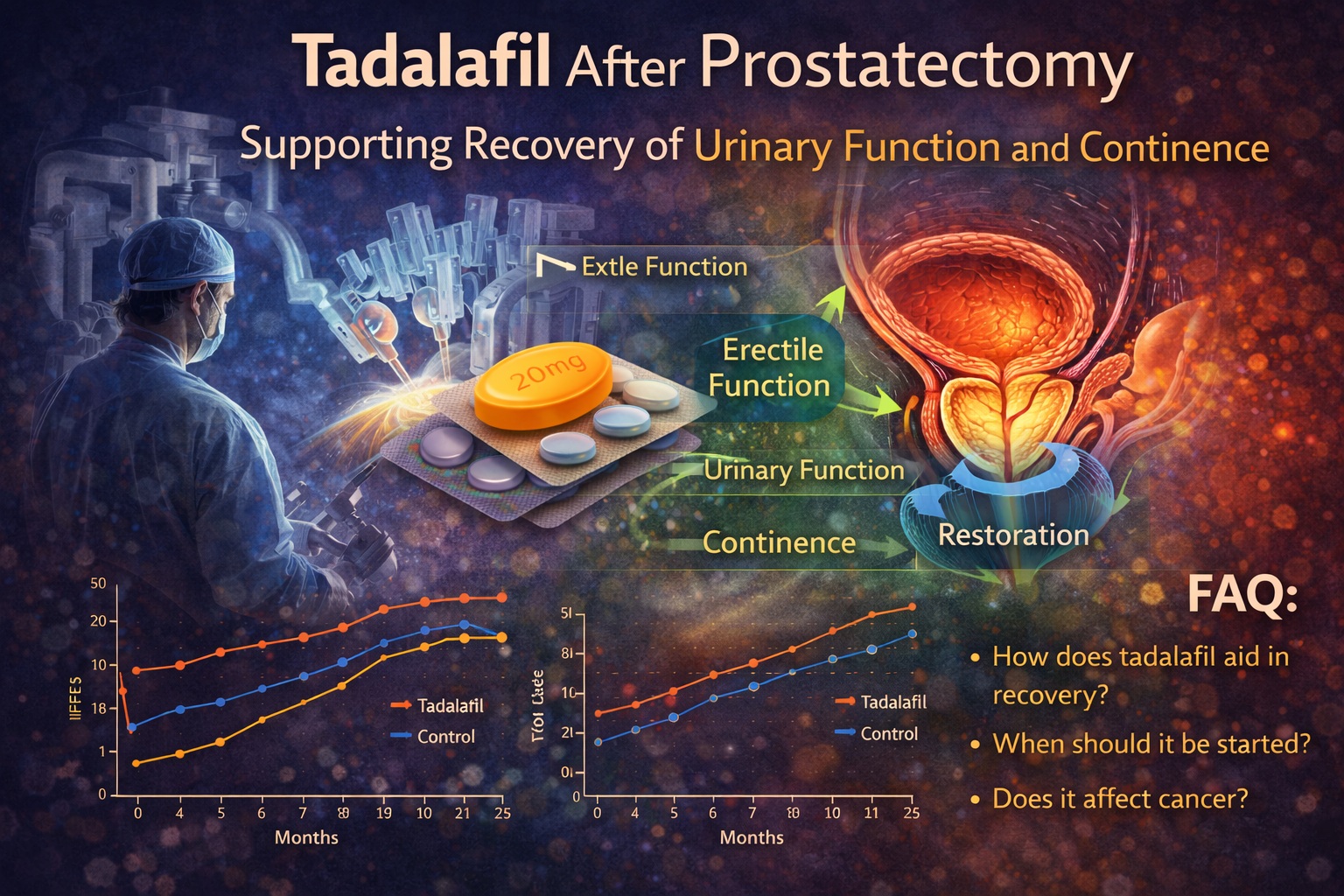
However, the trajectory changes over time. By 12 months, tadalafil-treated patients demonstrated significantly better recovery, with higher IIEF-5 scores indicating improved erectile function. The graph on page 3 illustrates this trend clearly, showing a steady divergence between groups over time.
This pattern suggests that tadalafil does not prevent early dysfunction—but it may accelerate long-term recovery. In other words, it changes the slope of recovery rather than the starting point.
Voiding Function: An Underappreciated Benefit
While the impact of tadalafil on erectile function has been widely studied, its effect on urinary function is less frequently discussed. Yet the data from this study suggest that this may be one of its most clinically relevant benefits.
Patients receiving tadalafil experienced a smaller increase in IPSS scores after surgery, indicating less severe worsening of urinary symptoms. The difference—1.4 points versus 2.4 in the control group—may appear modest, but it is statistically and clinically meaningful .
More importantly, this advantage was sustained over time. As shown in the IPSS curves on page 4, tadalafil-treated patients maintained better voiding function up to 12 months postoperatively.
This finding aligns with known pharmacological effects. By promoting smooth muscle relaxation and improving pelvic blood flow, tadalafil may reduce bladder overactivity and enhance functional adaptation after surgery.
Continence Recovery: The Outcome Patients Value Most
For many patients, urinary continence is the most important measure of recovery. It is a function that affects daily life, social interaction, and psychological well-being.
In this study, continence was defined as the use of one pad or less per day—a practical and patient-centered metric. The results were encouraging: 95.1% of patients in the tadalafil group achieved social continence, compared to 92.6% in the control group .
While the difference may seem small, it represents a meaningful improvement at the population level. More importantly, it reflects a consistent trend across functional outcomes.
The mechanisms underlying this effect are not fully understood. Possible explanations include improved sphincter function, enhanced neuromuscular recovery, and indirect effects on pelvic floor dynamics.
Whatever the mechanism, the implication is clear: tadalafil may contribute to a more complete and timely recovery.
Oncologic Safety: Addressing a Critical Concern
Any intervention in cancer patients must be evaluated not only for functional benefit, but also for oncologic safety. The concern that PDE5 inhibitors might influence tumor biology has been a topic of debate.
In this study, the rate of biochemical recurrence was lower in the tadalafil group (11.7% vs. 25.7%) . However, this difference is likely attributable to baseline characteristics, including lower tumor stage and grade in the treated group.
Importantly, there was no evidence that tadalafil increased recurrence risk. This finding is consistent with broader literature, which generally supports the oncologic safety of PDE5 inhibitors.
For clinicians, this provides reassurance. Functional recovery does not have to come at the expense of cancer control.
Mechanistic Insights: Why Tadalafil Works
The benefits of tadalafil can be traced to its effects at the cellular level. Following prostatectomy, reduced blood flow and nerve injury create a hypoxic environment in penile tissue. This promotes fibrosis and impairs functional recovery.
By enhancing cGMP signaling, tadalafil improves tissue oxygenation and inhibits fibrotic remodeling. This preserves the structural integrity of erectile tissue and facilitates neural regeneration .
In the urinary tract, similar mechanisms may apply. Improved blood flow and smooth muscle relaxation can reduce detrusor overactivity and support bladder function.
These effects are not instantaneous. They require sustained therapy and time. But they represent a rational, biologically grounded approach to rehabilitation.
Limitations and Clinical Interpretation
No study is without limitations, and this one is no exception. Its retrospective design introduces the possibility of selection bias. Patients receiving tadalafil were younger, had lower-stage disease, and may have been more motivated to pursue recovery.
Additionally, functional outcomes were assessed using patient-reported measures such as IIEF-5 and IPSS. While widely accepted, these tools are inherently subjective.
Despite these limitations, the consistency of findings across multiple outcomes strengthens the conclusions. The trends observed are unlikely to be entirely explained by confounding factors.
For clinicians, the message is not to adopt tadalafil indiscriminately, but to consider it thoughtfully as part of a comprehensive rehabilitation strategy.
Conclusion: Redefining Recovery in Prostate Cancer Surgery
Recovery after radical prostatectomy is not a single endpoint—it is a process. It involves the gradual restoration of function, the adaptation of physiology, and the rebuilding of confidence.
Tadalafil, long viewed as a treatment for erectile dysfunction, is now emerging as a broader therapeutic tool. Its effects on voiding function, continence, and tissue preservation suggest a more comprehensive role in postoperative care.
The study analyzed here provides compelling evidence to support this perspective. While further prospective trials are needed, the current data point toward a simple but powerful conclusion: recovery can be improved, and tadalafil may be part of the solution.
In medicine, progress often comes not from new discoveries, but from new ways of using what we already have.
FAQ: Key Questions About Tadalafil After Prostatectomy
1. Does tadalafil help recovery after prostate surgery?
Yes. It has been associated with improved erectile function, better urinary outcomes, and higher continence rates over time.
2. When should tadalafil be started after surgery?
Early initiation is often recommended, although optimal timing may vary depending on patient factors.
3. Does tadalafil improve urinary symptoms?
Yes. It may reduce lower urinary tract symptoms by relaxing smooth muscle and improving blood flow.
4. Is tadalafil safe for prostate cancer patients?
Current evidence suggests it does not increase cancer recurrence risk.
5. Is the benefit immediate?
No. Tadalafil improves long-term recovery rather than preventing early postoperative dysfunction.
