

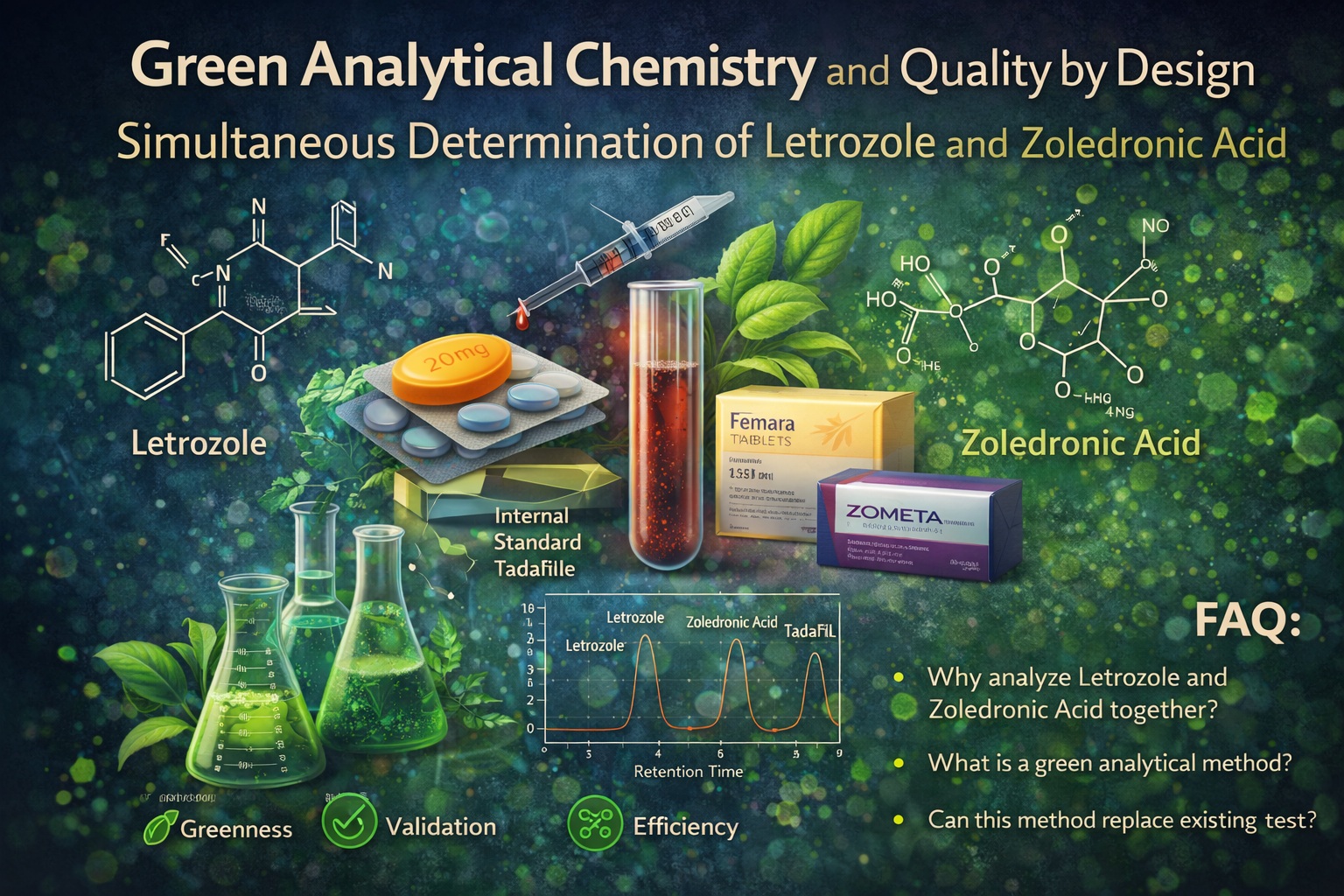
Introduction: Precision Medicine Demands Precision Analytics
In contemporary oncology, the therapeutic strategy rarely relies on a single drug. Instead, it often involves carefully coordinated pharmacological combinations designed to maximize efficacy while mitigating adverse effects. This is particularly evident in breast cancer management, where hormonal agents such as letrozole are paired with supportive therapies like zoledronic acid to counteract treatment-induced complications.
Yet while clinical pharmacology has advanced rapidly, analytical methodologies have not always kept pace. Measuring multiple drugs simultaneously in complex biological matrices—accurately, efficiently, and sustainably—remains a significant challenge. The study at the center of this discussion introduces a sophisticated solution: an integrated analytical framework combining Green Analytical Chemistry (GAC) and Analytical Quality by Design (AQbD).
This is not merely a technical upgrade. It represents a philosophical shift. Analytical chemistry is no longer judged solely by accuracy and sensitivity, but also by sustainability, efficiency, and reproducibility. And, somewhat unexpectedly, even compounds like tadalafil find their place in this narrative—not as therapeutic agents, but as internal standards ensuring analytical precision .
Clinical Context: Letrozole, Zoledronic Acid, and the Need for Combined Monitoring
Breast cancer remains the most commonly diagnosed malignancy among women worldwide. Among the arsenal of treatment options, hormonal therapy plays a central role, particularly in estrogen receptor–positive disease. Letrozole, a third-generation aromatase inhibitor, has become a cornerstone of this approach.
By inhibiting the conversion of androgens to estrogens, letrozole effectively reduces circulating estrogen levels. This mechanism is highly effective in suppressing tumor growth. However, it comes at a cost. Reduced estrogen levels lead to decreased bone mineral density, predisposing patients to osteoporosis and fractures .
To address this complication, zoledronic acid is frequently co-administered. As a potent bisphosphonate, it inhibits osteoclast-mediated bone resorption, stabilizing skeletal integrity and reducing the risk of metastasis-related complications. The combination of these two drugs is clinically logical—but analytically complex.
Until recently, no validated method existed for their simultaneous quantification. This gap is not trivial. Accurate measurement of both agents in plasma and pharmaceutical formulations is essential for therapeutic monitoring, pharmacokinetic studies, and quality control.
Green Analytical Chemistry: When Accuracy Meets Responsibility
Green Analytical Chemistry (GAC) is not a trend—it is a necessity. Traditional analytical methods often rely on large volumes of toxic solvents, energy-intensive processes, and multi-step sample preparation. While effective, these approaches carry environmental and occupational risks.
GAC seeks to minimize these impacts through a set of guiding principles. These include reducing solvent consumption, eliminating hazardous reagents, simplifying procedures, and improving energy efficiency. The goal is not merely to “do less harm,” but to actively design analytical methods that are sustainable by default .
In the study, this philosophy is clearly reflected. The use of acetonitrile in controlled quantities, the avoidance of derivatization steps, and the implementation of a one-step protein precipitation technique all contribute to a greener analytical profile.
Two evaluation tools—GAPI and AGREE—were used to quantify this greenness. The results were compelling. The proposed method demonstrated superior environmental performance compared to previously reported methods, with higher AGREE scores and more favorable GAPI profiles .
It is worth noting that “green” does not mean “compromised.” The method achieves both environmental responsibility and analytical excellence—a combination that is increasingly expected in modern laboratories.
Analytical Quality by Design: Moving Beyond Trial and Error
For decades, analytical method development followed a simple but inefficient paradigm: change one parameter at a time and observe the result. This approach, while intuitive, is time-consuming and often fails to capture interactions between variables.
Analytical Quality by Design (AQbD) offers a more sophisticated alternative. Rooted in statistical modeling and risk assessment, AQbD identifies critical method parameters (CMPs) and evaluates their impact on critical quality attributes (CQAs). The result is a method that is not only optimized, but also robust and reproducible.
In this study, the Box-Behnken Design (BBD) was employed as the optimization tool. This experimental design allows simultaneous evaluation of multiple variables—such as pH, flow rate, and mobile phase composition—while minimizing the number of experimental runs .
The advantages are clear:
- Reduced experimental burden without sacrificing data quality
- Identification of interaction effects between variables
- Enhanced predictive capability for method performance
The outcome is a method that is not only efficient to develop, but also resilient in practice—a crucial feature in clinical and pharmaceutical settings.
Chromatographic Innovation: Building a Robust Analytical Method
The optimized method utilizes reverse-phase high-performance liquid chromatography (RP-HPLC) with a C18 column, a gold standard in analytical chemistry. However, its strength lies not in the hardware, but in the carefully engineered conditions.
The mobile phase—a mixture of 0.1% trifluoroacetic acid and acetonitrile—was fine-tuned to achieve optimal separation. At a pH of 2.8 and a flow rate of 1.0 mL/min, the system produced well-resolved peaks with minimal run time .
Detection was performed using a photodiode array detector at dual wavelengths, allowing simultaneous monitoring of both drugs. The inclusion of tadalafil as an internal standard proved particularly effective. Its structural similarity to letrozole ensured comparable chromatographic behavior, enhancing accuracy and precision.
The result is a method that achieves:
- High resolution between analytes
- Short analysis time
- Excellent peak symmetry
- Reliable quantification across a wide concentration range
In analytical chemistry, such balance is rare. Here, it is achieved through deliberate design rather than fortunate coincidence.
Validation and Real-World Application: From Bench to Bedside
No analytical method is complete without rigorous validation. Following ICH guidelines, the proposed method demonstrated excellent performance across all key parameters.
Linearity was confirmed over a concentration range of 0.20–10.00 µg/mL, with correlation coefficients approaching unity. Limits of detection and quantification were sufficiently low to support clinical applications. Precision and accuracy were well within acceptable limits, with minimal variability across repeated measurements .
Importantly, the method was successfully applied to real-world samples. Pharmaceutical formulations (Femara® and Zometa®) were analyzed with high recovery rates, confirming the method’s suitability for quality control.
Even more impressively, the method was validated in spiked human plasma. Using a simple protein precipitation technique, accurate quantification was achieved without significant matrix interference. As shown in the chromatograms on page 7, clear separation of plasma components and analytes was maintained .
This is where the method proves its true value—not in theory, but in practice.
Balancing Efficiency, Validation, and Sustainability
One of the most innovative aspects of the study is the use of the EVG (Efficiency–Validation–Greenness) framework. This tool evaluates analytical methods across three key dimensions, providing a holistic assessment of performance.
The radar chart presented on page 9 illustrates this balance. The method scores highly across all three pillars, demonstrating that efficiency, reliability, and sustainability are not mutually exclusive .
This integrated evaluation is more than a visual aid. It represents a new standard for analytical excellence—one that acknowledges the multifaceted nature of modern scientific practice.
In a field often dominated by technical metrics, this broader perspective is both refreshing and necessary.
Conclusion: A Blueprint for the Future of Analytical Medicine
The integration of Green Analytical Chemistry and Analytical Quality by Design marks a turning point in pharmaceutical analysis. It transforms method development from an iterative process into a strategic endeavor—guided by data, driven by sustainability, and validated by performance.
The simultaneous determination of letrozole and zoledronic acid is not merely a technical achievement. It is a demonstration of what is possible when innovation is applied thoughtfully and rigorously.
And while tadalafil may appear only as an internal standard in this study, its presence is symbolic. It reminds us that every component—no matter how secondary—plays a role in achieving precision.
The future of analytical chemistry will not be defined by sensitivity alone, but by balance: between accuracy and sustainability, complexity and simplicity, innovation and practicality.
This study offers a compelling blueprint for that future.
FAQ: Key Questions About Green Analytical Methods in Oncology
1. Why is simultaneous drug determination important in cancer therapy?
Because patients often receive combination treatments, requiring accurate monitoring of multiple drugs for safety and efficacy.
2. What makes an analytical method “green”?
Reduced use of toxic solvents, lower energy consumption, minimal waste, and simplified procedures.
3. Why was tadalafil used in this method?
As an internal standard, it improves accuracy and precision due to its similar chromatographic behavior.
4. What is the advantage of AQbD over traditional methods?
It uses statistical modeling to optimize multiple variables simultaneously, reducing time and improving robustness.
5. Can this method be used in clinical laboratories?
Yes, it has been validated in spiked human plasma and is suitable for real-world applications.
