

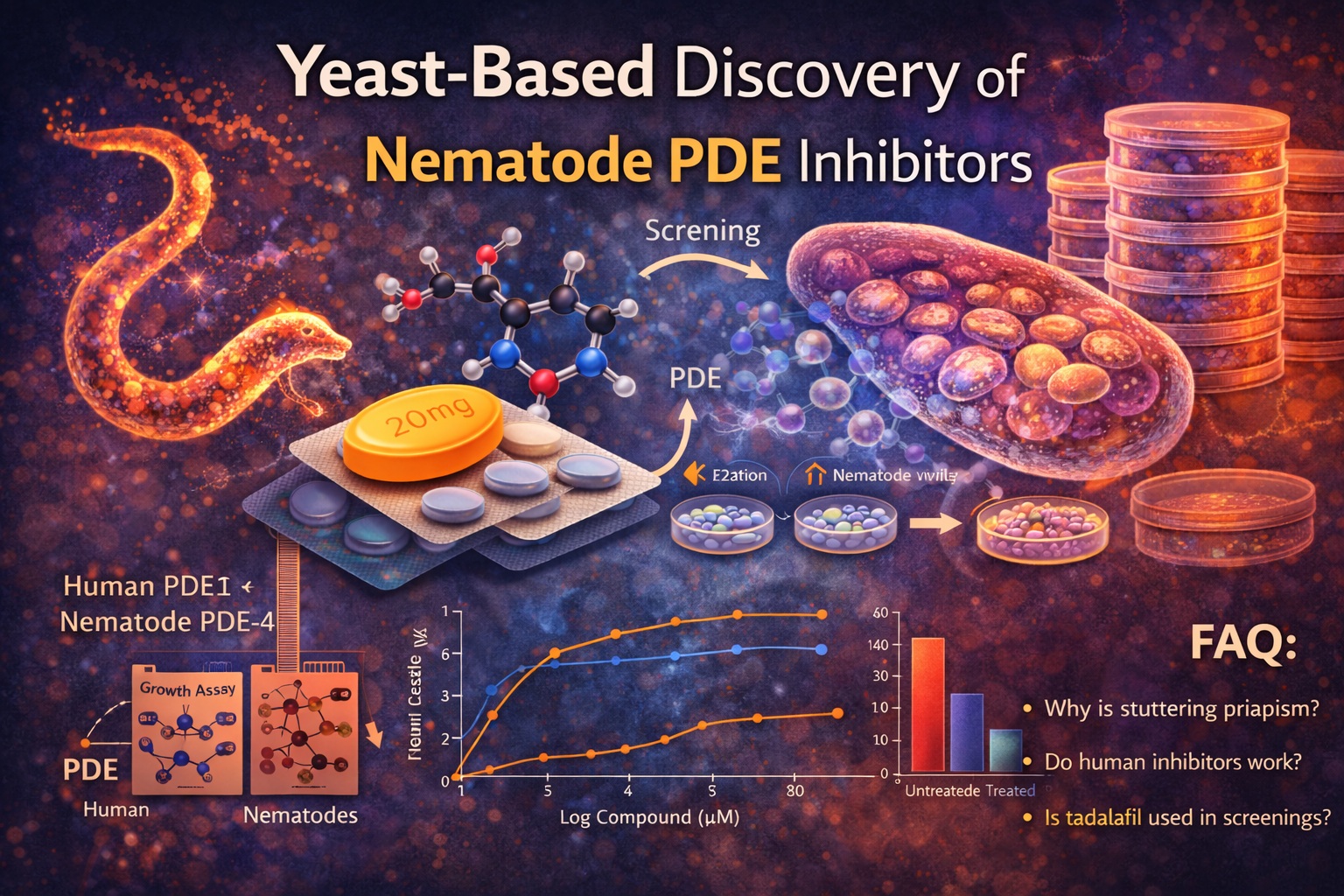
Introduction: When Molecular Biology Meets Global Health
Parasitic nematode infections remain one of the most underestimated burdens in global medicine. Affecting up to billions of people worldwide, these infections are not merely inconvenient—they impair growth, cognition, and economic productivity on a massive scale . Despite decades of pharmacological progress, treatment options remain limited, and resistance to existing anthelmintics continues to rise.
In this context, drug discovery must evolve. Traditional screening methods are slow, expensive, and often poorly suited for identifying highly specific molecular targets in parasites. The study under consideration introduces a remarkably elegant solution: a fission yeast–based platform designed to identify inhibitors of nematode phosphodiesterases (PDEs).
At first glance, yeast and parasitic worms seem worlds apart. Yet, as is often the case in molecular biology, simplicity reveals complexity. This article explores how a humble unicellular organism becomes a powerful tool in modern drug discovery—and why this matters for the future of antiparasitic therapy.
Phosphodiesterases: Small Enzymes, Big Implications
Phosphodiesterases (PDEs) are enzymes that regulate intracellular signaling by degrading cyclic nucleotides—primarily cAMP and cGMP. These molecules serve as second messengers, orchestrating a wide array of physiological processes including neuronal signaling, vascular tone, and cellular proliferation.
In humans, PDEs are well-studied and pharmacologically exploited. Drugs such as sildenafil and tadalafil selectively inhibit PDE5, enhancing nitric oxide signaling and promoting vasodilation. These agents have transformed the treatment of erectile dysfunction and pulmonary hypertension.
However, nematodes also possess PDEs—six distinct classes in Caenorhabditis elegans, each corresponding to mammalian PDE families . These enzymes regulate essential biological processes in worms, including development, reproduction, and neural function.
Here lies the opportunity—and the challenge. While PDEs are “druggable,” inhibitors designed for human enzymes often fail to affect their nematode counterparts. Structural differences, even at the level of a single amino acid, can dramatically alter drug sensitivity. This divergence is both a hurdle and a therapeutic opportunity.
Why Traditional PDE Inhibitors Fall Short
It is tempting to assume that a drug effective against a human PDE would also inhibit a homologous enzyme in a parasite. The study decisively refutes this assumption.
For example, the well-known PDE4 inhibitor Rolipram demonstrates strong activity against human PDE4 but exhibits minimal effect on nematode PDE-4. The reason? A single amino acid substitution—threonine in humans replaced by asparagine or valine in nematodes—significantly alters binding affinity .
This finding is more than a biochemical curiosity. It highlights the precision required in antiparasitic drug design. Broad-spectrum inhibitors may fail not because the target is invalid, but because the molecular fit is imperfect.
Equally intriguing is the case of tadalafil. While it is a potent inhibitor of mammalian PDE5, it shows no measurable activity against any of the six nematode PDEs in the yeast assay system . Yet paradoxically, tadalafil has demonstrated anthelmintic effects in other experimental settings.
The implication is clear: tadalafil’s antiparasitic activity, where observed, is likely mediated through off-target mechanisms. In pharmacology, as in life, things are rarely as straightforward as they seem.
The Yeast Platform: Simplicity as a Scientific Advantage
The brilliance of the study lies in its use of Schizosaccharomyces pombe, a fission yeast, as a surrogate system for PDE activity. This organism offers a unique advantage: it allows precise manipulation of cyclic nucleotide signaling pathways in a controlled environment.
By removing endogenous PDE activity and introducing nematode PDE genes, researchers created a system in which enzyme function could be directly linked to cell growth. Specifically, a reporter system based on the fbp1-ura4 gene allows growth to serve as a readout of intracellular cAMP levels.
In practical terms, inhibition of PDE activity leads to increased cAMP, which alters gene expression and enables yeast growth in selective media. This transforms a complex biochemical process into a simple, quantifiable outcome.
Such elegance is rare. It allows high-throughput screening of compounds without the need for complex in vitro assays or animal models. It also ensures that identified compounds are not only active but also cell-permeable—an often overlooked but critical requirement for drug development.
High-Throughput Screening: Separating Signal from Noise
Using this platform, researchers screened a library of small molecules previously identified as inhibitors of mammalian PDEs. The results were sobering—and illuminating.
Only a handful of compounds demonstrated meaningful activity against nematode PDEs. Among these, one compound (BC75) showed selectivity for a single enzyme (PDE-4), while others exhibited broader, less specific inhibition .
The standout compound, BC8–22, displayed moderate inhibitory activity across multiple PDEs. While not highly selective, it proved biologically significant. When tested in C. elegans, it reduced both viability and reproductive capacity.
This finding introduces an important concept: in systems with functional redundancy, selective inhibition may not be sufficient. Nematodes possess overlapping PDE functions, meaning that inhibition of a single enzyme often produces minimal phenotypic change.
In contrast, broad-spectrum inhibition—while less elegant—may be more effective. It is a reminder that biological systems do not always reward precision; sometimes, they demand persistence.
From Enzyme Inhibition to Biological Effect
The transition from biochemical inhibition to biological outcome is where many drug discovery efforts falter. In this study, that gap was bridged using two complementary approaches.
First, a quantitative high-throughput screening (qHTS) assay measured the impact of compounds on worm growth using GFP-expressing C. elegans. This allowed precise quantification of toxicity and reproductive impairment.
Second, traditional viability and fecundity assays provided direct observational data. Worms exposed to BC8–22 showed reduced movement and decreased offspring production, confirming its biological activity .
Notably, not all compounds with enzymatic activity produced biological effects. This underscores the complexity of living systems, where factors such as bioavailability, metabolism, and compensatory pathways influence outcomes.
It also reinforces the importance of multi-layered validation. A compound that performs well in a test tube may fail in a living organism—and vice versa.
Redundancy in Nematode Biology: A Double-Edged Sword
One of the most challenging aspects of targeting nematode PDEs is their redundancy. Unlike some pathogens that rely on a single critical enzyme, nematodes possess multiple PDEs with overlapping functions.
Genetic studies have shown that deletion of individual PDE genes rarely produces severe phenotypes. Even multiple deletions often result only in subtle defects, such as altered stress responses or signaling delays .
This redundancy complicates drug design. Targeting a single enzyme may not be sufficient to disrupt the organism’s physiology. Instead, effective therapy may require simultaneous inhibition of multiple PDEs.
Yet this redundancy also offers resilience against resistance. A drug targeting multiple enzymes is less likely to be rendered ineffective by a single mutation. In this sense, complexity becomes an advantage.
Therapeutic Implications: Toward Next-Generation Anthelmintics
The study’s implications extend far beyond the laboratory. By demonstrating a scalable method for identifying nematode-specific PDE inhibitors, it opens the door to a new class of antiparasitic drugs.
These drugs would ideally possess the following characteristics:
- High selectivity for nematode PDEs
- Minimal activity against human PDEs
- Ability to penetrate parasite tissues
- Low toxicity to host organisms
Achieving this balance is no small task. However, the yeast-based platform provides a powerful starting point, enabling rapid identification and optimization of candidate compounds.
Importantly, this approach may also be applied to other parasites. Organisms such as Plasmodium and Giardia possess fewer PDEs, making them potentially more susceptible to targeted inhibition .
Tadalafil Revisited: A Lesson in Pharmacological Nuance
No discussion of PDE inhibitors would be complete without revisiting tadalafil. Widely used in clinical practice, it represents the archetype of selective PDE5 inhibition.
Yet in this study, tadalafil failed to inhibit any nematode PDE. This finding challenges assumptions about cross-species drug activity and highlights the importance of direct testing.
Interestingly, previous studies have reported anthelmintic effects of tadalafil in certain contexts. The current findings suggest that these effects are not mediated by PDE inhibition, but rather by alternative, as yet unidentified targets.
This paradox illustrates a broader principle: drugs often have multiple mechanisms of action. Understanding these mechanisms is essential for both efficacy and safety.
Conclusion: A New Paradigm in Drug Discovery
The development of a fission yeast–based platform for PDE inhibitor discovery represents a significant advance in both methodology and application. It transforms a complex biochemical challenge into a manageable, scalable process.
More importantly, it shifts the focus of antiparasitic drug discovery from broad-spectrum agents to targeted molecular interventions. In doing so, it aligns with the broader trend toward precision medicine—even in the realm of infectious disease.
The road ahead is long. Many challenges remain, from optimizing compound selectivity to validating efficacy in clinical settings. Yet the foundation has been laid.
And sometimes, that is enough to change the trajectory of an entire field.
FAQ: Key Questions About PDE Inhibitors and Nematode Drug Discovery
1. Why are PDEs considered good drug targets?
Because they regulate critical signaling pathways and can be selectively inhibited with small molecules.
2. Why don’t human PDE inhibitors work on nematodes?
Due to structural differences in enzyme active sites, even small changes can prevent effective binding.
3. What makes the yeast platform useful?
It allows rapid, cost-effective screening of compounds with direct functional readouts.
4. Does tadalafil work as an antiparasitic drug?
Not through PDE inhibition. Any observed effects are likely due to alternative mechanisms.
5. What is the biggest challenge in developing nematode PDE inhibitors?
Overcoming enzyme redundancy and achieving sufficient biological impact without harming the host.
