

Introduction: When Timing Becomes Therapy
Erectile dysfunction (ED) is often discussed in terms of physiology, vascular health, and pharmacology. Yet in clinical reality, it is just as much about timing, spontaneity, and personal preference. The success of any therapy depends not only on its pharmacodynamic properties, but also on how well it integrates into a patient’s life.
Tadalafil, a long-acting phosphodiesterase type 5 (PDE5) inhibitor, has challenged traditional paradigms of ED treatment. Unlike shorter-acting agents, it offers a prolonged therapeutic window—up to 36 hours—allowing for greater flexibility in sexual activity . This pharmacokinetic advantage has opened the door to alternative dosing strategies, including scheduled administration.
The SURE (Scheduled Use versus on-demand Regimen Evaluation) study conducted in Italy provides a rare and valuable insight into this question: not which drug is superior, but which way of using the same drug is better. The answer, as it turns out, is not purely pharmacological—it is deeply human.
Erectile Dysfunction: More Than a Mechanical Failure
Erectile dysfunction is often reduced to a vascular issue, but this simplification misses its complexity. ED is a multifactorial condition involving endothelial function, neural signaling, hormonal balance, and psychological factors. Its etiology may be organic, psychogenic, or—most commonly—a combination of both.
In the SURE study cohort, nearly half of the patients had mixed etiology, while over one-third had purely organic causes . This diversity reflects real-world clinical practice, where ED rarely fits neatly into a single category.
The duration and severity of ED further complicate treatment. In this population, approximately 74% of patients had symptoms lasting more than one year, and over half had moderate to severe dysfunction. These are not transient issues—they are chronic conditions requiring thoughtful management.
This context is essential. It reminds us that ED treatment is not about achieving a single successful event, but about restoring confidence, consistency, and quality of life.
Tadalafil Pharmacology: The Science Behind Flexibility
Tadalafil’s defining characteristic is its long half-life. Unlike sildenafil or vardenafil, which require precise timing relative to sexual activity, tadalafil remains effective for up to 36 hours after administration .
This extended duration changes the therapeutic landscape. It reduces the need for planning and allows for a more natural approach to intimacy. In practical terms, it shifts treatment from a reactive model to a proactive one.
From a molecular perspective, tadalafil inhibits PDE5, leading to increased levels of cyclic guanosine monophosphate (cGMP). This enhances smooth muscle relaxation in the corpus cavernosum, facilitating penile erection in response to sexual stimulation.
However, pharmacokinetics is only part of the story. The question is not just how long the drug works, but how it is used. And this is where the SURE study provides its most valuable contribution.
Study Design: A Rare Look at Patient Preference
The SURE study is notable for its methodological rigor. It is a randomized, open-label, crossover trial involving 1,058 men across 94 urology centers in Italy . Each patient experienced both dosing regimens: on-demand use and scheduled administration three times per week.
This design eliminates many of the biases that plague comparative studies. Patients serve as their own controls, allowing for direct comparison of experiences.
The protocol was straightforward but elegant. Patients received 20 mg of tadalafil either on demand or on a fixed schedule (e.g., Monday, Wednesday, Friday), followed by a washout period and crossover to the alternate regimen.
At the end of the study, patients were asked a simple but powerful question: which regimen do you prefer?
Sometimes, the most important data come from the simplest questions.
Efficacy Outcomes: Subtle Differences, Meaningful Patterns
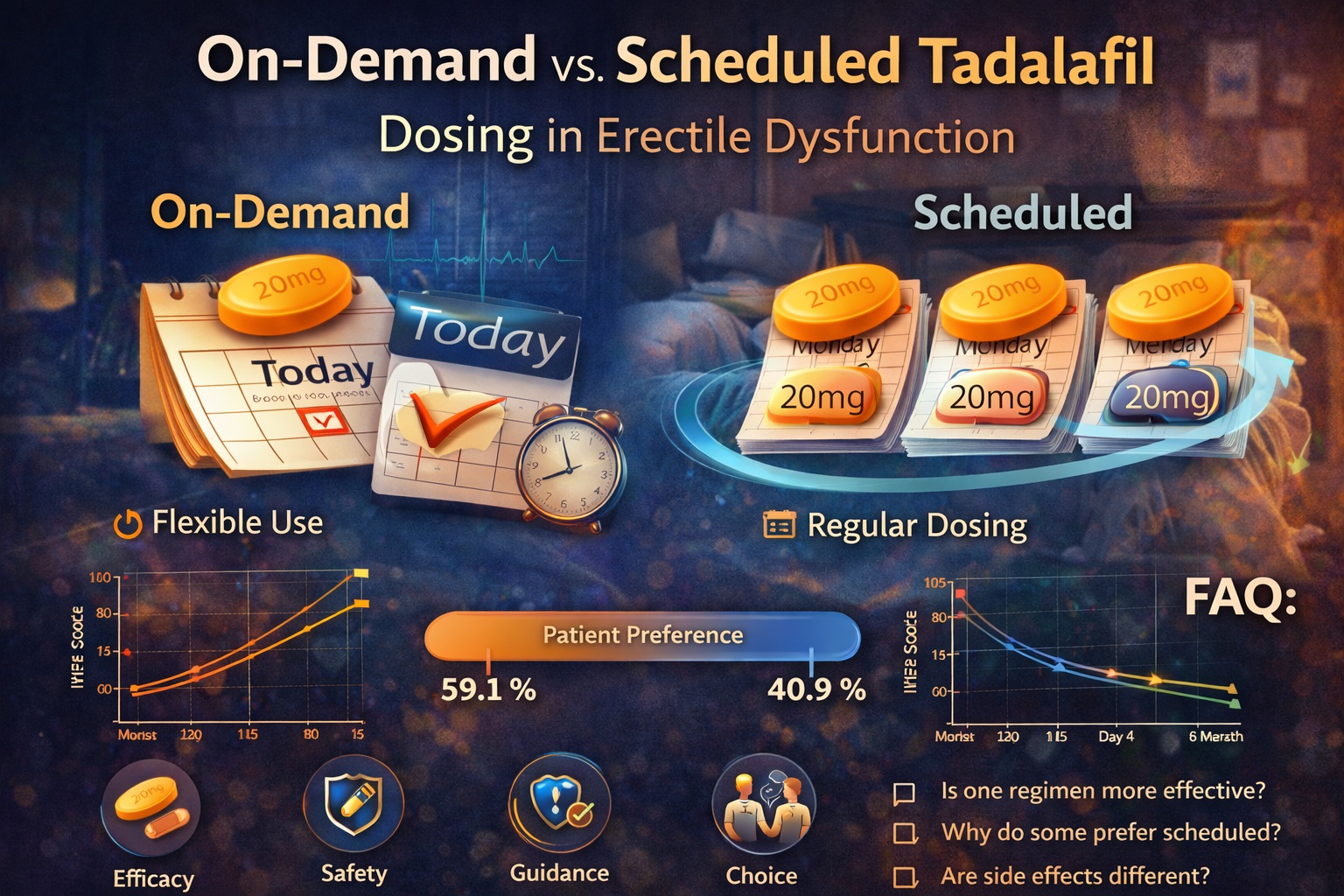
Both dosing regimens produced significant improvements in erectile function. The International Index of Erectile Function (IIEF) scores increased substantially from baseline in both groups, confirming tadalafil’s efficacy regardless of dosing strategy .
However, a closer look reveals subtle differences. The three-times-per-week regimen produced slightly higher improvements in the erectile function domain (25.00 vs. 24.67). While statistically significant, this difference was small and unlikely to be clinically noticeable for most patients.
The graph on page 5 illustrates this nuance. While both curves rise sharply from baseline, the scheduled regimen consistently edges ahead. Similar patterns are observed in the Sexual Encounter Profile (SEP) responses, where success rates for intercourse and satisfaction were marginally higher with scheduled dosing.
These findings suggest that regular exposure to tadalafil may enhance physiological readiness. Yet the magnitude of this benefit is modest, raising an important question: if efficacy is similar, what drives preference?
Patient Preference: The Decisive Factor
The primary endpoint of the study—patient preference—provides the most clinically relevant insight. Approximately 59.1% of patients preferred the on-demand regimen, while 40.9% favored the three-times-per-week schedule .
At first glance, this may seem like a clear victory for on-demand dosing. However, the story is more nuanced. Nearly half of the patients preferred a scheduled approach, despite its lack of clear clinical superiority.
Even more interesting is what did not influence preference. Age, severity of ED, duration of symptoms, and etiology had no significant impact on choice. Preference was independent of clinical variables.
This suggests that the decision is driven by psychosocial factors—lifestyle, relationship dynamics, and personal attitudes toward spontaneity versus structure.
In other words, the best regimen is not the one that works slightly better. It is the one that fits better.
Scheduled Dosing: A Case for Physiological Conditioning
The concept of scheduled dosing introduces an intriguing possibility: that tadalafil may have a rehabilitative effect when used regularly.
The study authors hypothesize that sustained exposure to PDE5 inhibition may improve endothelial function in the corpus cavernosum . This could enhance baseline erectile capacity, rather than simply facilitating individual events.
Support for this idea comes from subgroup analysis. Patients with severe ED showed greater benefit from the scheduled regimen, suggesting that higher cumulative exposure may be more important in advanced disease.
This observation aligns with emerging concepts in sexual medicine, where ED is viewed not only as a symptom, but as a marker of vascular health. In this context, tadalafil becomes not just a facilitator, but a modulator of underlying physiology.
On-Demand Dosing: The Power of Simplicity
Despite the theoretical advantages of scheduled dosing, the majority of patients preferred the on-demand approach. The reasons are not explicitly detailed in the study, but they are not difficult to infer.
On-demand dosing offers simplicity. It aligns treatment with need, minimizes medication use, and avoids the psychological burden of a fixed schedule. For many patients, this flexibility is more valuable than marginal improvements in efficacy.
There is also an element of autonomy. On-demand use allows patients to retain control over their treatment, rather than adhering to a predefined regimen.
In clinical practice, these factors matter. They influence adherence, satisfaction, and ultimately, treatment success.
Safety and Tolerability: Consistency Across Regimens
One of the most reassuring findings of the study is the consistent safety profile of tadalafil across both regimens. Adverse events were infrequent, mild, and comparable between groups.
Common side effects included headache, dyspepsia, and myalgia, with no significant differences in incidence between dosing strategies . Importantly, no serious adverse events or deaths were reported.
The table on page 6 provides a detailed breakdown of these events, confirming that both regimens are well tolerated. This consistency allows clinicians to focus on efficacy and preference without concern for differential safety risks.
Clinical Implications: Toward Personalized Treatment
The SURE study challenges a fundamental assumption in medicine—that there is a single “best” way to use a drug. Instead, it suggests that multiple approaches can be equally valid, provided they align with patient needs.
This has important implications for clinical practice. Rather than prescribing tadalafil in a fixed manner, clinicians should engage patients in shared decision-making.
Two practical approaches emerge:
- On-demand dosing for patients who value flexibility and minimal medication use
- Scheduled dosing for those seeking consistency, spontaneity, or potential long-term improvement
The choice is not binary—it is individualized. And that, perhaps, is the most important lesson.
Conclusion: When Medicine Meets Preference
Tadalafil’s success lies not only in its pharmacology, but in its adaptability. It is a drug that accommodates different lifestyles, expectations, and therapeutic goals.
The SURE study demonstrates that both on-demand and scheduled dosing are effective and safe. The differences in efficacy are small, but the differences in experience are meaningful.
In the end, the question is not which regimen is superior, but which is appropriate. And the answer, as always in medicine, depends on the patient.
Because sometimes, the most effective treatment is the one the patient is willing to use.
FAQ: Key Questions About Tadalafil Dosing Strategies
1. Is tadalafil more effective when taken regularly?
It may provide slightly better outcomes, especially in severe ED, but the difference is usually small.
2. Why do many patients prefer on-demand dosing?
Because it offers flexibility, simplicity, and aligns treatment with need.
3. Who benefits most from scheduled dosing?
Patients with more severe ED or those seeking greater spontaneity in sexual activity.
4. Are side effects different between regimens?
No. Both regimens have similar safety and tolerability profiles.
5. What is the most important factor in choosing a regimen?
Patient preference. It plays a central role in adherence and treatment success.
