

Introduction: From Erectile Function to Reproductive Potential
Tadalafil has long occupied a well-defined role in clinical medicine—as a reliable and effective treatment for erectile dysfunction. Its pharmacological identity is clear: a phosphodiesterase type 5 (PDE5) inhibitor that enhances nitric oxide–mediated vasodilation, facilitating penile erection. Yet, as is often the case in medicine, a drug designed for one purpose may reveal unexpected benefits in another domain.
Male fertility is one such domain. Traditionally, PDE5 inhibitors have been considered neutral with respect to spermatogenesis—neither harmful nor particularly beneficial. This assumption, however, has begun to shift. Emerging data suggest that tadalafil, especially when administered daily, may actively improve sperm quality.
The study analyzed here provides compelling evidence to support this hypothesis. Conducted in a cohort of young men with psychogenic erectile dysfunction, it demonstrates that once-daily tadalafil administration leads to measurable improvements in spermogram parameters . This finding invites a broader reconsideration of tadalafil—not merely as a facilitator of sexual performance, but as a potential modulator of male reproductive physiology.
Understanding Spermatogenesis: A Delicate and Dynamic Process
Spermatogenesis is a highly regulated biological process that takes approximately 72 days to complete. It involves the proliferation, differentiation, and maturation of germ cells within the seminiferous tubules of the testes. This process is influenced by hormonal signals, local cellular interactions, and biochemical mediators.
Key parameters used to assess sperm quality include concentration, motility, morphology, and seminal volume. Each of these reflects a different aspect of reproductive potential. Motility, in particular, is critical, as it determines the ability of sperm to reach and fertilize the ovum.
At the molecular level, cyclic adenosine monophosphate (cAMP) plays a central role in regulating sperm motility. It influences tyrosine phosphorylation pathways, which are essential for sperm capacitation—the process that enables sperm to penetrate the oocyte.
This biochemical framework is important because it provides a mechanistic link between PDE inhibition and sperm function. By modulating cyclic nucleotide levels, tadalafil may influence not only vascular tone, but also cellular processes within the testis.
Study Design: A Focused Exploration of Daily Tadalafil Use
The study enrolled 27 young men aged 19 to 35 years, all diagnosed with psychogenic erectile dysfunction and unaware of their fertility status . Importantly, all participants met the World Health Organization (WHO) criteria for normal semen parameters at baseline.
This is a critical detail. The study did not target infertile men, but rather a population with ostensibly normal reproductive function. The aim was not to correct deficiency, but to explore whether tadalafil could enhance an already functional system.
Participants received tadalafil 5 mg once daily for three months—covering a full spermatogenic cycle. Semen analysis was performed twice before treatment and twice after completion, ensuring robust baseline and post-treatment comparisons.
The methodology was rigorous. Samples were collected under standardized conditions, analyzed in a certified laboratory, and evaluated according to WHO guidelines. This consistency lends credibility to the findings.
Results: Quantitative Gains and Qualitative Improvements
The results of the study are both statistically significant and biologically meaningful. After three months of daily tadalafil administration, several key sperm parameters improved.
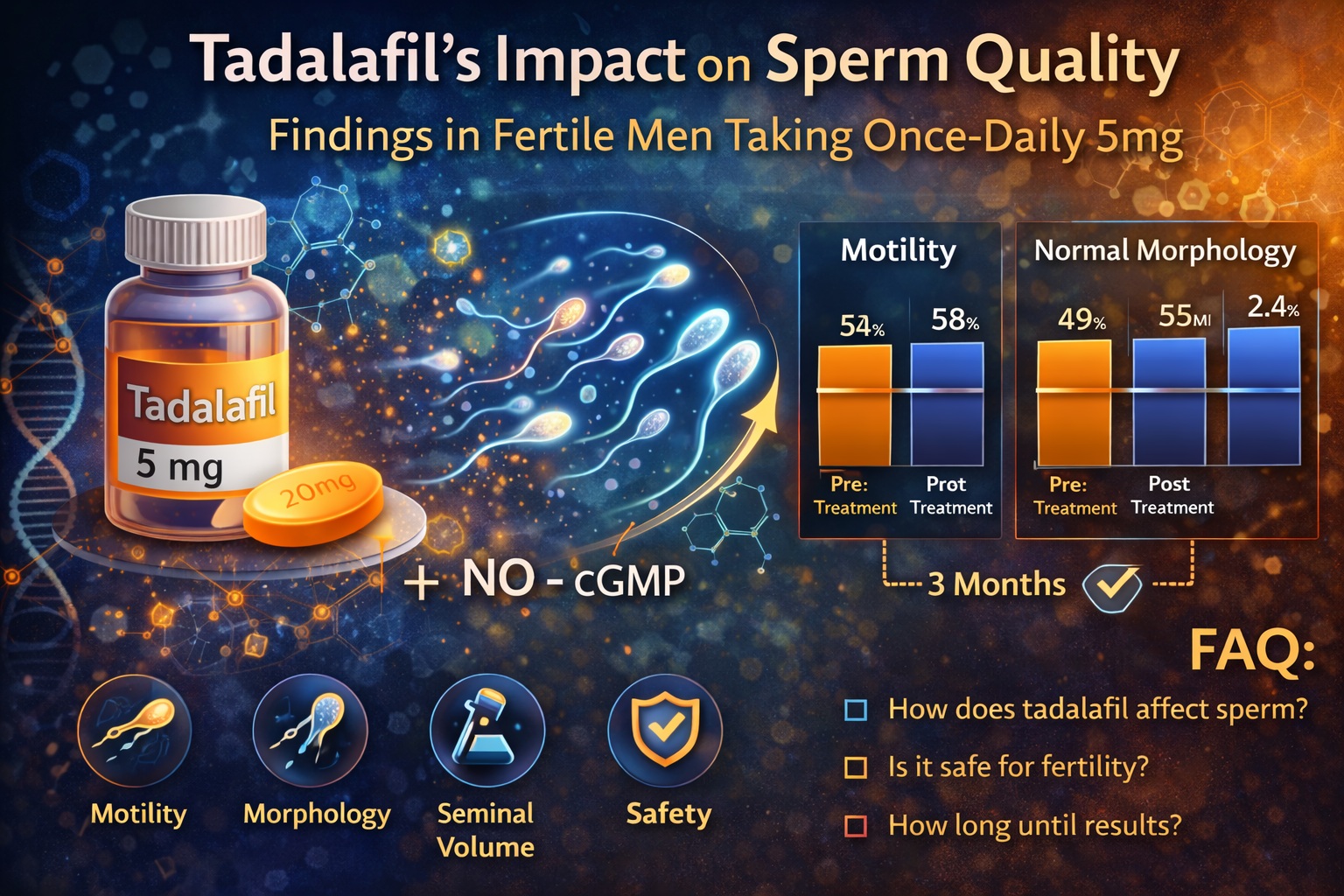
According to Table 1 on page 2, the total sperm concentration increased from 44 million/mL to 48.7 million/mL, although this change did not reach statistical significance. More importantly, progressive motility (types a+b) increased significantly from 53.94% to 57.59% .
Even more notable was the improvement in sperm morphology. The percentage of normal sperm increased from 48.91% to 54.74%, a statistically significant change. Seminal volume also increased modestly, from 1.97 mL to 2.38 mL.
The confidence interval graphs on page 2 show a consistent upward shift in mean values across multiple parameters, even where intervals overlap. This pattern suggests a general enhancement of spermatogenic function rather than isolated changes.
In simple terms, tadalafil appears to push the system toward its “functional reserve,” optimizing performance without disrupting balance.
Mechanistic Insights: The Role of Nitric Oxide in Fertility
The observed improvements raise an important question: how does tadalafil influence spermatogenesis?
The answer lies in the nitric oxide (NO) pathway. NO is a key signaling molecule involved in vascular regulation, but its role extends into reproductive biology. It is present in the testes, where it influences germ cell development, Sertoli cell function, and Leydig cell activity.
As described in the study, NO synthase enzymes (eNOS and iNOS) are expressed in multiple stages of spermatogenesis, including spermatogonia, spermatocytes, and spermatids . This widespread presence suggests a fundamental role in sperm development.
By inhibiting PDE5, tadalafil increases cGMP levels, enhancing the effects of NO. This may improve testicular blood flow, support cellular signaling, and facilitate processes such as chromatin condensation and sperm maturation.
In essence, tadalafil does not create new pathways—it amplifies existing ones.
Clinical Interpretation: Enhancement Without Disruption
One of the most reassuring aspects of the study is the absence of adverse effects on spermatogenesis. Previous research had already established that tadalafil does not negatively impact reproductive hormones or sperm production. This study goes a step further, demonstrating potential benefits.
Importantly, no participants discontinued treatment due to side effects, and no unexpected safety findings were reported . This confirms the excellent tolerability of low-dose daily tadalafil.
From a clinical perspective, this positions tadalafil as a unique agent—capable of addressing erectile dysfunction while simultaneously enhancing sperm quality. This dual effect may be particularly valuable in men with psychogenic ED who are planning conception.
However, caution is warranted. The study population consisted of young, healthy men with normal baseline parameters. Whether similar benefits would be observed in infertile populations remains an open question.
Psychogenic Erectile Dysfunction: An Overlooked Variable
The choice of study population is not incidental. Psychogenic erectile dysfunction introduces a layer of complexity that is often overlooked.
Unlike organic ED, psychogenic ED is influenced by anxiety, performance pressure, and psychological stress. These factors can indirectly affect hormonal balance and reproductive function.
Daily tadalafil administration may reduce performance anxiety by eliminating the need for on-demand dosing. This psychological benefit, combined with improved erectile function, may create a more favorable environment for spermatogenesis.
In this sense, the drug acts not only on the body, but also on the mind—a dual effect that is difficult to quantify but clinically significant.
Broader Implications: Fertility, Lifestyle, and Pharmacology
The findings of this study challenge traditional boundaries between sexual medicine and reproductive medicine. They suggest that drugs used for one purpose may have broader physiological effects.
This has implications for clinical practice. In men with ED who are attempting to conceive, tadalafil may offer advantages beyond erectile function. It may enhance sperm quality, improve confidence, and support overall reproductive health.
At the same time, it highlights the importance of holistic care. Fertility is influenced by multiple factors, including lifestyle, nutrition, and psychological well-being. Pharmacological intervention is only one piece of the puzzle.
The integration of these elements represents the future of andrology—a field that is increasingly interdisciplinary and patient-centered.
Limitations and Future Directions
Despite its strengths, the study has limitations. The sample size is small, and the population is highly specific. The absence of a control group limits the ability to attribute changes solely to tadalafil.
Additionally, the study does not assess long-term outcomes, such as pregnancy rates or offspring health. These are critical endpoints in reproductive medicine.
Future research should address these gaps. Larger, randomized controlled trials in infertile populations are needed to confirm and extend these findings. Mechanistic studies may further elucidate the role of NO and cGMP in spermatogenesis.
Until then, the results should be interpreted as promising—but not definitive.
Conclusion: A New Perspective on an Established Drug
Tadalafil has long been a cornerstone of erectile dysfunction treatment. This study suggests that its role may be broader than previously recognized.
By improving sperm motility, morphology, and seminal volume, daily tadalafil administration appears to enhance key parameters of male fertility. These effects are likely mediated through the nitric oxide–cGMP pathway, linking vascular physiology with reproductive biology.
The implications are significant. A drug once used solely to enable intercourse may also improve the chances of conception.
In medicine, such duality is rare—and valuable.
FAQ: Key Questions About Tadalafil and Male Fertility
1. Does tadalafil improve sperm quality?
Yes. Daily administration has been shown to improve motility, morphology, and seminal volume in healthy men.
2. Is tadalafil safe for men trying to conceive?
Current evidence suggests it is safe and does not negatively affect spermatogenesis.
3. How long does it take to see effects on sperm?
Approximately three months, corresponding to a full spermatogenic cycle.
4. Does tadalafil increase sperm count?
It may increase total sperm count, but this effect is not always statistically significant.
5. Can tadalafil be used as a fertility treatment?
Not yet as a primary treatment, but it may serve as a supportive therapy in selected patients.
