

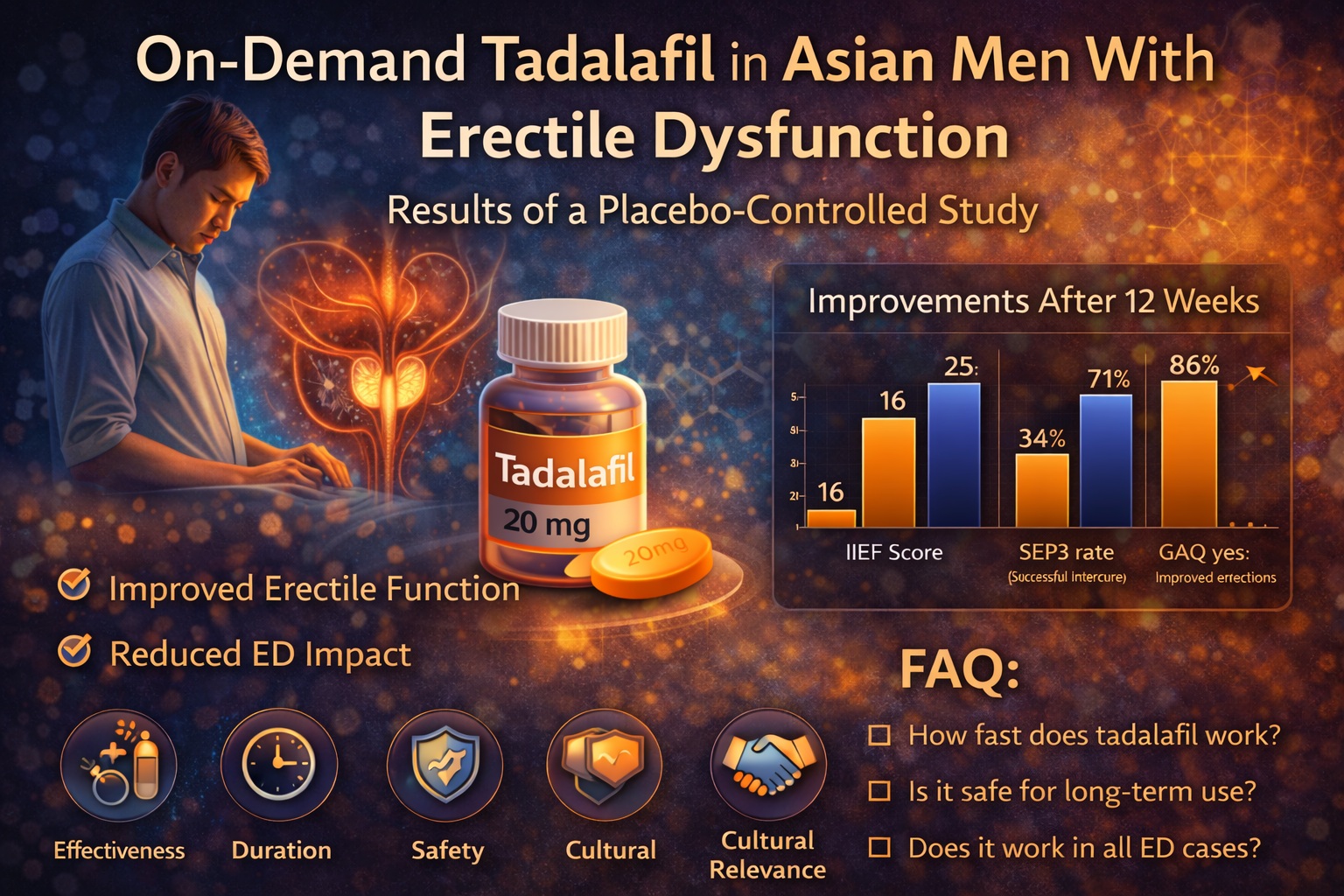
Introduction: When Evidence Meets Cultural Reality
Erectile dysfunction (ED) is often described in universal physiological terms, yet its clinical expression is deeply shaped by cultural, psychological, and social factors. Nowhere is this more evident than in East and Southeast Asia, where stigma, modesty, and limited health-seeking behavior frequently delay diagnosis and treatment.
The study under consideration represents a significant contribution to this field. It evaluates the efficacy and safety of on-demand tadalafil in a large, multicenter Asian population using a rigorous randomized, double-blind, placebo-controlled design. What makes it particularly valuable is not only its methodological strength, but its contextual relevance.
Tadalafil, already established in Western populations, is here examined through a different clinical lens. The results are clear: it is highly effective, well tolerated, and broadly applicable across etiologies and severities of ED . But beyond statistics, the study offers something more important—a framework for understanding how treatment success is defined in real life.
Erectile Dysfunction in Asia: A Condition Beyond Biology
Erectile dysfunction affects millions of men worldwide, with projections suggesting a dramatic increase in prevalence over the coming decades. In Asia, however, the burden is often underreported.
Cultural factors play a central role. Many men perceive ED as a personal failure rather than a medical condition, leading to reluctance in seeking care. Shame, misinformation, and limited awareness further compound the problem.
The study highlights this issue indirectly. Despite the high prevalence of ED, recruitment required structured clinical settings and informed consent, emphasizing the gap between disease burden and treatment engagement .
This context matters. A treatment is only effective if it is accepted. Oral therapies like tadalafil, which are discreet and easy to use, may therefore have a unique advantage in populations where privacy is paramount.
Pharmacological Foundations: Why Tadalafil Works
Tadalafil belongs to the class of phosphodiesterase type 5 (PDE5) inhibitors, which enhance erectile function by amplifying the nitric oxide–cGMP pathway. This pathway is central to penile erection, facilitating smooth muscle relaxation and increased blood flow within the corpus cavernosum.
What distinguishes tadalafil from other PDE5 inhibitors is its pharmacokinetic profile. With a half-life of approximately 17.5 hours, it provides a prolonged therapeutic window of up to 36 hours .
This extended duration offers a practical advantage. Unlike shorter-acting agents, tadalafil does not require precise timing relative to sexual activity. It allows for a more natural and less pressured experience.
In clinical terms, this translates into improved adherence, reduced anxiety, and greater patient satisfaction. In human terms, it restores spontaneity—a quality often lost in ED.
Study Design: A Robust Framework for Clinical Evaluation
The study was conducted across 17 centers in East and Southeast Asia, including Hong Kong, Malaysia, the Philippines, Singapore, and Taiwan. A total of 242 men were randomized in a 2:1 ratio to receive either tadalafil 20 mg or placebo for 12 weeks .
Participants represented a broad spectrum of ED etiologies—organic, psychogenic, and mixed—as well as varying degrees of severity. This diversity enhances the generalizability of the findings.
The study design included a 4-week run-in period followed by a 12-week treatment phase. Patients were instructed to take tadalafil on demand, with a maximum frequency of once daily.
Efficacy was assessed using validated tools:
- International Index of Erectile Function (IIEF)
- Sexual Encounter Profile (SEP) diary
- Global Assessment Questions (GAQ)
This multidimensional approach captures not only physiological outcomes, but also subjective experience—a critical aspect of ED treatment.
Efficacy Outcomes: Strong Signals Across All Measures
The results of the study are unequivocal. Tadalafil demonstrated significant improvements across all primary and secondary efficacy endpoints compared to placebo.
The table on page 5 provides a detailed breakdown. The mean increase in IIEF erectile function domain score was 8.5 points in the tadalafil group, compared to only 2.1 in the placebo group (P < 0.001) .
Similarly, success rates for sexual activity improved dramatically:
- Successful penetration (SEP2): increased to 83.3% vs. 52.7% in placebo
- Successful intercourse (SEP3): increased to 70.9% vs. 33.5%
These are not marginal gains—they represent a transformation in functional capacity.
The graph on page 5 further illustrates that improvements were consistent across all severity levels, from mild to severe ED. This universality is particularly important, as it suggests that tadalafil is effective regardless of baseline condition.
Patient Satisfaction: The True Endpoint
While objective measures are essential, patient satisfaction remains the ultimate benchmark of success in ED treatment.
The study’s secondary endpoints provide valuable insight. Tadalafil significantly improved scores related to penetration ability, erection maintenance, hardness, and overall satisfaction .
Perhaps most compelling are the responses to the Global Assessment Questions. At the end of the study:
- 86.2% of patients reported improved erections
- 80.5% reported improved ability to engage in sexual activity
These figures, presented in the summary table on page 5, reflect not just functional improvement, but restored confidence.
In clinical practice, this distinction is critical. A technically successful treatment that fails to satisfy the patient is, ultimately, a failure.
Safety Profile: Predictable and Manageable
No discussion of pharmacotherapy is complete without addressing safety. In this regard, tadalafil performed well.
Adverse events were generally mild to moderate and consistent with the known profile of PDE5 inhibitors. The most common included headache (11.3%), back pain (7.5%), dizziness (3.8%), and dyspepsia (3.1%) .
Serious adverse events were rare and largely unrelated to the study drug. Importantly, there were no clinically significant changes in vital signs, including blood pressure and heart rate.
The adverse event table on page 5 confirms the low incidence and manageable nature of these effects.
For clinicians, this consistency provides reassurance. For patients, it builds trust.
Clinical Interpretation: Who Benefits Most?
One of the strengths of this study is its inclusivity. Patients with varying etiologies and severities of ED all benefited from tadalafil treatment.
Notably, efficacy was observed in:
- Patients with organic ED, including those with diabetes and hypertension
- Patients with psychogenic ED, where psychological factors predominate
- Patients with mixed etiologies, representing the majority of real-world cases
This broad applicability simplifies clinical decision-making. Tadalafil can be considered a first-line option for most patients, without the need for extensive stratification.
However, individualization remains important. Factors such as comorbidities, medication interactions, and patient preference should guide final decisions.
Limitations and Considerations
Despite its strengths, the study has limitations. One notable issue is the potential exclusion of patients who previously failed sildenafil therapy. This may have resulted in a slightly more responsive population.
Additionally, the study duration of 12 weeks, while sufficient for efficacy assessment, does not provide long-term safety data.
Finally, the reliance on self-reported measures introduces a degree of subjectivity. However, this is an inherent feature of ED research, where patient perception is central.
These limitations do not undermine the findings, but they do frame them within an appropriate context.
Conclusion: A Reliable Option in a Complex Landscape
The study provides strong evidence that on-demand tadalafil is an effective and well-tolerated treatment for erectile dysfunction in East and Southeast Asian men.
Its benefits are consistent across severity levels and etiologies, and its safety profile is predictable and manageable. More importantly, it addresses not only the physiological aspects of ED, but also the psychological and relational dimensions.
In a region where cultural barriers often limit treatment uptake, the availability of a discreet, effective oral therapy is particularly valuable.
Tadalafil, in this context, is more than a drug. It is an enabler—of function, confidence, and connection.
FAQ: Key Questions About On-Demand Tadalafil
1. How effective is tadalafil compared to placebo?
It significantly improves erectile function, with success rates for intercourse reaching over 70% compared to around 33% with placebo.
2. Does tadalafil work for all types of ED?
Yes. It is effective in organic, psychogenic, and mixed etiologies.
3. How quickly does tadalafil act?
It works within a few hours and remains effective for up to 36 hours.
4. Are side effects common?
They are generally mild and include headache, back pain, and dyspepsia.
5. Is tadalafil suitable for long-term use?
Yes, but long-term treatment should be guided by a healthcare professional.
